Author Archives: David George Haskell

A poppy bloom to celebrate the day

poppy

A Celandine Poppy was blooming in Shakerag Hollow this morning. I was delighted and surprised. Delighted because these are the forest’s most gorgeous flowers; surprised because the plant’s timing is unusual. Most of the plants of this species bloom in March or April, before the trees leaf out, before the summer’s heat.

Celandine poppies can self-fertilize, so the absence of other flowers will not prevent this individual from setting seed. This is a good thing for the future of wildflowers. In a changing world, the natural variation present in all populations allows species to adapt and change. So creatures who “deviate” from the norm give species new genetic pathways to the future. The unexpected sight of this flower is therefore both a sensory delight and a reminder of life’s beautiful variability and adaptability.

Rattlesnake

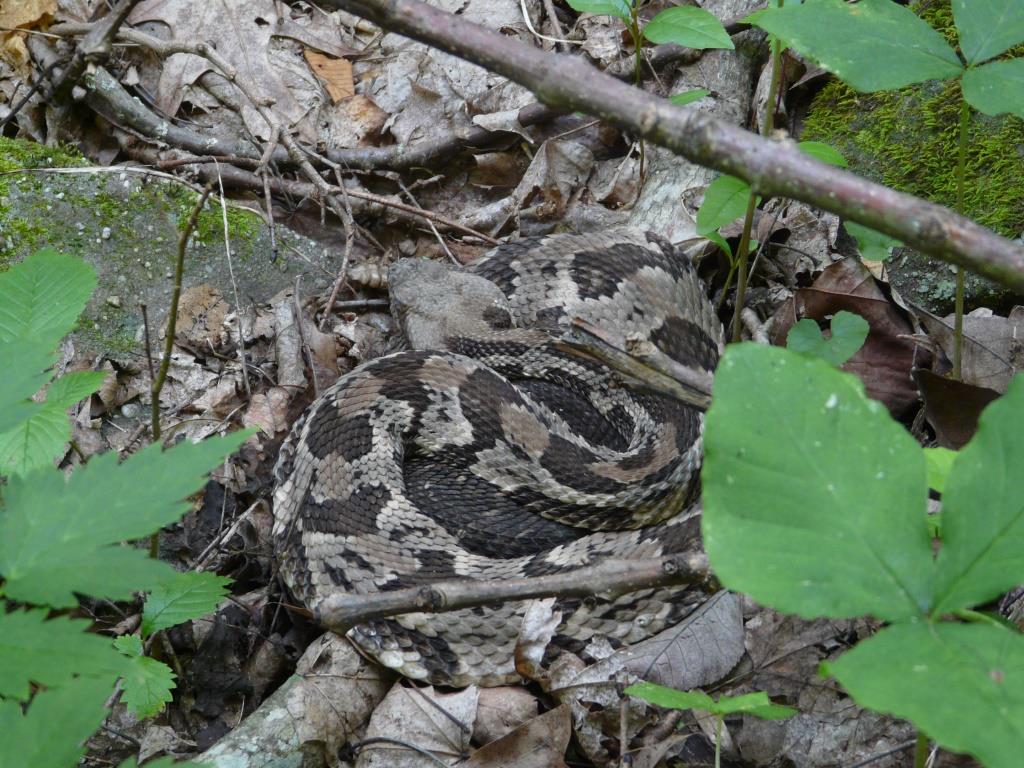
I’d been sitting on the dead ash log for a good thirty minutes before I noticed that I had company. The rattle caught my eye — what an odd piece of vegetation — then the whole snake popped into consciousness — whoa! The animal was curled catlike, its nose and tail resting on the body. It did not move one tiny little bit for the hour that I watched.

2013-06-20 rattlesnake ash 003The eye is clouded which, I think, means that the snake is preparing to molt.

2013-06-20 rattlesnake ash 016A close-up of the scales on the animal’s back (taken with a flash, hence the change in tone from the photos above):

2013-06-20 rattlesnake ash 020The camouflage was incredible: the head was a perfect match for sun-bleached maple leaves, the dark patches were the color of wet litter. Hard to spot, even when you’re close:

2013-06-20 rattlesnake ash 008

I returned the next day found the snake coiled in exactly the same place, its body shifted slightly. Still very hard to see:

spottherattlesnake2By coincidence, I received a frozen road-killed rattlesnake this week from some colleagues whose vehicle accidentally violated the revolutionary imperative: Don’t Tread on Me. This allows a closer look at the source of the phobias that have etched snakes into the deepest parts of our subconscious (religious allegories, anyone?).

roadkilledrattlesnakeIn pulling open the mouth to get a photo, I managed to spike myself on the lower teeth. So when asked whether I’ve ever been bitten by a snake, I can now answer No, but I’ve bitten myself with a rattlesnake. Another entry in the Annals of Zoological Stupidity. As it happens, this week I’m reading David Quammen’s excellent new book, Spillover, which is full of tales of microbes leaping into humans through pin-prick wounds. So far, the end of my thumb shows no sign of incubating the next zoonotic pandemic.

If these images fang you with fear, let me add that I’ve spent thousands of hours in Shakerag Hollow and this is the only close encounter I’ve had with a rattlesnake.

The timber rattlesnake is declining across most of its range due to habitat changes, road mortality and direct persecution from people. In its former territory in the Northeast, sightings are very rare indeed. In the snakes’ place, plagues of tick-bearing small rodents tromp merrily through the woods, their enemy defeated.

Fledgling Hooded Warbler

My ears found this one for me. I was studying a beech tree when the mother’s chup chup calls grabbed my attention. She got closer and the calls jumped into a higher register, tink tink. Surely a nest must be close by. Junebug The Hound and I saw it at the same time: not a nest but a tiny fledgling in a blueberry bush.

fledgling hooded warblerEight days ago this creature was inside an egg. Twelve days before that, the bird was just an egg and a sperm cell, yet to unite. In a couple of months this youngster will, with luck, be in the forests of the Yucatan in Mexico.

May the big raccoon that I saw up a neighboring tree find its dinner elsewhere tonight.

Pseudoscorpion

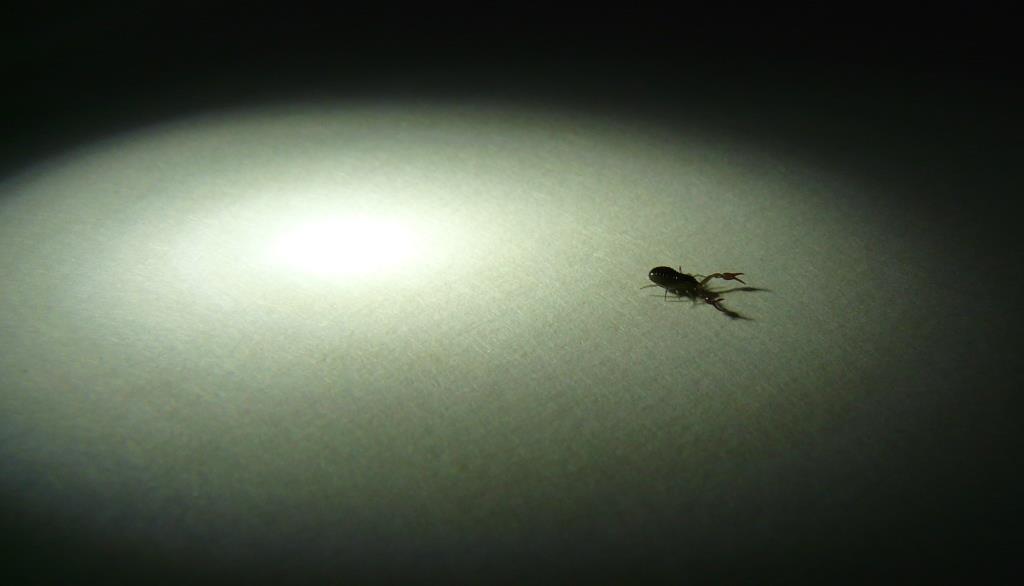
They’ve been around since the Devonian, 380 million years ago. This one was on the kitchen table, threatening my finger. It scuttled backward as it waved pincers at the looming digit. A dozen of these creatures could stand on a single cherry pit, so the display was heavy on charm and light on fearsomeness.

2013-06-13 pseudoscorpion 0012013-06-13 pseudoscorpion 005Although pseudoscorpions are quite abundant, we seldom see them. They hide in and under vegetation, inside empty snail shells, under rocks. Our eyes are rarely tuned to their scale.

Many pseudoscorpion species have the unusual habit of “riding” larger flying insects to hitch rides to new habitats. Some of these beasts of burden include the cerambycid beetles that I watched several weeks ago on the fallen ash. Next time, I’ll pay closer attention to the beetles’ bits and bridles.

Riders are ridden: some nematodes move about by clinging to pseudoscorpions.

So nat’ralists observe, a flea

Hath smaller fleas that on him prey;

And these have smaller fleas to bite ’em.

And so proceeds Ad infinitum.

— Jonathan Swift

Allegory of the Cave (via vultures)

A jumble of sandstone debris lies a few meters from the base of a high cliff. The rocky blocks are the size of wardrobes, small cars, houses. A fallen tree crowns the heap and thick grapevines crawl over its fissures. From a deep crevice, vapors of ammonia reach out and punch me in the nose: aha! Promising.

I clambered up here after seeing a black vulture take flight from a low branch above the rocks. Black vultures do not usually roost so low or in such deep woods. I suspected that the vulture might have an interesting reason for choosing this unusual slumbering spot. So I hauled myself onto the rocks, then tip-toed across their angled surfaces.

First the smell, then a beautiful sight: the random tumble of rocks created a passageway leading to a small underground chamber. If I crawled down there I could just about crouch in place or curl up on the ground to sleep. But going farther was out of the question. Rough-edged, deep hissing emerged from the gloom a few seconds after I peered down the entranceway. The message is clear enough: “Do not disturb.” Unheeded, the message will intensify, turning to a spray of hot vulture vomit. These parents want no visitors as they incubate their eggs. I backed off straight away.

A couple of weeks later I made another brief visit to peek at the hatchlings and to leave a small infra-red triggered camera in a rock crevice several meters back from the nest. I left the camera in place for 24 hrs to see what the parents were up to.
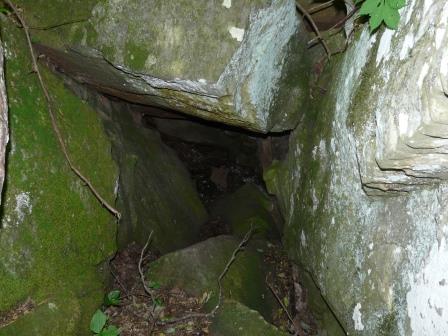
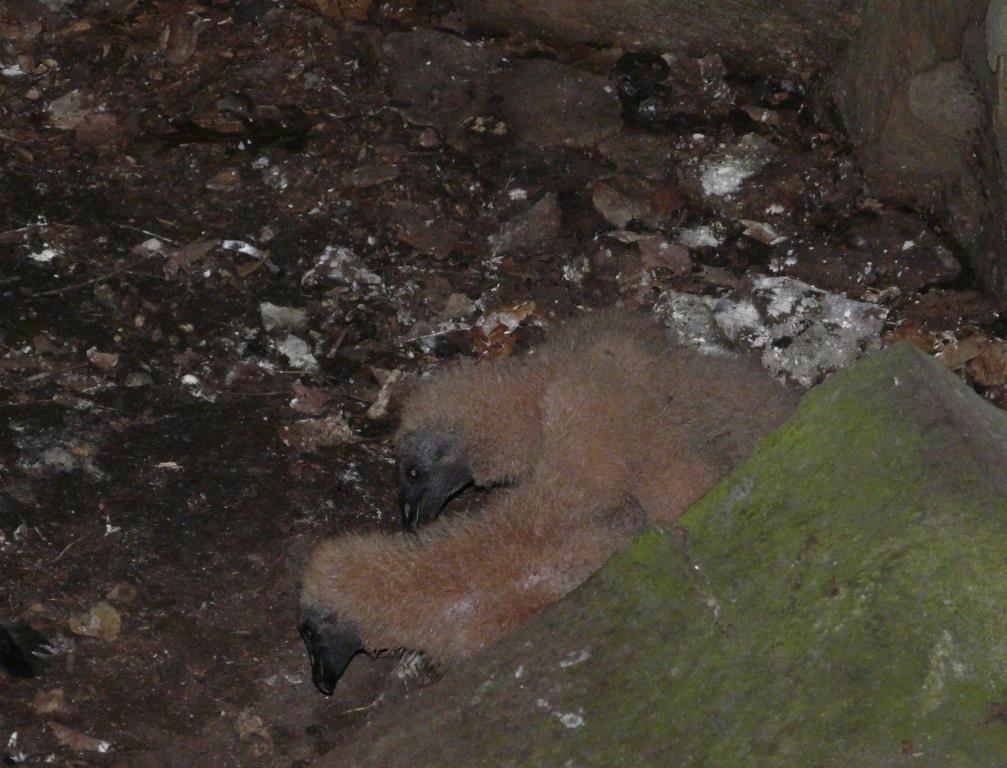
The young black vultures are just visible at the bottom of their rocky chute.
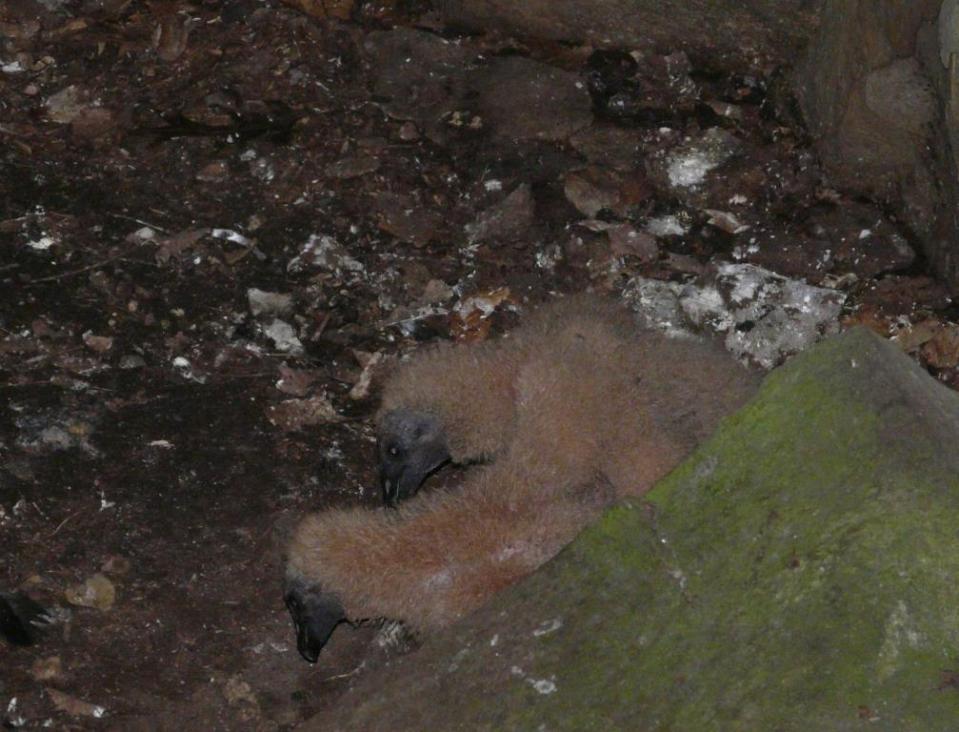
Young black vultures are just visible at the bottom of their rocky chute.

Fuzzy apricots. Mini-hissers. Vultures have no syrinx (the birds’ “vocal chords”) so they make sound by rushing air through their trachea.

Fuzzy apricots. Mini-hissers. Vultures have no syrinx (the birds’ “vocal chords”) so they make sound by rushing air through their trachea.

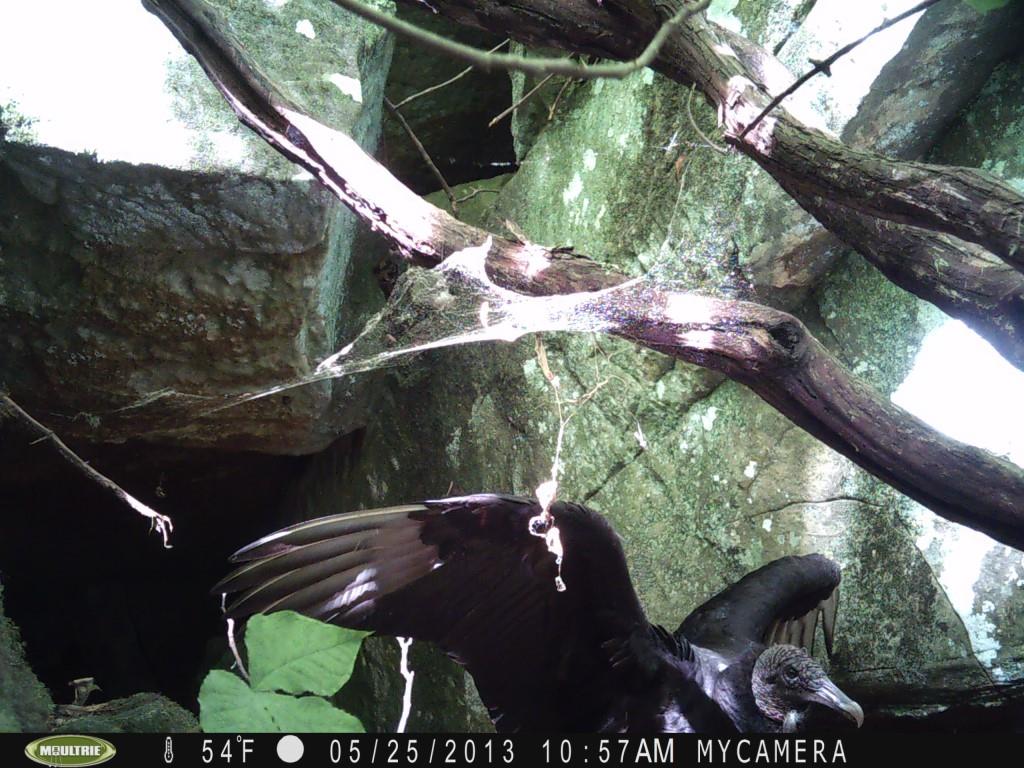
Attentive parents. they feed their young partly digested roadkill in the form of hot vomit. This is the vulture version of Mac-n-Cheese for the kids.
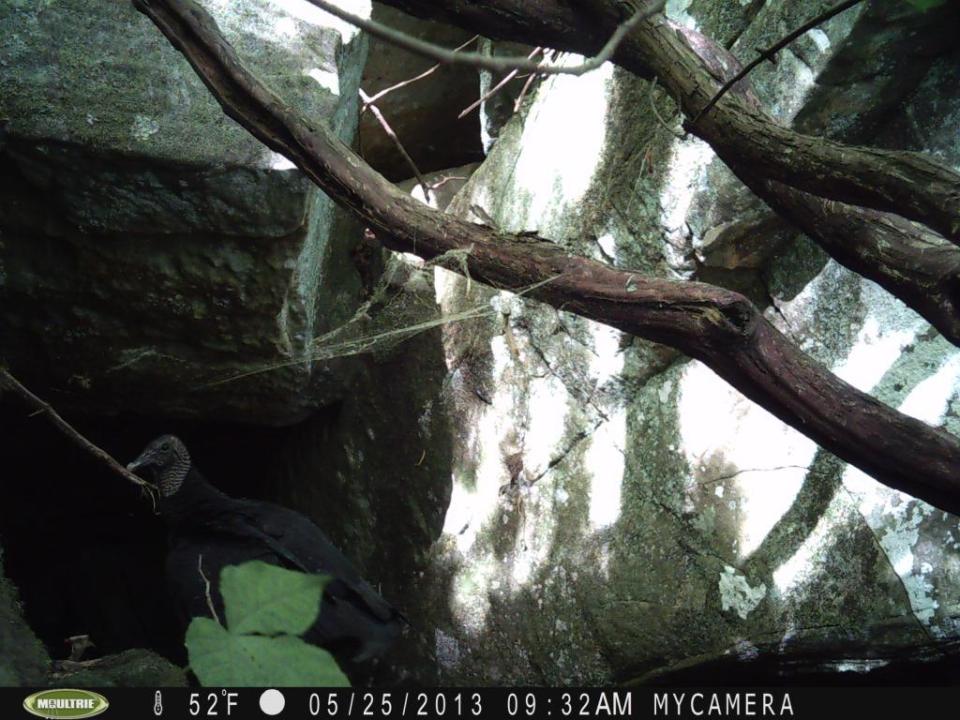
Attentive parent walking up the stony passageway. They feed their young partly digested roadkill in the form of hot vomit. This is the vulture version of Mac-n-Cheese for the kids.

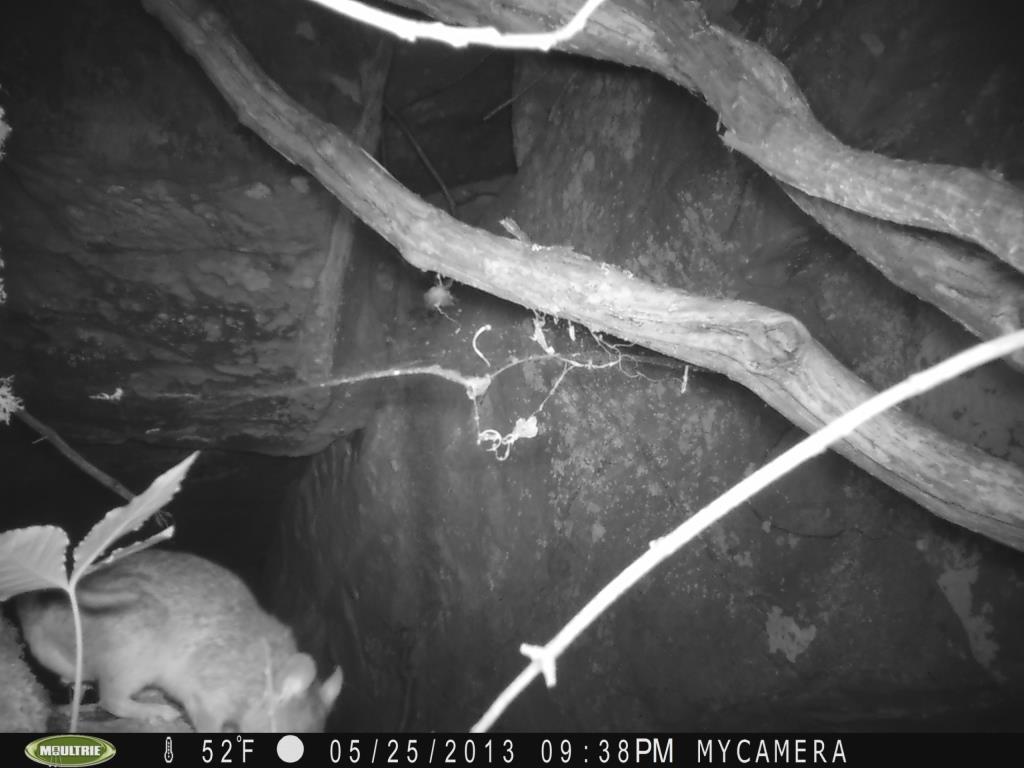
A nighttime visitor: what appears to be an Allegheny woodrat (Neotoma magister). This species is one of the "packrats" that make big nests. It is in decline over much of its range due to habitat loss and raccoon-transmitted parasites. Woodrats love rocky jumbles.

A nighttime visitor: what appears to be an Allegheny woodrat (Neotoma magister). This species is one of the “packrats” that make big nests. It is in decline over much of its range due to habitat loss and raccoon-transmitted parasites. Woodrats love rocky jumbles.

Vultures are loaded with metaphor: they nest in tombs, lower than any other bird, foreshadowing their role as ecological undertakers. But when they walk out of The Cave of Childhood, they enter adult lives that are spent on the wing, avian prayer flags that fly higher than all others: defiers of gravity, lifting dead remains away from the pull of the  sepulchral Earth.

Evolution may have robbed vultures of their rightful inheritance as birds — voices and gay plumage — but it seems to me that they sing and shine nonetheless. The vultures’ response to these acrobatics would, I suspect, be a shrug of the dark wings. For now, a dead ‘possum delivered to eager mouths is philosophy enough.

Glaucon answers, Yes, very natural.

17 year cicadas

The seventeen year cicadas are emerging in the Northeast, so they’ve been in the news quite a bit of late. One video in particular is worth watching: Sam Orr’s mix of time-lapse and real time video of the complete life cycle. He has been working on this project for several years and has filmed parts of the life cycle that are seldom seen. You can read more about his work here.

To learn more about where (and in what year) these creatures emerge, visit this page or this one.

For those lucky enough to live where the action is, remember what you’re hearing: seventeen years of stored sunlight being released all at once as acoustic energy. The terrestrial end product of nuclear fusion exploding into your consciousness.

Sewanee cicada: ours are on the thirteen year plan.

Sewanee cicada from back in 2011: ours are on the thirteen year plan.

For literary/musical engagement with these insects, I recommend David Rothenberg’s Bug Music, which has just recently been published. I was honored to “blurb” the book and here is what I had to say:

“Fabulous entomological jazz: David Rothenberg draws together disparate strands of inspiration and writes a new song, full of unexpected riffs and harmonies. Bug Music is a thought-provoking celebration of the acoustic bonds between humans and our insect cousins.”

In other words: a treat and an education for the mind and the ears.

Uncoiled

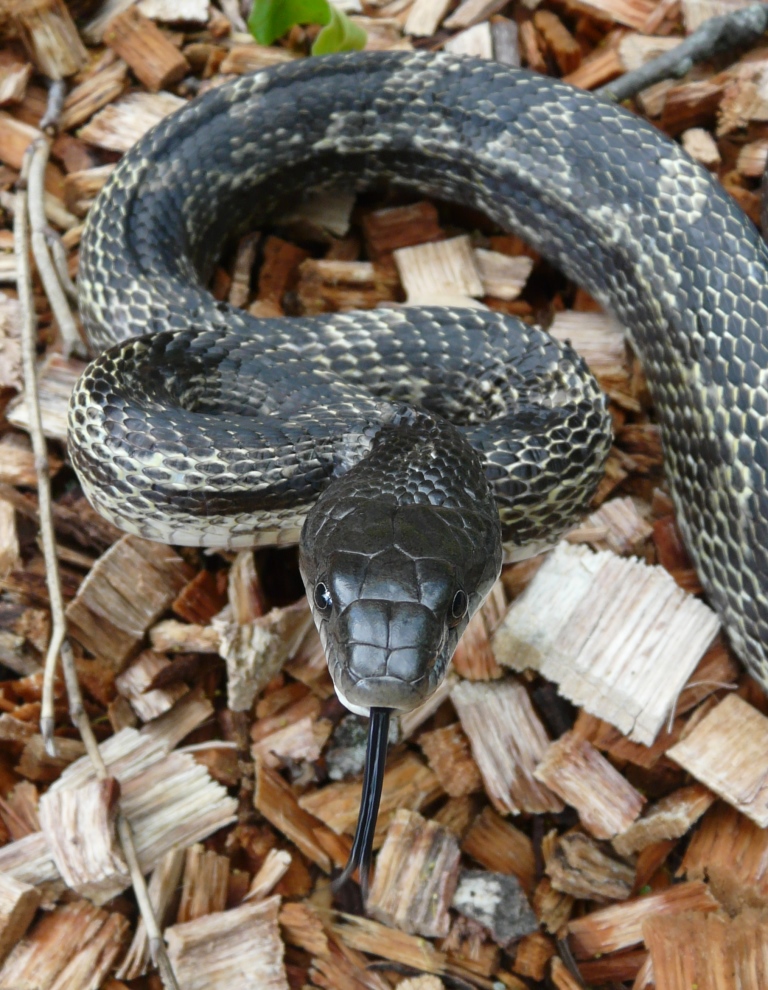
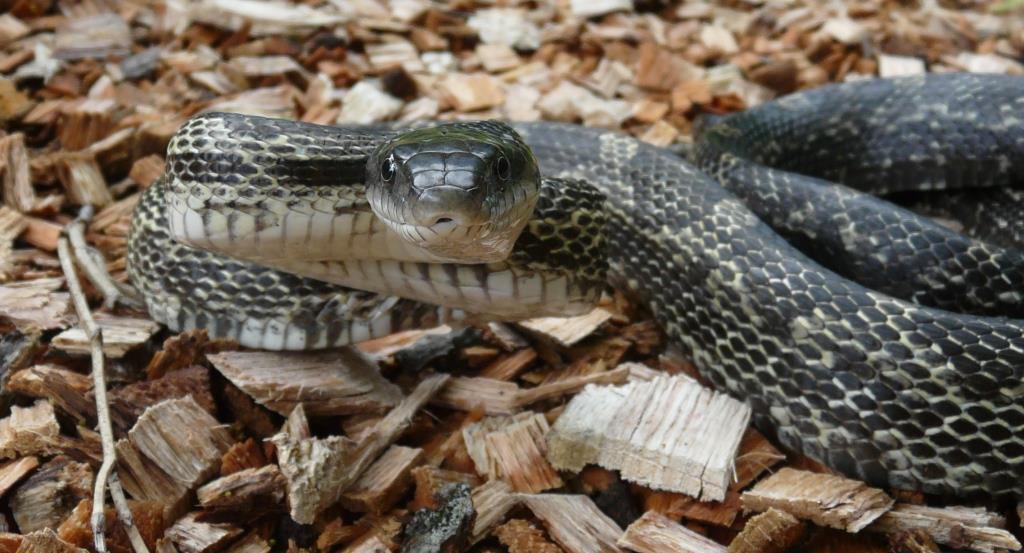
ratsnake ratsnake2This handsome black rat snake was in a neighbor’s yard, tangled in the plastic netting used to deter deer from browsing on plants. Dozens of strands of netting were bunched around the snake, completely immobilizing the strong body. Some work with small scissors (points held out!) freed the animal who was unharmed enough to tongue the air at me, then launch a little jabbing strike that stopped well short of contact.

It is rat snake breeding season, so the animal no doubt has a social life to be getting on with. I returned it to the adjoining woods.

Brood

Cuteness alert: Brown Betty (a bantam cochin chicken) broods her small flock of chicks.

brown betty with chicksOne of the youngsters has clambered onto her back, the others poke out from under her generous bustle or peer at the world from under her wing. These birds continue a long dinosaurian tradition: their extinct forebears and kin incubated eggs and were solicitous parents.

For cute Archosaurs and more, Sarah’s blog has pictures of the tumbling profusion of baby animals that have greeted the spring at Cudzoo Farm.

Emerging from the underworld

They’re back. Cicadas are crawling out of the hypogeal darkness. Summer must be coming, hidden somewhere behind the cold, rainy clouds.

Cicada emerging 009 This pallid nymph was hauling itself out of a hole in the trail. The front legs are mole-like: sharp-edged shovels. After the insect’s molt, which usually happens shortly after emergence, the shovels will turn to grappling hooks, a more elongate form suited to clambering in trees. The molt will also equip the adult cicada with wings (wing buds are visible on the nymph’s back in the photo above).

Cicada emerging 013This is a so-called “annual” cicada, a name that belies the two or more years that the nymph has spent below ground. Although individual cicadas take more than one year to develop, there are multiple cohorts present in every location, so at least some of them emerge every year. This contrasts with the “peridocial” cicada species whose cohorts are synchronized, emerging every thirteen or seventeen years. Sewanee had one such emergence back in 2011. The New York region is due for an emergence this year, so we can expect some cicada media coverage in the coming weeks. (To find out whether or not you’re in the emergence area, see here for maps of the various “broods” of periodical cicada — the NY brood for 2013 is Brood II.)