Monthly Archives: August 2012

Amazonia bound

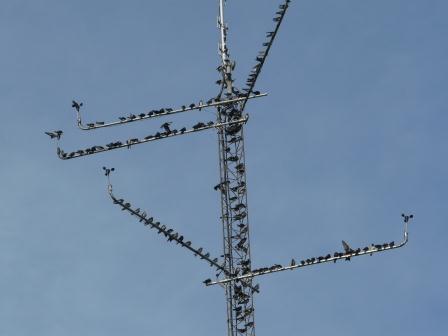
Sewanee got pounded with rain yesterday. A hard day for birds that feed on aerial insects. Late in the afternoon, the skies cleared and dozens of purple martins swarmed the radio antenna pole near Lake Cheston. They circled in noisy groups, feeding then swirling in to roost.

Many of these birds are likely migrants from the north, winging their way across Tennessee on the first leg of a long journey to their Amazonian wintering grounds.

In the eastern U. S., martins are almost entirely dependent on humans for nest cavities, a dependence that goes back to the days of Native American agriculturalists who erected poles with hollow gourds for the birds. Martins chase away crows, so this was a mutualistic arrangement. The birds got homes; the humans got protection for their corn crop.

In 1831, John James Audubon noted: “Almost every country tavern has a martin box on the upper part of its sign-board; and I have observed that the handsomer the box, the better does the inn generally prove to be.”

I think Lake Cheston could use a handsome box. Perhaps a class project for the spring?

One more smutty webpage

These are healthy corn tassels, ready to shed their pollen:

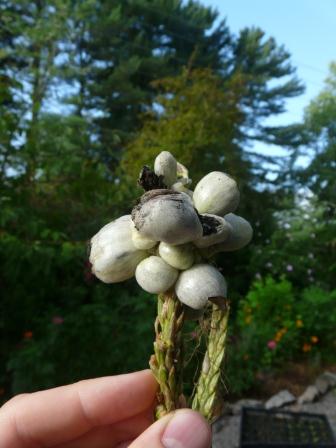
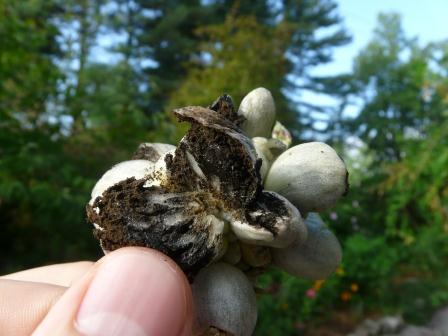
And these are tassels that have been infected by a fungus, the “corn smut” (Ustilago maydis; formerly U. zeae):

Smut spores overwinter in the soil, then as the weather warms they blow up onto corn plants and infect leaves, tassels, and ears. Like corn itself, smut is native to Mexico and thrives when the weather is hot and dry in early summer. This Mexican weather came to Tennessee in June, so we’ve had a good crop of fungal growth this year.

The fungus causes grotesque swellings on the corn. These pustules eventually burst and disgorge clouds of dark spores. The whole process is interesting to watch: the civilized, elegant growth of a plant hijacked by an ugly, destructive mob. Depending on your mood, this discord is either disturbing (the world’s order is threatened) or profoundly hopeful (the world’s order is indeed threatened).

Fungal infections are usually unmitigated bad news for gardeners, but this one has a surprising silver lining. The fungus causes uncontrolled growth and swelling of cells in the corn plant, cells that then get filled with…mushroom. In Central America and Mexico, smut is considered a delicacy, called “huitlacoche,” and farmers can get a higher price for infected ears. I was unfortunately not aware of the gastronomic possibilities when I culled the smut from our corn patch. Next year, perhaps?

The word “smut” obviously has another meaning. The etymological common origins here are straightforward: lewd smut and fungal smut are both “dirty.” The Online Etymology Dictionary (one of my favorite websites…a celebration of the anastomosing evolutionary trees of language) traces the word to pre-1500s West Germanic, smutt-, “to make dirty,” through the 1400s where smutten meant “to debase or defile,” then to the 1660s when the word meant both “black mark or stain” and “indecent or obscene language.” There is a botanical irony here, of course. The smut fungus is “defiling” one of the more overtly sexual plants under cultivation, one that sheds its pollen to the air and lets both male and female parts hang exposed (at eye-level, no less; I blush to gaze at a field of corn). But only when these parts become darkened with unbidden strands of fungal desire do they count as smut. Order is indeed threatened.

Snake

While walking down the garden path, I was stopped by the sight of a black rat snake, its body woven loosely through the low weedy plants. The snake was a youngster, too young to have the heft and scratched hide of a mature adult, but too old to be striped and worm-like. It was about two feet long and was basking in the weak heat of an overcast noon. The snake was entirely still, but its whole being said: alive.

Light hit the snake’s scales and melted. Black. Somehow, an earthy deity had lifted its head from the ground and breathed life into graphite. I’ve never been so captivated by a snake’s quiet presence.

In my admiration and greed, I wanted to catch and remember this beauty. So I walked to the house for my camera. Of course, the snake was gone on my return, leaving a wavy line of pressed vegetation as a mark of its passing.

So far this year, I have not seen the big old rat snake that used to patrol our garden. Even the strong snaky smell around the apple trees has dissipated. This newcomer may have wandered into a deceased old-timer’s empty domain. To stay, I hope.

Cicada killer

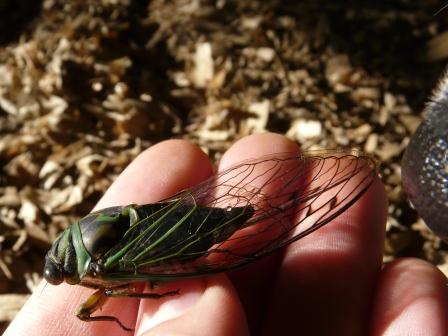
Stop and listen. Every tree is occupied by buzzing cicadas. Their vigor of their acoustic attack builds through the day, then dies away after dark, giving way to katydids.

We’re not the only species to tune into this sound. Cuckoos, blue jays, and other large-billed birds will grab cicadas when they can. But the champion hunter is the cicada killer, Sphecius speciosus, a large wasp that flies up into the trees in search of its prey.
The wasp grasps a cicada then tries to jab its stinger into the weak spots on the cicada’s exoskeleton. The cicada reacts violently — fighting for its life — buzzing its wings, writhing, and rolling. Often the tussling pair fall to the ground as they struggle. The cicada tries to break free while the wasp lances with the sharp stinger on the end of the abdomen. Spear and armor clash, then resolution comes. If the cicada can free itself, it takes wing and zooms away. The wasp does not follow, having no hope of recapture. But if the wasp’s poison finds its mark, the cicada falls into a deep sleep. This is no fairytale, no prince comes to waken the sleeper; instead, the mother wasp carries her prey to an underground tunnel where she buries it, alive but paralyzed, with a wasp egg. The larval wasp will fuel its growth by consuming the cicada.

Cicada killers have been active these last several weeks. They prefer to build their tunnels in well-drained sand, so the upper portion of the Lake Cheston “beach” has numerous holes, as do other sandy areas in town.
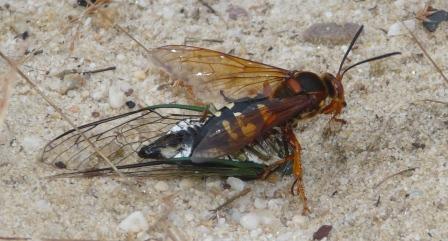
Cicada killer with paralyzed cicada. The wasp was dragging her prey across the sand toward a burrow.
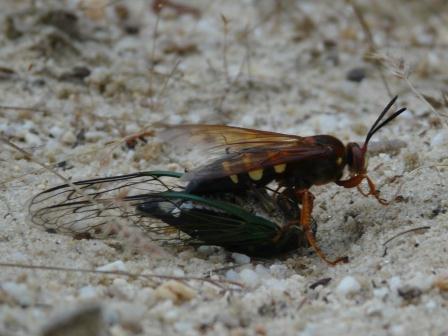
The wasp is almost as long as my thumb. They look fearsome, but don’t attack humans unless molested. Unlike yellowjackets and bees, cicada killers don’t defend their nests from intruders and can be observed at close range.
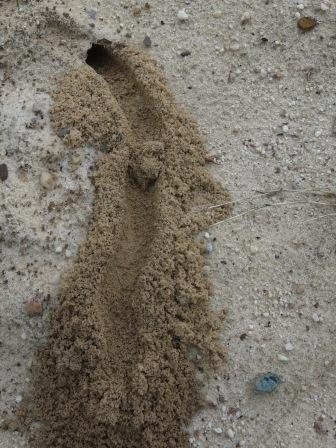
Entrance to nest burrow. The cicada pictured above was laid to “rest” here.

Cicadas are big insects and the wasps often struggle to carry them. I was swimming in Lake Cheston a few days ago when a low-flying creature — I thought at first a hummingbird — flew across the water, losing altitude as it went. When it reached the lake’s center, the flier hit the water’s surface, dropped its excess baggage and shot away. I swam out to retrieve the cargo: a cicada bobbing on the water. Back on shore, Junebug (the dog, not the insect), wanted a look. Lacking a burrow and an egg, we left the cicada to its unfortunate fate.