A pleasant outdoor evening for Cari and Jason Reynolds was interrupted by the antics of some rather large slugs. The slugs had entwined their bodies, then suspended themselves from a stiff strand of mucus. Two large translucent structures emerged from their heads and coiled together. Sex, slug style. More precisely, sex, European slug style; American slugs have more pedestrian ways of completing their unions. For readers with sluggy, salacious turn of mind, the Ever So Strange Animal Almanac has a description (note for the bemused: some British slang involved) and David Attenborough narrates the whole process with some “marvels of nature” music playing along. Bottom line: the translucent structures were penises, exchanging sperm between two hermaphrodites.
Cari alerted the world through Facebook and I requested a closer look at these creatures. Thanks to a prompt delivery by Jason, I’m now in possession of two specimens of Limax maximus (well named, they grow to eight inches long; photos below). These are the first that I have encountered on the Cumberland Plateau. This worries me a bit, not just because the spotless innocents of Sewanee and surrounding areas are perhaps not ready for regular exposure to giant penis-dangling hermaphrodites, but because these monster slugs may be about to invade our woodlands and out-compete native species. We’re in one of the world’s epicenters of gastropod diversity, so such an invasion would be one more loss in the ongoing worldwide (and local) erosion of biological diversity. In the northeastern U. S., non-native slugs have thoroughly disrupted the local ecology. We have far more native species, so the damage here would be that much more troubling.
The species has been present in the cities of the Northeast since at least the late nineteenth century. Tyron’s Manual of Conchology published in 1885 includes a plate featuring Limax maximus (top two animals in the plate). In these more northerly areas, the slug seems to prefer to live in disturbed habitats and gardens, so it might not invade the forests here. However, our climate is more slug-friendly that that of Boston and Philadelphia; we can’t assume that the species will behave in the same way here as it does elsewhere. Stay tuned for further adventures in the biology of invasive species. Up next: Arion, an exotic slug that is ubiquitous further east, but has not yet been seen in Sewanee (to my knowledge — keep the reports coming!).
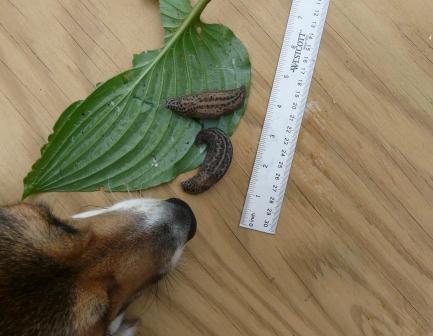
Limax maximus. Junebug for scale.

One common name is “leopard slug.”
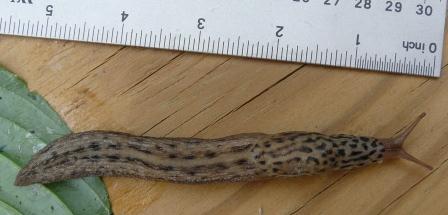
Five inches. Three more to go. They can live for several years.



 David George Haskell