Monthly Archives: June 2012

Banana slugs

The hilly redwood forests of Santa Cruz are home to a spectacular gastropod, the Slender Banana Slug (Ariolimax dolichophallus). These sulfurous-yellow slugs are large: many are over six inches long. They creep through the forest floor and across trails in broad daylight, munching on fallen leaves, fungi, and low-growing plants. Apparently, they don’t eat redwood seedlings, so they keep the competition down in the understory, helping the redwoods to regenerate.
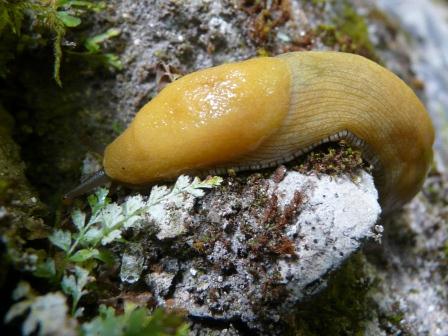
A general rule of natural history is that brightly colored animals that wander around in the open without any visible means of defense or escape are likely to be poisonous in some way. As far as I can tell, the chemical ecology of banana slugs has not been fully analyzed, but among Santa Cruz naturalists there is a tradition of experiential investigation of these slugs, an experience that is mediated through the tongue. So, eager to join the inner circle of initiates, I genuflected then prostrated myself before a large specimen on the trail. The animal was strangely unperturbed by my licking. The same could not be said about my tongue. I did not taste much in the way of noxious secretions, but for half an hour afterward I had a layer of gelatin firmly adhered to the top of my tongue.
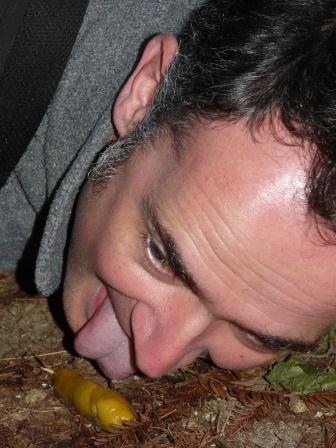
Note for Tennessee readers: please do not try this at home. Thanks to the action of the 2012 state legislature, this kind of behavior is considered “gateway activity” and may result in your having to repeat a grade in school, the revocation of your concealed weapon permit, or both.

Following this encounter, I learned that the tangy stalks of redwood sorrel (Oxalis ¿oregana?) do a great job of “cleansing the palate” (an expression that I believe originated somewhere a little more classy than among the Ariolimax-lickers of California). For those of you whose thoughts are turning to hallucinogens: you’re thinking of toad-licking. Believe me, lying flat out on a redwood forest floor licking a giant yellow slug is experience enough for me. What could a hallucination possibly add?

The slug is endemic to the Santa Cruz area (two other species are found elsewhere on the west coast) and is the mascot of UC Santa Cruz. The T-shirts say: “Banana Slugs: No Known Predators” which is catchy but not entirely true. The less well-informed Pacific giant salamanders eat them, as do snakes and some other creatures.

I looked into Mead’s original 1943 description of this species and the diagnostic character  is the length of the penis: “not infrequently of greater length than the slug itself.” Mead was so breathless with amazement that he added an exclamation point in the scientific description, a form of punctuation that is as rare as the smiley face in taxonomic journals. Quite why the famously enterprising undergrads of UCSC have not developed a T-shirt emphasizing this zoological phenomenon in their hermaphroditic mascot, I don’t know.

Thank you to my friend and former student Leighton Reid for being my host for this visit and guiding me in the ways of the banana slug.

Forest Unseen, update II

I just learned that The Forest Unseen is now in its second printing, which is great news. I know that the enthusiasm of many of the followers of this blog is part of the reason for this success: thank you. A paperback version will be coming out in spring of 2013.

Some recent reviews include one in the NRDC’s magazine, OnEarth, and inclusion in John Sutherland’s essay about the direction of modern “nature writing” in the Financial Times. I was particularly honored to be included in this essay alongside authors whose work I greatly admire.

I am in Santa Cruz, CA, today giving a talk at UCSC. Banana slugs are underfoot, ravens overhead, and redwoods surround buildings on campus. What passes for rain in these parts is falling outside, what Tennesseans might call a vigorous, organized mist; apparently this may be the only precipitation until the autumn.

“Under the spreading chestnut tree…” (via telescreen)

Hill Craddock and Tom Saielli visited Sewanee today with four hybrid chestnut trees to plant in our forest. Hill is in the Biology Department at UT Chattanooga and has worked for many years on American chestnut breeding and restoration; Tom is the Southern Regional Science Coordinator for the American Chestnut Foundation.

Photo credit for this photo and all others in this post: Buck Butler. Thank you, Buck!

Some backstory: the American chestnut (Castanea dentata) was formerly one of the dominant trees in our region, comprising half of all the trees in many forests. In some places the species grew in pure stands, a fact that is commemorated in many place names (Chestnut Ridge, Chestnut Hollow, etc). Chestnuts produced annual crops of tasty nuts and many animals depended on this massive burst of autumnal nutrition to make it through the year. In the late 1800s a fungus (Cryphonectria parasitica, an ascomycete) came into the U.S. on trees (of another chestnut species) imported from Japan. The fungus spread from the New York City area across the entire Eastern U.S., wiping out chestnuts as it went. From about 1900 to 1940, almost every tree was killed. The ecology of our forests was forever changed; other trees increased in abundance and many animal populations undoubtedly declined significantly due to the loss of the chestnut crop. These changes took place at the same time as the forest was being hit hard by unsustainable logging and grazing, so these were not happy decades for woodlands.

These days, the chestnut survives in the wild mostly as scattered small trees that grow for a few years, then get knocked back to their roots by the fungus. The fungus also infects scarlet oak, an unfortunate state of affairs because scarlet oak now acts as a continual reservoir of spore-producing fungus ready to attack chestnut saplings. A few large trees survive, either through luck or through the presence of a fungus-weakening virus that keeps the infection in check. But in the big ecological picture, the tree is functionally extinct.

All may not be lost. For many years now, scientists have been crossing the American chestnut (obtaining pollen and nuts from a few survivors) with the Chinese chestnut, a different species that is more resistant to the fungus. The resulting hybrids are indeed resistant to the fungus, but they have many characteristics of the Chinese parent that make them unsuitable for becoming true ecological “substitutes” for our lost Americans (e.g., their growth form is more bushy, they are more vulnerable to late freezes, etc). So, these hybrids (F1s, in biological lingo) are back-crossed to the American chestnuts for several generations (summarized here). These crosses produce plants that are nearly all American, with a few Chinese genes thrown in. The important step is then to pick out the offspring of these back-crosses that are truly disease resistant. This is where the trip to Sewanee comes in. Only by placing thousands of back-crossed seedlings in the forests, then testing them for disease resistance, can we ascertain which trees have inherited the right combination of genes.

So today we planted four seedlings in an area that had previously been cleared of planted pine. We hope in the future to establish a larger test area with hundreds of seedlings. The seedlings today were B3s — meaning that they are the result of three generations of back-crosses.

I’ll close with thanks to my colleagues Nate Wilson and Ken Smith who arranged for this visit and planting, and to Hill (in the green shirt above) and Tom for sharing their plants, their expertise, and their good cheer.