Yearly Archives: 2012

Earthstar

Indulge me by letting me start with a short quote from The Forest Unseen:

August 8th — Earthstar. Summer’s heat has coaxed another flush of fungi from the mandala’s core. Orange confetti covers twigs and litter. Striated bracket fungi jut from downed branches. A jellylike orange waxy cap and three types of brown gilled mushroom poke from crevices in the leaf litter. The most arresting member of this death bouquet is the earthstar lodged between rafts of leaves. Its leathery outer coat has peeled back in six segments, each segment folded out like a flower’s petal. At the center of this brown star sits a partly deflated ball with a black orifice at its peak.”

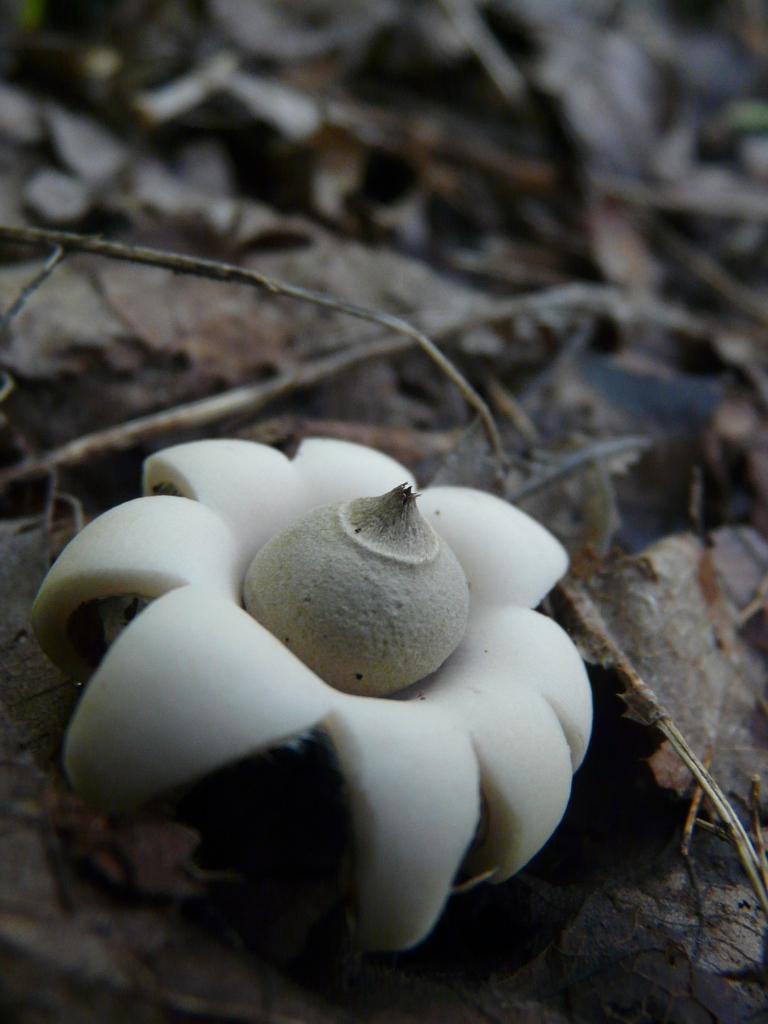
And, several years later, right on cue in early August, here are the earthstars in Shakerag Hollow. They must be the most gorgeous fungi ever. The one pictured above is Geastrum saccatum. It is about the size of a quarter.

My essay in The Forest Unseen rambles off in the direction of golf balls. Here I’ll keep my eye on the fungus.

Earthstars belong to the Gasteromycetes (“stomach fungi”), a motley collection of mushrooms that hold their spores in a stomach-like sac. Other members of the group of puffballs, stinkhorns, and bird’s nest fungi. Unlike the gilled mushrooms, bracket fungi, and others that forcibly eject spores using microscopic catapults, Gasteromycetes take an entirely passive approach to dispersing their spores. They hope for a raindrop, or the step of a beetle, or a prod from a falling twig to puff their spores into the air.

The evolution of these Gasteromycete fungi reveals some interesting evolutionary processes. Once the “stomach-like” form evolves, there is no turning back. Although “normal” gilled mushrooms have evolved earthstar or puffball-like structures at least four times, there are no known evolutionary transitions in the other direction. Why? The catapult mechanism is so complicated that it is very unlikely to re-evolve once it has been lost. After the catapult genes have been discarded, only a very long stretch of time and some lucky mutations could bring them back.

The loss of forcibly discharged spores has unexpected consequences. It turns out that having a passive spore dispersal mechanism makes a species more likely to split into new species. Exactly why this should be so is not clear. Perhaps their spores do not travel as far, so allow populations to become isolated from each other, leading to reduced gene exchange and then speciation? Regardless of the mechanism, the Gasteromycete fungi have been speciating more rapidly than their gilled relatives.

So the future belongs to the earthstars. Especially those that can figure out how to eat golf balls.

____

For those interested in digging deeper, the relevant articles in the scientific literature are listed below.

Hibbett, D. S., E. M. Pine, E. Langer, G. Langer, and M. J. Donoghue. 1997. Evolution of gilled mushrooms and puffballs inferred from ribosomal DNA sequences. Proceedings of the National Academy of Sciences, USA 94: 12002–6.

Wilson, A. W., Binder, M. and Hibbett, D. S. (2011), Effects of gasteroid fruiting body morphology on diversification rates in three independent clades of fungi estimated using binary state speciation and extinction analysis. Evolution, 65: 1305–1322. doi: 10.1111/j.1558-5646.2010.01214.x
Amazonia bound

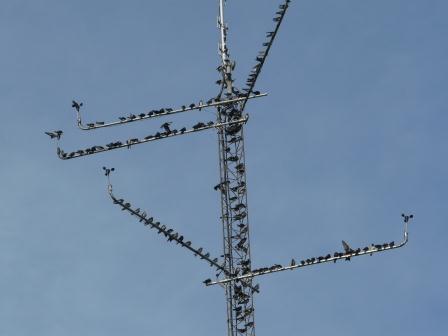
Sewanee got pounded with rain yesterday. A hard day for birds that feed on aerial insects. Late in the afternoon, the skies cleared and dozens of purple martins swarmed the radio antenna pole near Lake Cheston. They circled in noisy groups, feeding then swirling in to roost.

Many of these birds are likely migrants from the north, winging their way across Tennessee on the first leg of a long journey to their Amazonian wintering grounds.

In the eastern U. S., martins are almost entirely dependent on humans for nest cavities, a dependence that goes back to the days of Native American agriculturalists who erected poles with hollow gourds for the birds. Martins chase away crows, so this was a mutualistic arrangement. The birds got homes; the humans got protection for their corn crop.

In 1831, John James Audubon noted: “Almost every country tavern has a martin box on the upper part of its sign-board; and I have observed that the handsomer the box, the better does the inn generally prove to be.”

I think Lake Cheston could use a handsome box. Perhaps a class project for the spring?

One more smutty webpage

These are healthy corn tassels, ready to shed their pollen:

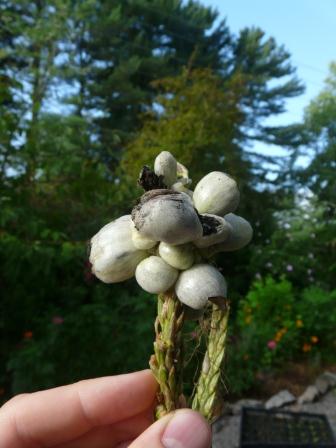
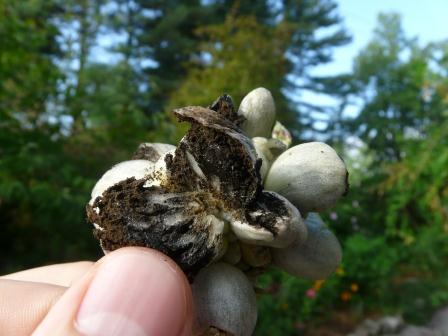
And these are tassels that have been infected by a fungus, the “corn smut” (Ustilago maydis; formerly U. zeae):

Smut spores overwinter in the soil, then as the weather warms they blow up onto corn plants and infect leaves, tassels, and ears. Like corn itself, smut is native to Mexico and thrives when the weather is hot and dry in early summer. This Mexican weather came to Tennessee in June, so we’ve had a good crop of fungal growth this year.

The fungus causes grotesque swellings on the corn. These pustules eventually burst and disgorge clouds of dark spores. The whole process is interesting to watch: the civilized, elegant growth of a plant hijacked by an ugly, destructive mob. Depending on your mood, this discord is either disturbing (the world’s order is threatened) or profoundly hopeful (the world’s order is indeed threatened).

Fungal infections are usually unmitigated bad news for gardeners, but this one has a surprising silver lining. The fungus causes uncontrolled growth and swelling of cells in the corn plant, cells that then get filled with…mushroom. In Central America and Mexico, smut is considered a delicacy, called “huitlacoche,” and farmers can get a higher price for infected ears. I was unfortunately not aware of the gastronomic possibilities when I culled the smut from our corn patch. Next year, perhaps?

The word “smut” obviously has another meaning. The etymological common origins here are straightforward: lewd smut and fungal smut are both “dirty.” The Online Etymology Dictionary (one of my favorite websites…a celebration of the anastomosing evolutionary trees of language) traces the word to pre-1500s West Germanic, smutt-, “to make dirty,” through the 1400s where smutten meant “to debase or defile,” then to the 1660s when the word meant both “black mark or stain” and “indecent or obscene language.” There is a botanical irony here, of course. The smut fungus is “defiling” one of the more overtly sexual plants under cultivation, one that sheds its pollen to the air and lets both male and female parts hang exposed (at eye-level, no less; I blush to gaze at a field of corn). But only when these parts become darkened with unbidden strands of fungal desire do they count as smut. Order is indeed threatened.

Snake

While walking down the garden path, I was stopped by the sight of a black rat snake, its body woven loosely through the low weedy plants. The snake was a youngster, too young to have the heft and scratched hide of a mature adult, but too old to be striped and worm-like. It was about two feet long and was basking in the weak heat of an overcast noon. The snake was entirely still, but its whole being said: alive.

Light hit the snake’s scales and melted. Black. Somehow, an earthy deity had lifted its head from the ground and breathed life into graphite. I’ve never been so captivated by a snake’s quiet presence.

In my admiration and greed, I wanted to catch and remember this beauty. So I walked to the house for my camera. Of course, the snake was gone on my return, leaving a wavy line of pressed vegetation as a mark of its passing.

So far this year, I have not seen the big old rat snake that used to patrol our garden. Even the strong snaky smell around the apple trees has dissipated. This newcomer may have wandered into a deceased old-timer’s empty domain. To stay, I hope.

Cicada killer

Stop and listen. Every tree is occupied by buzzing cicadas. Their vigor of their acoustic attack builds through the day, then dies away after dark, giving way to katydids.

We’re not the only species to tune into this sound. Cuckoos, blue jays, and other large-billed birds will grab cicadas when they can. But the champion hunter is the cicada killer, Sphecius speciosus, a large wasp that flies up into the trees in search of its prey.
The wasp grasps a cicada then tries to jab its stinger into the weak spots on the cicada’s exoskeleton. The cicada reacts violently — fighting for its life — buzzing its wings, writhing, and rolling. Often the tussling pair fall to the ground as they struggle. The cicada tries to break free while the wasp lances with the sharp stinger on the end of the abdomen. Spear and armor clash, then resolution comes. If the cicada can free itself, it takes wing and zooms away. The wasp does not follow, having no hope of recapture. But if the wasp’s poison finds its mark, the cicada falls into a deep sleep. This is no fairytale, no prince comes to waken the sleeper; instead, the mother wasp carries her prey to an underground tunnel where she buries it, alive but paralyzed, with a wasp egg. The larval wasp will fuel its growth by consuming the cicada.

Cicada killers have been active these last several weeks. They prefer to build their tunnels in well-drained sand, so the upper portion of the Lake Cheston “beach” has numerous holes, as do other sandy areas in town.

Cicada killer with paralyzed cicada. The wasp was dragging her prey across the sand toward a burrow.

The wasp is almost as long as my thumb. They look fearsome, but don’t attack humans unless molested. Unlike yellowjackets and bees, cicada killers don’t defend their nests from intruders and can be observed at close range.

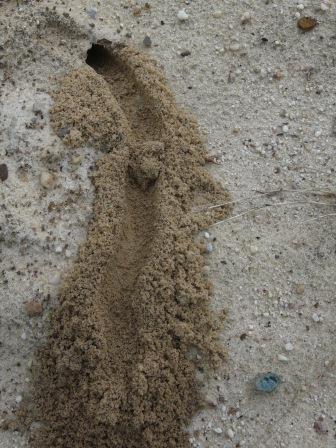
Entrance to nest burrow. The cicada pictured above was laid to “rest” here.

Cicadas are big insects and the wasps often struggle to carry them. I was swimming in Lake Cheston a few days ago when a low-flying creature — I thought at first a hummingbird — flew across the water, losing altitude as it went. When it reached the lake’s center, the flier hit the water’s surface, dropped its excess baggage and shot away. I swam out to retrieve the cargo: a cicada bobbing on the water. Back on shore, Junebug (the dog, not the insect), wanted a look. Lacking a burrow and an egg, we left the cicada to its unfortunate fate.

Guide to Sewanee’s butterflies now online

Eileen Schaeffer and Arden Jones’ guide to Sewanee’s butterflies is now available online (as a pdf at Issuu.com). Eileen and Arden are both rising seniors at Sewanee and have worked on this guide for the last two years, collating photographs, information about host plants, and data about abundance. The end result is a fabulous review of the diversity of these beautiful animals. The guide is also available in hard copy at Lulu.com.

This is not the only lepidopteran project that Eileen and Arden have undertaken. Last summer they completed a survey of the butterflies of St Catherine’s Island, GA. This summer they have taken a step into the daunting world of moth identification and are studying the moths of the Valles Caldera National Preserve in New Mexico.

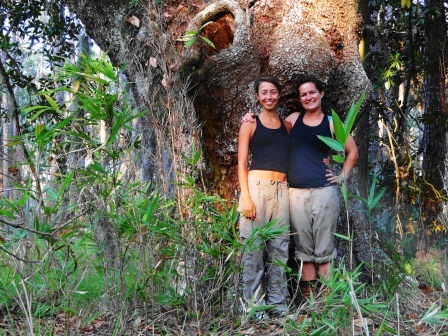
Taking a break from butterfly surveys, St Catherine’s Island, GA. Eileen Schaeffer (left) and Arden Jones (right). Both are Environmental Studies majors: Ecology and Biodiversity for Eileen and Natural Resources for Arden.

I have also uploaded a very short checklist of the butterfly species found in Sewanee.

One of my favorites: the long-tailed skipper.

“The butterfly counts not months but moments, and has time enough.” — Rabindranath Tagore

Agrippina visits Sewanee’s mushroom fest

This has been a phenomenal week for mushrooms. A reminder that we are not alone: below our feet lives an empire of rot. Stand still for too long and they’ll draw you into their net.

My last post on mushrooms discussed “American Caesar’s mushroom.” My friend and colleague Chris McDonough (and fellow blogger at Uncomely and Broken, a site that I highly recommend) added the following to our mycological ramble into the Classical World:

“The Caesar of the Linnaean term refers, it seems, to the unfortunate Claudius (you must recall that, after Julius and Augustus, all the emperors took the title “Caesar,” a tradition continued by the Czars and Kaisers into relatively modern times). Poor old Claudius, done in by a mushroom fed to him by Agrippina, who wanted her son Nero to ascend to the throne. It’s all in Suetonius, Life of the Divine Claudius, chap. 44, but you may want to watch the BBC’s “I Claudius” version (episode 13, “Old King Log”). The relevant portion is here.

The clip from I Claudius is fabulous. Never was a slowly advancing mushroom on a fork laden with such meaning. Suetonius’ account in no less gripping (taken from the public domain translation by Rolfe):

“That Claudius was poisoned is the general belief, but when it was done and by whom is disputed. Some say that it was his taster, the eunuch Halotus, as he was banqueting on the Citadel with the priests; others that at a family dinner Agrippina served the drug to him with her own hand in mushrooms, a dish of which he was extravagantly fond. Reports also differ as to what followed. Many say that as soon as he swallowed the poison he became speechless, and after suffering excruciating pain all night, died just before dawn. Some say that he first fell into a stupor, then vomited up the whole contents of his overloaded stomach, and was given a second dose, perhaps in a gruel, under pretense that he must be refreshed with food after his exhaustion, or administered in a syringe, as if he were suffering from a surfeit and required relief by that form of evacuation as well.”

‘Nuf said, I think, about the dangers of Amanita mushrooms.

Here is a slide collection of some of the diversity of form on display in the forest this week. My favorite, of course, is the photo with the snail — a young Ventridens, I think. Snails love to graze mushrooms, having the digestive enzymes needed to escape Agrippina’s reach.

This slideshow requires JavaScript.

Tracking migration: a window into the lives of wood thrushes

This image comes from a remarkable new paper about the migration of wood thrushes. A team of ornithologists led by Calandra Stanley and Maggie MacPherson from Bridget Stutchbury’s lab at York University in Toronto have used  tiny “light-level geolocators” to track the individual migration routes of wood thrushes. Geolocators use the daily cycle of sunlight and darkness, referenced to the time of day and date, to calculate where in the world they are. Sunrise and sunset vary consistently according to longitude (sun rises earlier in North Carolina than it does in Tennessee) and latitude (day length is longer in New York than in Belize in summer, but shorter in winter — except on the equinox when the machines get confused). Geolocators are not as accurate as GPS but they have the great advantage of being very small and lightweight. GPS needs a big, heavy antenna — there is no way that a songbird could carry even the smallest GPS unit.

The image above shows the path of one wood thrush over two years as it moves between its wintering area in Belize and its breeding grounds in Pennsylvania. The particularities of the route taken bring the map alive. The details change each year. In the fall of 2009, the bird came south over Florida and Cuba, but took the direct route across the Gulf of Mexico the next year. The map makes clear that migration is not an abstraction, but a yearly marvel.

This bird winged across Tennessee twice. That makes my heart leap — I may have heard this bird in Sewanee’s woods — but it also gives me chills. I have a freezer full of thrushes that hit windows and cars. (The dead birds are for use in the anatomy labs in my ornithology class.) We’ve thrown so many hurdles in the way of these migrating birds. To see the migration path is therefore not just to marvel, but to imagine the dangers.

A composite of the maps of multiple individuals shows the diversity of migratory paths within the species. Some birds hug the Mexican coast, some come through the Florida peninsula, and others take the dare-devil ocean crossing.

Joanna Foster’s article at the NYTimes Green blog does a great job of putting this study into the larger context of climate change and habitat loss. The important finding of this study was that the date of departure for spring migration barely varied from year to year. Individual birds, in other words, were consistent in when they left Belize. This is surprising — you’d expect them to be more sensitive to local conditions like the weather or their body condition. In the words of the authors, this lack of variability “may limit the ability of individuals to adjust migration schedules in response to climate change.” As my previous post of thrushes described, these birds have been declining for decades, so this is not good news.

Images here are from the paper: Stanley CQ, MacPherson M, Fraser KC, McKinnon EA, Stutchbury BJM (2012) Repeat Tracking of Individual Songbirds Reveals Consistent Migration Timing but Flexibility in Route. PLoS ONE 7(7): e40688. doi:10.1371/journal.pone.0040688 [Creative Commons]

For another mind-blowing set of maps from geolocators, see the Arctic Tern Migration Project website and click on “maps.”

A mushroom worthy of a Roman dictator?

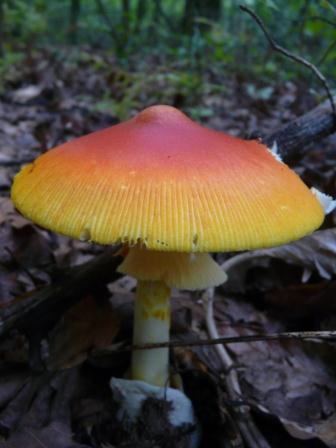
Early this morning I ran across this beauty growing on a dry slope in the upper reaches of Lost Cove. Even though the light was still dim, the mushroom’s sunny cap glowed. The species is Amanita jacksonii, or American Caesar’s mushroom. This is the American relative of a European delicacy which, it seems, was a favorite of Julius Caesar (evidence for this claim would be interesting to come by — perhaps when Chris McDonough returns from his conquest of Britain?). Several field guides claim that we have the European Amanita caesarea in North America; I think this is likely incorrect — see M. Kuo’s page over at MushroomExpert.com for an overview.

This is an edible species. But I’ll leave it in place. A small error can be costly in this genus of mushrooms — close relatives have cheery names like “destroying angel” and “death cap.” Interestingly, that venerable source of information on all things Classical, Wikipedia, notes that Roman Emperor Claudius may have been felled by Amantia phalloides, the death cap.

These mushrooms not only defend themselves with potent little peptides, they have interesting lives below the ground. Mushrooms are just temporary parts of much larger fungal bodies, like biological icebergs bobbing on the forest floor. The below-ground parts are filamentous, spreading through the leaf litter and slowly munching at their homes. The Amanitas also squeeze their filaments around tiny tree roots, exchanging minerals for sugars. This mutually beneficial relationship helps the forest retain its vitality. No dictators here, just plebeians trying to make it work.

For those in need of Scrabble words, the technical name for this is an “ectomycorrhizal” relationship — ecto because the filaments stay outside the plant cells, myco for mushrooms, and rhizal for roots. Regrettably, all these terms derive from Greek, not Latin, so they likely did not cross the lips of Caesar as he nibbled on his ‘shrooms.

Shakerag Hollow: update

Thank you to the University President, John McCardell, for making this statement: “We will solve this issue in a way that is not only exemplary, but permanent.” Kudos also to Jon Evans, my colleague in Biology and Assistant Provost for Environmental Stewardship and Sustainability, who first found the problem and took immediate action both in the field and in the administrative workings of the University. We are lucky to have leadership that understands the importance of Shakerag Hollow and that cares enough not only to remedy the present situation, but to look to the future and make permanent changes in University policy.

For the full text of the University’s initial statement, see here.

Regrettably, there is not word yet on whether we’ll maximize the educational potential of this debacle by making public the video and a full report. I’m sure more information will be forthcoming as the University takes its next steps.