Yearly Archives: 2012

Crowned Slug Moth, Isa textula

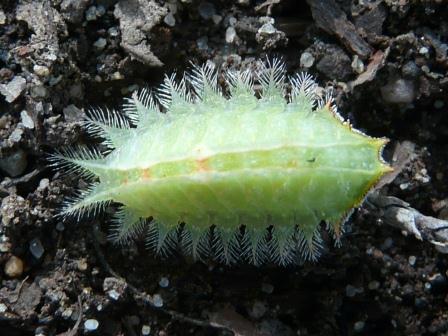
I came across this tiny (1.5 cm long) but handsome caterpillar on my walk to Piney Point this morning. It was lying immobile in the trail, under a white oak. Wagner’s Caterpillars of Eastern North America (what a great book!) notes that these caterpillars “may be active very late in the season, sometimes dropping down with autumn rains and winds.” After photographing the animal, I placed it on an adjacent oak sapling.

Murphy, Lill and Epstein’s study in the Journal of the Lepidopterists’ Society has some interesting background information on these caterpillars. They belong to the Limacodidae family, the so-called “slug caterpillar moths,” a group named for their strange offspring. All the species in the family have caterpillars that look like gummy worms going through a punk adolescence. Studs and spiky hair adorn colorful pudgy bodies. They can deliver quite a sting, as I noted a few weeks ago in my post about the saddleback, a different species in this family.

Murphy et al. confirm Wagner’s statement about the lateness of the species. This species is one of the season’s last active caterpillars, and are “frequently found feeding on leaves in the midst of turning color in late October, right up until leaf drop.”

Once they have finished growing, the caterpillars find a safe nook, then make a cocoon in which they enter a state of suspended animation (known as “diapause” in the zoological world). In the spring they make a pupa within the winter cocoon, then transform into an adult moth.

Tick Bush, Tennessee

It seems that my previous post about monstrous numbers of ticks near Lake Dimmick echoed a very old pattern. My friend Lizzie Motlow reminded me that the old name for the Lake Dimmick area is “Tick Bush.” Readers familiar with Sewanee history will remember that Ely Green’s autobiography from the late nineteenth and early twentieth centuries features a number of encounters with residents of the Tick Bush area. I had not, until now, known the exact location of Tick Bush.

Jerry Smith and Sean Suarez’s Sewanee Places corroborates this Acarine geography. They write that Tick Bush was down the hill from “Summit” or Midway. The two locations even had different schools. Smith and Suarez’s account places Tick Bush close to the present day airport, just two thousand feet upstream from where Lake Dimmick is located.

I think we can now say, with the confidence that comes from replicated quantified samples, that Tick Bush remains firmly planted on the map.

Now for some relief from discussions of ectoparasites… Ticks were not the only animals in evidence. The following male Black Swallowtail was nectaring on the thistles in the University’s cattle pasture. His beauty is a nice antidote to the creepiness of the skin-crawling masses emerging from Tick Bush’s bushes.

Dragging for ticks

My “Advanced Ecology and Biodiversity” class has been surveying ticks in and around Sewanee. We’re documenting which species live here, where they live, and what their relative abundance is in different habitats. So far, the hands-down winners for numbers of ticks are the cattle pasture and adjacent wooded roadsides near Lake Dimmick. In one twenty meter sample, we found nearly six hundred small ticks.

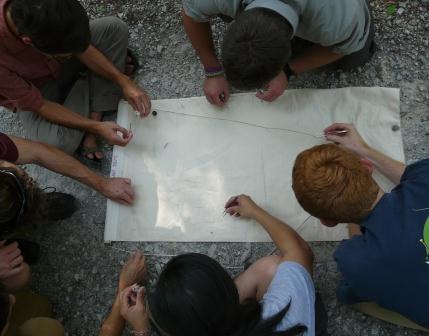
We sample by dragging a canvas cloth over the ground, then counting the ticks that have latched onto the cloth. This simple method is the standard protocol for assessing tick populations. These “tick drags” go very quickly when we encounter few animals, but when a seed tick “bomb” hits the cloth, it can take half an hour to pick off all the minute crawlers.

We’re storing the ticks in vials of alcohol. We’ll identify them later on in lab and we may also extract DNA to assess whether any of the ticks are carrying disease. We discovered today that when shaken the vials make snow-globe like ornaments. We’ll be marketing these as rustic woodland souvenirs.

Note that cloth drags are not the only way of sampling ticks. The label in the next vial hints at some misery.

Extra credit for students who wear T-shirts with slogans appropriate to the sampling method for the day:

As part of the class, students will be producing a pamphlet on the ticks and tick-borne diseases of Sewanee. I’ll pass it along through this blog when it is ready. For now, I recommend not rolling around in the cattle pasture at Lake Dimmick. The lawn around Stirlings coffee shop appears to be much safer for that kind of activity. (For real: we found no ticks there; Abbo’s Alley, on the other hand, had a few.)

Herp fest continues

Herpetological wonders continue to unfold. The Cumberland Plateau and the Southern Appalachians are among the most diverse places in North America (and the world) for amphibians and, to a lesser extent, reptiles. The last few weeks have not disappointed in encounters with this group.

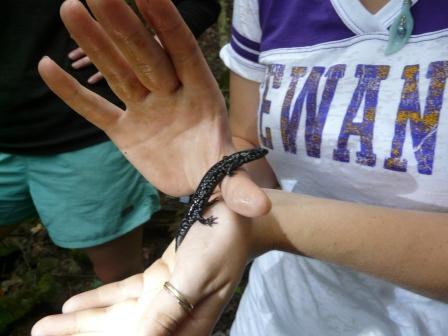
We found this Seal Salamander during my Advanced Ecology/Biodiversity lab last week. The animal was in a creek in Shakerag Hollow. It was about five inches long. Seal salamanders spend most of their time in water, but will wander on land to feed, especially on wet nights.

Unlike its close relatives, the Seal Salamander has tough cornified toe tips, possibly to help it climb vegetation during its terrestrial forays. You can see the blackened tips through the ziplock bag.

This Slimy salamander was under a rock in the same creek. This species is usually found away from water, under logs or rocks, so this individual may have just been passing through. Slimy salamanders lay their eggs in moist places on land and their young never dip their feet in water. Young Seal Salamanders, on the other hand, are aquatic and have feathery gills.

I found this Marbled Salamander during Intro Biology class. It was hiding under a log in a dried up vernal pool. In a normal year, the salamander would wait for several more months before the pool filled up. This week’s phenomenal rains mean that the pools are now overbrimming. We’ll see whether or not the water stays. If so, this will be the earliest filling of these ephemeral wetlands that I know of in recent years.

Scott Summers, a freshman at Sewanee, found this spectacular Red Salamander last week under a log near Morgan’s Steep. Great find!

A Pickerel Frog in Shakerag Hollow. Note the squarish spots on the back. The similar Leopard Frog has rounder spots that are more randomly scattered over the back.

A Green Frog snuggled underwater with an acorn. Also in Shakerag Hollow. Note the nice clear water — thankfully, not all streams have been impacted by silt runoff into the hollow.

And from an entirely different habitat, located just a stone’s throw away from the vernal pool: a fence lizard enjoying the baking sun on a sandstone outcrop near Piney Point. These outcrops are incredibly dry and blazing hot. Fence lizards love the heat.

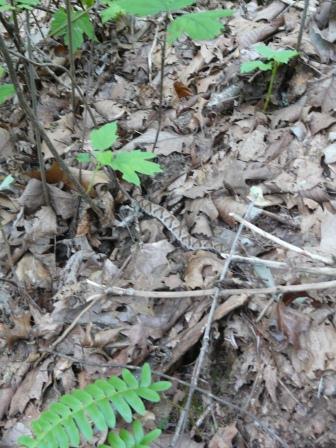
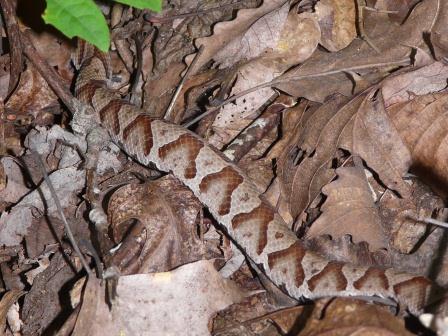
In closing, a frission of danger. This Timber Rattlesnake was on the trail in the northern Smoky Mountains where I was botanizing with the TN Native Plant Society last weekend. The botanists stopped briefly to admire the snake’s freshly molted shine, then returned their attention to petioles, leaf margins, and floral structure. The snake had thirteen rattles, so it has molted thirteen times. They molt two or three times a year, so this one is relatively young. They live up to twenty years.

Crab spider

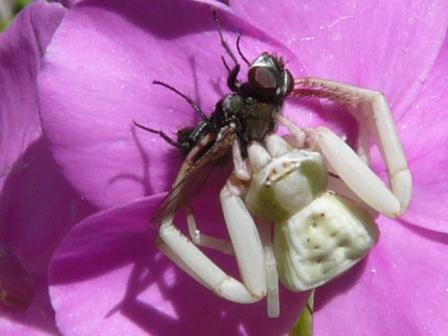
Just under the petal’s lip sat a small green spider. The fly landed. The petal twitched. The spider’s tidy fangs sank into the fly’s crunchy exoskeleton.

Next day, the spider sat on the same flower, but this time on the upper surface of a petal. The spider held its arms to the sky, keeping utterly still. Even some pokes from a piece of straw did not break its steely immobility. While I watched, no flies came to visit.

Crab spiders add a streak of danger to the cosy relationship between flowers and their pollinators. There are hundreds of species of these spiders (named, of course, for their crabby look while sitting) and in some habitats (e.g., Sewanee’s fall blooming meadows and roadsides) they are quite common. Their sit-and-wait hunting strategy makes them inconspicuous, but close attention (or the movements of unfortunate flies) will reveal their presence.

How many poems feature thorns and roses? Crab spiders seem so much more interesting. Not just the prick of a thorn, but the dying fall of a poisoned bite. And all the fly wanted was to touch its feet to a flower, to sip a drop of nectar. OK, that’s a pretty overworked theme. How about the flower’s perspective? A display of beauty, a straightforward offering of pollen, yet here come the Arachnid riff-raff, ready to knife the honest customers.

Horror from within

The rains have brought all kinds of strangeness to the woods. As we wrapped up our surveys of stream salamanders, a cry went up: nematomorph! (Yes, this is an advanced class; in Introductory Biology the cry would have been, OMG-gross…) Lying on the stream bed was half of a Narceus millipede with a long white worm writhing its way out of the broken body. The millipede’s front legs were still grasping feebly at the ground. It had dragged itself several feet to this spot, leaving its other half discarded on the wet rocks.

This individual was not alone. Barely ten minutes later we found another, this time with both halves still encasing the emerging parasite.

I’m fairly confident that the students’ identification of the cause of this distress was correct: a nematomorph worm emerging from its host. However, the light color of the worm makes me a little suspicious that a mermithid nematode might also be the culprit. My search of the scientific literature revealed nothing about either of these worms in this particular host, so we may have stumbled into new corner of the vast wonderland of pain that is animal parasitism. We’ll likely head back down into Shakerag Hollow to see if we can find more worms to bring back to the lab.

Nematomorphs appear in the first chapter of The Forest Unseen as examples of one extreme of the continuum between cooperation and conflict. The worms eat their hosts from the inside out, with no regard for the comfort of the suffering victim. The vital organs are left in place to allow the host to continue feeding (the food goes mostly to the inner pirate, of course). At last the parasite directs its hollowed-out victim to water. There the worm breaks free, discards its dying carrier and squirms away to look for a mate.

After one of my recent public lectures, someone recently asked me for an example of what I meant by the “weight of the world’s pain” (what a blessed life the questioner must have led). This species could surely serve as an answer.

Some visceral fears are tapped when we observe the emergence from within of a life-robbing villain. I think these fears may, in part, be rooted in our species’ long history with parasites, some of which do indeed emerge through our flesh, others merely use existing exit orifices. Either way, we recoil in horror. Movie-makers titillate these deep-seated fears when they show slick-bodied monsters sliding out of our skin. And Freud et al‘s ideas of the unconscious are so successful because of our pre-existing and, ahem, unconscious fear of what might be hidden within us (oh delicious infolding circularity). Psychoanalysis entices because it promises to draw out the appalling inner worm, a cleansing that is surely the deep desire of all animals.

Act I of Autumn

A vigorous belt of chilly rain passed over Sewanee this morning. In its wake, a Canada Warbler feeding on the shrubs in our garden. This is a bird of the boreal forest, found here only during migration. Cool rain, falling temperatures, a forecast for a week of low humidity and clear sunny skies, and the Bird from the North: these all speak of the season’s change.

The plants are ready. Many local species make use of the autumnal surge of birds to complete their pollination and seed dispersal. Cardinal flowers bloom along lake edges, beckoning hummingbirds with their crimson blooms. Dogwood and beautyberry offer brightly colored fruits to the passing thrushes, vireos and warblers. These birds feed on North American insects all summer, then become frugivorous on their tropical wintering grounds. They start the fruity feast right here, gobbling the fruits of our native shrubs and depositing the seeds a few hours later.

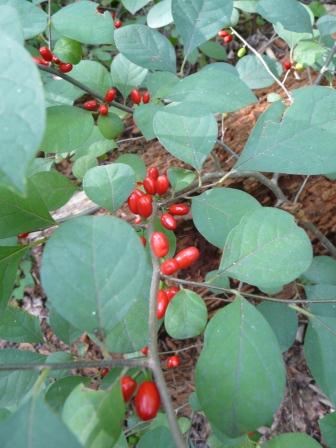
One of the most abundant of these fruiting shrubs is spicebush (Lindera benzoin), a species that is particularly common on the mountain slopes. This has been an incredible year for spicebush. I’ve never seen so many fruits. The warm spring must have suited them.

Like Christmas trees loaded with goodies, the plants will be stripped bare when the party gets going. For now, they sit in a quiet forest, waiting for the rambunctious guests to arrive. But unlike the treats on Christmas tree which make up just a small part of the festive food, these berries are the main meal for migrant birds. Now that dogwoods are nearly gone from our forests, killed by an invading fungus, spicebush is a lifeline for the feathered travelers.

Fall garden emerges

This slideshow requires JavaScript.

The slideshow shows a few snapshots of the emerging fall garden (and a gratuitous picture of a Seminole squash bloom — one plant has put on about 200 ft of vine and is still producing). It is very good to see lettuce again after a too-hot summer. I feel healthier just seeing the gentle green of lettuce. Eating is almost an afterthought.

The benign and drawn out autumn weather here make fall gardening quite easy. The weeds grow just a little slower than in the summer and the cooler temperatures are kinder on the soil. Lettuce, Asian greens, and carrots all thrive. And, with a little protection, fall-grown veggies will be good to eat all the way until February.

Unfortunately, a lot of local stores pull their seed racks or offer only turnip greens. If you want to put in a fall garden and need seeds in a hurry, Johnny’s is a good place to start, as is Southern Exposure Seed Exchange. For readers in colder climes, check out Eliot Coleman’s books on winter gardening — the man eats home-grown lettuce in mid-winter in Maine. I can only imagine how good that must look and taste.

Red eft

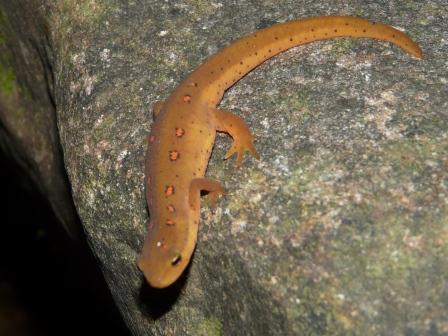
We found this beauty in Shakerag Hollow today during our stream surveys: a red eft, the terrestrial form of a salamander that has no fewer than four life stages. The eggs (stage 1) hatch in lakes, then the larva (stage 2) fattens up in the lake before metamorphosing into an eft (stage 3) that leaves the water and wanders on land for several years before returning to a lake and transforming into an adult red-spotted newt (stage 4).

The eft stage is very unusual; no other salamanders in our region have such a stage. The advantages are clear: the eft can feed on the forest’s abundant small invertebrates and grow to adult size without having to compete with any adults. This is a common strategy among other animals, especially insects whose young specialize on different food sources than the parents (butterflies and caterpillars; maggots and flies; lake-dwelling larvae and flying dragonflies). But why should only the newt adopt such a strategy among salamanders? No-one knows, but I suspect that part of the reason lies in the species’ powerful defensive chemicals. All red-spotted newt life stages have neurotoxins in their skin and are therefore well protected from predators. It was therefore presumably not that hard for evolution to draw the eft out of water onto land. Indeed, unlike all other local salamanders, efts wander the woods in broad daylight. They are seemingly the most fearless of all the woodland creatures, with the possible exception of hornets and yellowjackets. Like these wasps, efts advertise their noxiousness with dramatic colors. This one was about only two or three inches long, but was sighted from several meters away.

“Eft” is from the Old English for “newt” or “small lizard.”