Yearly Archives: 2012

Happy 203rd Birthday, Charles Darwin

“It is interesting to contemplate an entangled bank, clothed with many plants of many kinds, with birds singing on the bushes, with various insects flitting about, and with worms crawling through the damp earth, and to reflect that these elaborately constructed forms, so different from each other, and dependent on each other in so complex a manner, have all been produced by laws acting around us … There is grandeur in this view of life, with its several powers, having been originally breathed into a few forms or into one; and that, whilst this planet has gone cycling on according to the fixed law of gravity, from so simple a beginning endless forms most beautiful and most wonderful have been, and are being, evolved.” Charles Darwin, concluding paragraph from the first edition of On The Origin of Species.

Charles Darwin by John Maller Collier. The image is from the WikiMedia Commons.

Robert Pinsky on movement and grunting

Robert Pinsky spoke in the Hunter Lecture Series in Chattanooga a couple of nights ago. I knew I was in for a good evening when I swung into Moccasin Bend on I-24 and the biggest moon I’ve ever seen appeared, a massive golden orb in the blue dusk over the city lights. I was moved to invoke aloud the name of a Hebrew man-god. I had no camera, so was free from the temptation to risk my life by pulling over for a shot, and I was forced to just enjoy Lady Moon’s full spectacle. On top of that miracle, I found an unoccupied free parking spot near UTC.

Pinsky did not read his poems (bummer), but instead gave a great talk (bummer erased) about art, education, the evolution of grunting, the physicality of poetry, and the Favorite Poems project. In other words, here was another Rambler (albeit a three-time poet laureate, so an über-rambler). I had a great time.

I will not attempt to give an abstract of his talk, but instead I’ll share a few interesting ideas and links to his great online poetry videos.

One of the questions he asked was, “why has an unpromising little ape [Homo sapiens] done so well when so many other species have more impressive physical attributes?” His answer: we cooperate, not just with those alive now, but with past and future generations. That sharing of knowledge is extraordinarily powerful. How do we accomplish this? Well, these days via the web. Before that, with the printed or scribbled word. But for most of our life as a species, by “moving and grunting in certain ways.” In other words, by dance, music and poetry (he left out story-telling, aka sitting around the fire BSing…). Art, he claimed, is the key feature of our species that has allowed us to thrive.

(Side thought: some skill with thrown rocks and spears probably helped. Give me poetry, but give me meat also. Poems about spears, maybe – Homer?)

After some discussion of taxi drivers in Russia, W. E. B. Du Bois, the Boston Arts Academy public high school, Robert Frost’s assessment of the poetry-college athletics nexus, the desirability of extending the educational philosophy of the ruling classes to all people (i.e., everyone gets to take art seriously, not just the aristocrats), and his experience of Aristotle as a college freshman, Pinsky made a convincing case that, for art, physical experience is central, not peripheral or ornamental. So, art is central to our existence as a species and the physicality of art is the ground on which all this is built. He illustrated this with some examples from the Favorite Poems project – “normal” people reading and talking about their favorite poems. These are not profs, critics, or specialists. Pinsky claimed that their giving voice to the poems allows us to “see the work of art happening in the reader,” a “deep connection” back over tens of thousands of years to the core of our nature as humans.

At a time when our lives often revolve around uploads and downloads to “the cloud,” with physicality reduced so often in our culture to tasteless gluttony and tawdry lust, his emphasis on artful embodiment was refreshing. Occupy: your body. I wonder how much of this embodiment can be captured in online videos? So asks the blogger through his Ethernet cable, coming to your Android (aye, language is telling).

Homo sapiens, let’s be the lightning that connects cloud to ground. We’re the one species that can do it. Yes, we can have both; sparks fly when they connect.

Ephemeral pond

On Saturday morning, I visited the large ephemeral pond at the end of Brakefield Road. This pond, like all ephemeral ponds or “vernal pools,” fills with water in the early winter, stays wet through the spring, then dries up completely in either summer or early fall. The peculiar hydrology keeps fish out – they obviously can’t survive the dry spells – and creates an incredibly rich community of animals that thrive in the absence of fish predation. The abundance and diversity of salamanders and crustaceans in these pools is unrivalled; many of these species live nowhere else.

Although February has just started, spotted salamanders (Ambystoma maculatum) have already visited the pond, mated, and laid their eggs. The adults of this species lives underground in the surrounding forest and emerge only for a few nights in the spring. After breeding in the ponds, they burrow back down into the leaf litter and disappear from view for another year. This year’s breeding season got going very early. In most years, mating doesn’t happen until late February or early March.

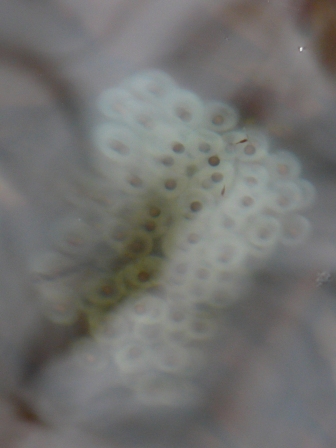
Spotted salamander egg mass seen through the wind-stirred light on the pond surface

I returned later, at night under a misty, drizzly moon, to see whether any salamanders were still in the pond.

Despite a thorough search, I couldn’t find any adult spotted salamanders, but I found dozens of egg masses attached to submerged twigs, especially in the center of the pond where the water was deepest (thigh-high: deeper than I expected). Illuminated with a flashlight these masses are quite stunning. The little embryos are visible within.

When these spotted salamander eggs hatch, they’ll feed on the diverse set of small crustaceans and larval insects that swarm through the pond’s water. Their cousins, the larvae of marbled salamanders (Ambystoma opacum), hatched in the early winter and have a head start on growth (I posted about a female marbled salamander guarding her eggs in this same pond last fall). This sets the stage for some inter-species struggles: the smaller larvae make good meals.

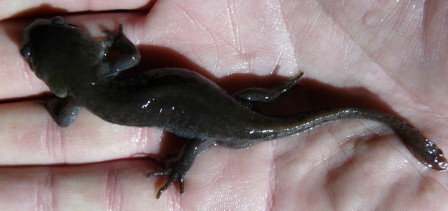
At the shallow end of the pond, I found a few mole salamanders (Ambystoma talpoideum). In our region, this species is found only at ephemeral ponds. Like spotted salamanders, they lay egg masses attached to small twigs in the pond, although the mole salamander has a smaller cluster of eggs (fewer than one hundred, rather than up to two hundred as in spotteds). The adult is also smaller, about half the length of the spotted.

Ephemeral ponds are in trouble – they have no legal protection in most states. The federal Supreme Court SWANCC decision removed Clean Water Act protections from these and other “isolated wetlands”) and these small pools tend not to get protected when residential development, tree plantations, or other habitat modifications happen in a forest. A few states have adopted their own protections, but Tennessee is not one of them, to my knowledge (and I’d be oh so happy to be corrected on that point if some recent legislative action has taken place).

Salamanders were not the only creatures on the move.

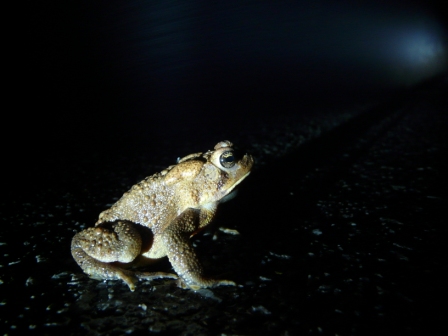
Toads were sitting on the paved roads in town.

I suspect that the toads were hunting stranded earthworms, which were everywhere.

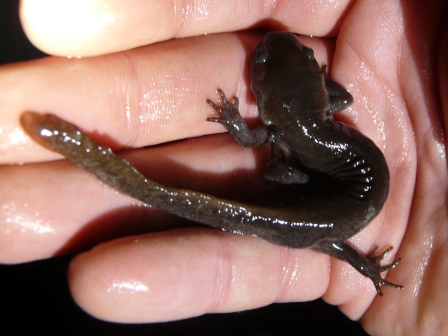
Turning the flashlight around for a moment, another wet-skinned night wanderer was seen in the rain.

In closing, I’ll record a new life goal: to get some waders that don’t leak. The gallon or two of water that oozed into my boots was cold, cold. On the other hand: the feeling of icy water around my toes; the utter silence of the woods except for the patter of water drops in the dark pool; the spicy smell of wet leaves on the forest floor mingling with the slightly sulphurous odor of the black, sodden leaves on the pond margins; the feel of rain on my face. These things bring me back to my senses. Reframing: leaky boots are a doorway into experience. A new product line idea for LaCrosse boots?

The sign of a Saturday night well spent: wringing out your socks.

Merlin!

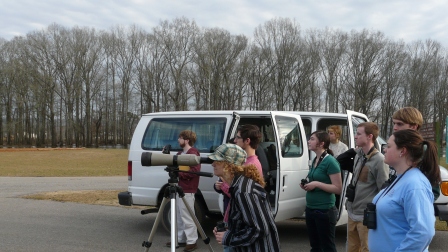
This lonesome old tree by the waterline has a special visitor perched at its top: a merlin visiting from Northern Canada. Merlins (Falco columbarius) are small falcons that breed in the boreal forest. They are uncommon winter visitors to our region. We found the bird at the end of our class visit to Crow Creek Wildlife Refuge near Stevenson, AL.

Merlin, condensed to about 2 pixels. Great views through the scope, though.

Merlins are spectacular little birds. They sit and wait for an unsuspecting songbird to fly past, then they explode into rapid flight and chase down the prey, catching it in midair. They are the fighter jets of the bird world: fast, maneuverable, and uncompromisingly fierce. “…no falsifying dream/Between my hooked head and hooked feet”.

Scoping

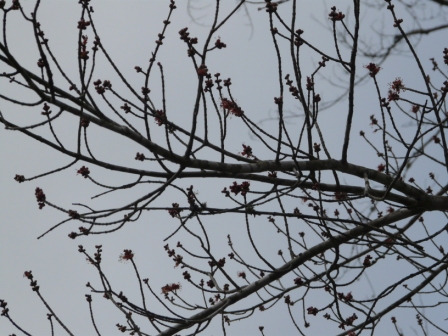
The warm weather turned up some other unusual phenomena: great-blue herons standing over their big stick nests, maples in bloom, and chorus frogs singing. This is a very peculiar January — prolonged warm weather has unlocked all kinds of activity that in normal years would not happen for another month.

Red maple flowers...on Jan 31st

In summer, the water in the Crow Creek Refuge is carpeted with the large round leaves of American Lotus (Nelumbo lutea; also called Water Chinquapin). Now, the plants are invisible (their stems are underwater in the mud) except for the strange seed receptacles that litter the shoreline like organic showerheads.

Seeds fit inside the holes on the top surface.

We also found a rare specimen of Florus plasticus washed up on shore.

The pollinator of this flower is unknown, but it probably requires a battery.

Limestone foray

I rambled halfway down the mountain to visit some caves this morning. The Cumberland Plateau is a layer-cake of rock: the top layer is sandstone, the bottom is limestone. Sandstone does not dissolve in water, but limestone does. Over millions of years, this dissolution of rock by water has gouged holes in the lower reaches of the mountainside, creating an impressive network of caves.

From the outside, looking in.

From the inside, looking out.

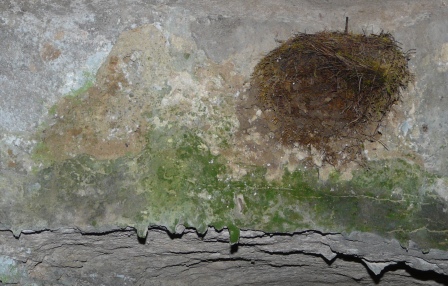
A phoebe nest on the inner wall of the cave, about fifty feet back from the entrance. These nestlings were raised in near darkness. Their first flight out into the world must have been a revelation.

"Solomon's Temple" cave entrance. No Ark of the Covenant here, just limestone-adapted spleenwort ferns.

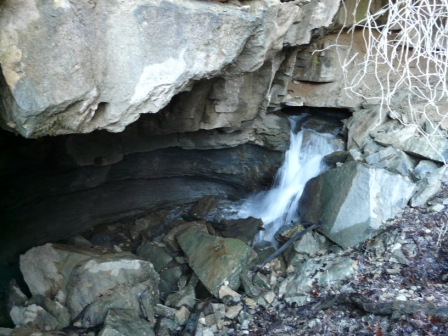
An underground stream surfaces briefly at the base of the cliffs. Inside the cave, this stream roars away at the bottom of large pits. I was by myself, so I did not scramble into the cave to see them again -- rule number one of caving is 'don't go inside dangerous caves alone'.

Multiple layers of eroding and fractured rock: another reason for caution.

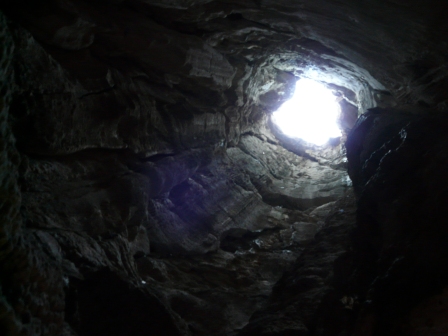
My favorite spot around these caves. This is a vertical tube, about twelve feet wide, running straight down from a hole on the forest floor, emerging far below in a pile of debris on the side of the cliff face.

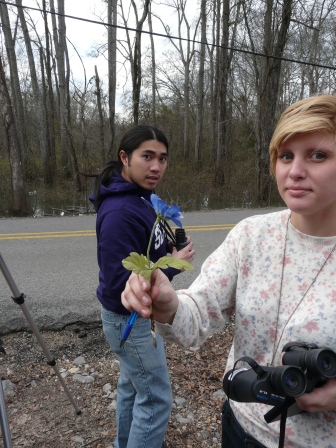
Just below the cliffs and caves, I found the first wildflower of the the year, “pepper-and-salt” or “harbinger-of-spring”, Erigenia bulbosa. It seems a little early to be harbinging the spring — we’ve got plenty of winter to go yet — but it is good to be reminded that spring will come. These little flowers belong to the carrot family and their tuberous root is supposedly edible. I’d rather leave them rooted and feed on the hope they offer.

Woods Reservoir Trip

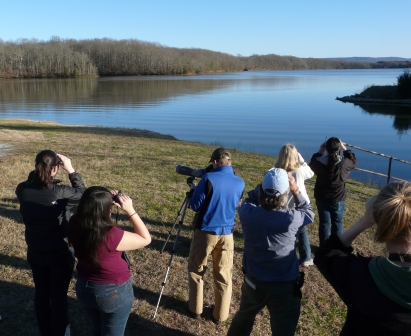
Yesterday, I took my Ornithology class to Woods Reservoir to look for ducks and other waterbirds. Many of these species overwinter here in the south before heading back north to breed in the boreal forest, the prairie-potholes, or the arctic. The weather was as warm and balmy as I’ve experienced in January and the duck count reflected this: we see fewer ducks during extended warm spells, presumably because they have not been pushed south by hard weather up north. However, we did see a good assortment, with the coots leading the count, as usual.

Many of the waterbirds that we saw are fish-eaters (loons, grebes, herons, mergansers). Unfortunately for them, Woods Reservoir is contaminated with PCBs and the fish bioacummulate these toxins and pass them up the food chain to the birds. The PCBs came from the Air Force’s Arnold Engineering Development Center (Woods Reservoir was built in 1952 to provide cooling water for the site). The Tennessee Department of Public Health has issued an advisory that recommends no human consumption of catfish caught from Woods Reservoir. They recommend that consumption of other fish species be limited to one fish per month. The birds (and the many fishermen at the lake) have evidently not heard this advice.

PCBs are found in the lake sediment and fish accumulate these pollutants in their bodies, especially in fat. Manufacture (but not use) of PCBs was banned in 1979, but the chemicals are very persistent, so linger in many ecosystems. PCBs were used at AEDC from approximately 1952 to 1990 and they are believed to have entered Woods Reservoir via streams draining contaminated soil at the site (2007 TDEC report).

Two non-duck highlights were a Bald Eagle and a Northern Harrier. The eagle gave us a great display, soaring in great ascending circles over the lake against the blue sky. Its slow, self-assured flight and eight-foot wing span embodied unfashionably grand qualities: majesty, imperialism, and hauteur. Bald Eagles may be ill-tempered, bad-breathed fish-scavengers, but they’re awesome nonetheless. The harrier flew across the lake with lazy wing beats as the sun set.

Chocolate in trouble?

Melt a square on your tongue and immediately you’re connected — to your own senses, but also to the other species and other people who made possible the experience. Your chocolate community includes: the cacao tree, the bacteria that fermented the pods to unlock the goodness inside, the tropical South American forests where the tree evolved, the midges and bats that pollinate the tree, the Olmec people of Mexico who domesticated the plant two or more thousand years ago, the soil and air of the farms in Africa, Asia, or South America where the atoms in the chocolate in your mouth last resided, the hundreds of people, living and dead, who developed and implemented modern preparation methods. Like the taste itself, this web is almost too rich to fully grasp.

But, all is not well in the world of chocolate. The latest issue of Scientific American (print only — the choc feature is not yet online) contains an article by scientists at Mars (yeah, yeah, Venus is next issue) detailing some of the challenges faced by the cacao tree. Domesticated cacao is not very genetically diverse, so disease is rampant. Some areas of Brazil have had their trees almost completely destroyed by fungi. Climate change and shifting socio-economic conditions are both projected to further threaten the crop.

The article suggests a number of ways of addressing these problems, mostly focused on genetics (the cacao genome was recently sequenced) and changed production practices (getting more fertilizer and fungicide into farmers’ hands). Some of these avenues seem sensible — finding new disease-resistant variants — but others have some hidden costs that the paper does not address. In particular, one of the proposed solutions to the problems of cacao is to “creat[e] large plantations…at higher altitude..in the full sun and irrigat[e] them with fertilizer-enriched water.” But, high elevation tropical forests are some of the richest places in the world for biodiversity and this diversity is almost entirely annihilated when forests are converted to monocultures of cacao (or to other crops like full-sun coffee or palm oil).

Interestingly, more traditional methods of cacao cultivation can, according to Smithsonian scientists Robert Rice and Russ Greenberg, support “a greater diversity of tropical forest organisms…than most other lowland tropical agricultural systems.” What makes the difference? These traditional farms grow cacao under a canopy of shade trees. Shade trees provide habitat for many other forest-dwelling species. According to Rice and Greenberg, cacao farms that “incorporate a high diversity of trees with animal dispersed and pollinated fruits and flowers, along with retaining epiphytes, lianas, and mistletoes, will support the greatest diversity.” Further, in places where native forest is entirely gone, shade-grown cacao (and shade-grown coffee) farms provide the only remaining habitat for many species.

Deforestation not only hurts the legions of other species that live in the tropics, but it destroys the wild relatives (and progenitors) of our domesticated crops. So, even from a purely agricultural perspective, loss of wild populations of  cacao hinders our ability to find the new genetic variants needed to produce the chocolate of the future.

If loss of biodiversity doesn’t give reason enough to question large technified plantations, then socio-economic factors might. The recommendation to remove shade cover and to increase fertilizer use has, in some cases, not worked in the past: it provides, at best, a short term fix. At worse, it could replicate the coffee boom and bust that drove many farmers from their lands a few years ago.

Unlike coffee, there is no system of certification for “shade-grown” cacao. “Organic” chocolate is more likely to be shade-grown and responsibly produced, but this is an imperfect signal. So, information for responsible consumers is hard to come by.

Should we therefore stop eating chocolate? Ouch — I hear a chorus of wailing. Instead, perhaps, could we eat less chocolate, of higher agricultural and gastronomic quality? I’d say, yes. The problem of deforestation is driven largely by quantity — demand for chocolate is higher than ever. Moderation of our consumptive desires might be part of the answer.

The scientific name for cacao is Theobroma, “God food.” I vote that we treat it as such.

The defiled altars at Kroger...

…sometimes the gap between the potential for transcendent sensory delight and our culture’s delivery of this potential leaves something to be desired.

Bait

“’Hope’ is the thing with feathers,” so tells us Ms. Dickinson.

So, a bird feeder is a baiting station for hope. And why not invite wild, feathered dreams? Hope is also a classroom full of students eager to learn about feathers and other seemingly esoteric parts of the community of life.

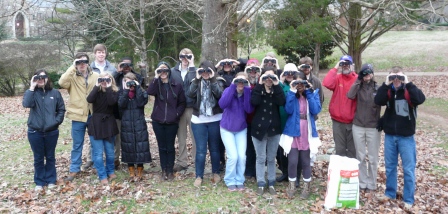
The 2012 Ornithology class, giving me some scrutiny. We'd just installed the feeder behind.

The feeder sits below the “moon tree” – a tree whose seed went to the moon (oh, curious journey), and is now back on Earth.

I imagine that no other tree on the planet is more relieved to have its roots worming through the soil of home.