Yearly Archives: 2012

Happy New Year from the Blue-spotted Mudskipper

One of the many delights of working with Sewanee’s students is the biodiversity that they bring to my desktop. Sometimes, these species arrive on my actual desktop (snails, leaves, dead coots, live hummingbirds, and so forth…), but species also arrive via the glow of the screen. Here is one such arrival. I’m posting it for no other reason than the smile it brought to my face. Thank you, Dr. Bert Harris (Sewanee class of 2006 — a great vintage), for sharing this after a recent research trip to Sumatra. Without further ado, the blue-spotted mudskipper:

mudskippers

These air-breathing fish live in the mud flats of Asia. Males come out of their burrows to joust each other and to perform leaping dances for females. You can read more about their biology here and here.

What these websites will not explain is why they make me slightly nervous: I get the sense that they are ready to step in and take over when the current gaggle of tetrapods finally gives up the ghost. Give these mud-skippers three hundred million years and they’ll be strutting around with sapiens after their names. So this New Year, let’s look sharp and keep focused. We have competition.

Addendum: Thank you to Karen C. Rio for pointing me to this video of the mudskippers in action :)

Beech

The woods are mostly bare and gray, but American beech still shines. The trees, especially the young trees, retain their coppery leaves until spring. Beech is the bright ornament of the dark woods, gold leaf flecking the gloom.

winter beech

The leaves are exposed to all of winter’s assaults and many of them abrade away until all that is left is translucent paper, etched with veins.

beechtrans

Other trees weather more slowly. Perhaps they grow in slightly more sheltered areas or have a genetic propensity for toughness. Their leaves keep the full, metaled color of autumn.

beech copper

Botanists are fond of classically derived English neologisms to describe their plants and the scientists have not let us down here. Unfallen leaves are “marcescent” (from the Latin, marcesco, wither).

But nomenclature is easier than explanation. Why might trees be marcescent? One idea is that a fuzz of leaves might protect nutritious buds from browsing animals like deer. Having watched goat lips strip shrubbery, I initially found this explanation unlikely. Browsers are adept at taking what they like and leaving the rest. Goats work around tiny thorns with ease. A few crisped leaves would be unlikely to keep deer away from beech buds. But my skepticism should be tempered by actual experiments. I know of no such experiment in North America, but a study of beech, hornbeam, and oak in Denmark did find that marcescence had a protective effect for beech and hornbeam, but not for oak. Apparently, the lower nutritional content of the leaves compared to buds and twigs acted as a deterrent for deer. The fact that marcescence is most common in young, short trees and on the lower branches of older trees is another piece of evidence in favor of this hypothesis.

On the other hand, retained leaves may act as cues for ovipositing insects in the spring. Or so it appears for gall-forming cynipid wasps infecting one species of California oak. This tree species lives in a very different environment, but galls are also common in Sewanee’s forests.

Another idea is that the retained leaves subtly change the micro-climate around buds. There is experimental evidence for such an effect in Andean plants with rosettes of marcesent leaves. It is possible (although no-one has checked, that I know of) that the ice and snow that gathers on marcescent leaves might act as a buffer, protecting buds from the more extreme winds and temperatures of winter.

I encourage you to seek out beech on your woodland walks. The species is found all over eastern North America. On the southern Cumberland Plateau it has an odd distribution. Puckette, Priestley, Kuers and Hay’s excellent 1996 guide to Sewanee’s trees states that beech is found “almost exclusively in the bottomlands and the neighboring lower slopes of coves.” I’d add that the species also likes (strangely) dry ridges and the streamside habitat of the eroding bluff. It may be that the semi-domesticated hogs that ran through these forests for decades have caused the species to have a more patchy distribution than it otherwise would have done. Beech nuts were favorite food for hogs and in the late 1800s and early 1900s it is likely that almost no young beeches germinated across large parts of the mountain. The species’ present-day distribution is therefore hard to interpret.

Look closely and you’ll see another interesting feature: needle-like buds. Unlike the rotund buds of oak, ash, and maple, beech has stilettos on the ends of its twigs. They are quite remarkably elongate.

beech budbeech bud2I am not the first person to marvel at this species. I have heard that Native Americans in these parts viewed groves of beech as sacred places. One such grove, in Champion Cove, has come up repeatedly in conversations over the years. A destination, perhaps, for a pilgrimage next year.

Reindeer carved deep into our history

How long have reindeer been dancing through our midwinter celebrations?Rudolph,_The_Red-Nosed_Reindeer_Marion_Books

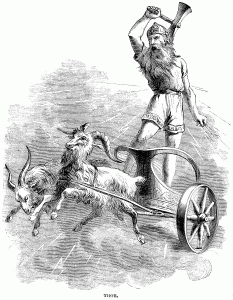
Rudolph is seventy three years old. He came into being in 1939 for a Montgomery Ward Christmas publicity campaign. He joined his older cousins Dasher, Dancer, Prancer, Vixen, Comet, Cupid, Donner, and Blitzen, a little herd that celebrates its one hundred and ninetieth birthday this week. The eight “tiny rein-deer” originated with Clement Clarke Moore’s poem, A Visit from St. Nicholas, written in 1822. Moore apparently re-imagined some Norse myths, replacing Odin’s Wild Hunt with St. Nicholas’ sleigh-in-the-sky. To power the sleigh, Moore replaced Thor’s goats (called teeth-barer — the snarler — and teeth-grinder) with more kid-friendly reindeer. Moore may also have penned a slightly older poem, Old Santeclaus, that also places reindeer at the head of a sleigh (originally published in a pamphlet by William B. Gilley, but the poem’s authorship is apparently in doubt). Unlike A Visit from St. Nicholas, this poem languishes in obscurity, perhaps because it ends with the gift of a birch rod with which parents can enact God’s will by thrashing their kids. Montgomery Ward would have a hard time weaving that idea into their sales pitch. Christmas is a lot tamer these days: gone are the snarling goats and instruments of corporal punishment.thor-clipart

In sum, Rudolph is a bit of an upstart. But all these modern deer are babies compared to the venerable grandma and granddaddy of them all: the Swimming Reindeer of Montastruc. This pair of reindeer are thirteen thousand years old. They live in the British Museum, in a carefully climate-controlled case. The pair were carved by an artist in what is now France. The artist carved a mammoth tusk (!) to create a sculpture of two reindeer swimming across a river.swim

This carving is a work of stunning beauty, carrying the artist’s skill across a chasm of time. More, it reveals much about the world in which the artist lived. Reindeer (Rangifer tarandus, called caribou in North America) are animals of the tundra and northern forests. Their presence in France is a reminder that at the time of the carving the world was engulfed by the last ice age. Half of Britain was under ice, as was much of North America. The people of Europe were living in conditions similar to those of modern northern Scandinavia. Reindeer formed a substantial part of the diet of these early modern people, especially in the coldest years of the ice age. (The so-called Cro-Magnon/Paleo diet should, if carried out with rigor, be comprised of about 95% reindeer, with a little horse, cave bear, chamois, and mammoth thrown in for good measure. And don’t expect to live much beyond forty.)

I’m awed by the sculpture. For a more complete discussion of the artistic and archeological context, I recommend Robin McKie’s recent article in the Observer (reprinted in the Guardian). Here I’ll just note the artist’s attention to the particularities of the animals’ lives. This is the work of someone who understood their subject and was able to convey this understanding through sophisticated artistic technique. Natural history, science, and art have been close companions for a long, long time.

For a good view of the carving, use the British Museum’s online viewer and press the “zoom” buttons to magnify the image. Click the little square underneath these buttons to flip into “full screen” mode. You can see most of the details quite clearly and thus imagine the hands that conjured reindeer from a tusk so long ago.

Of all the various symbols and myths of the modern solstice celebration, reindeer may perhaps be the oldest. Humans were celebrating the return of Light with reindeer meat, hides, and carvings long before the agrarian revolution, let alone the origin of the Abrahamic religions. Clement Clarke Moore tapped something deep. Lighted reindeer on lawns and Rudolph songs are reminders of who we are: a species that has depended on ungulates for tens of thousands of years. These animals are carved into our psyche.

I know nothing about the midwinter traditions of cultures in places other than western Europe (transplanted to North America). Like most arctic animals, reindeer have a circumpolar distribution, so I’d predict that they appear in solstice stories in other northern temperate regions. If anyone know of any such stories (or their absence), I’d love to hear about them.

[Photo sources/credits: Rudolph, Thor, Swimming Reindeer.]

Fifty Shades of Grey: Woodland Edition

Sitting in the woods with my class last week, I was struck by how grays had come to dominate. The light environment is transformed. Of course, a “fifty shades” wisecrack had to work its way into my impromptu lesson on the visual aesthetics of the forest. The witticism turned into a small project for my walks of the last week: pay attention and find these shades. So here they are, fifty photographs of variations on the theme.

Gray is the most egalitarian of hues. Indeed, its essence is that is not a single color. Instead, gray gives us a muted echo of all the light spectrum, a moody version of white. Contrast this with the bias of other pigments — reds, blues, yellows — that reflect just a tiny slice of the light available to them.

Gray is an unassuming mirror of the world and a quiet companion for its more assertive kin. It absorbs metaphors with ease, having combined light and dark: ash, silver, lead, pepper. A suitable tone, then, for winter reflections.

Happy Solstice, fellow ramblers.

This slideshow requires JavaScript.

Nested sets

Sandy Gilliam brought by this nest of a colony of bald-faced hornets (Dolichovespula maculata). The nest was attached to the wall of his barn.

bald faced hornet nest

Bald-faced hornets are well-known for the vigorous defense of their nests, a strategy that often follows the Bush Doctrine of pre-emptive strike. Unlike honeybees, the female wasps can sting repeatedly without harm to themselves.

But this nest had no angry occupants. It was abandoned last year when the winter set in. This is part of the normal life cycle of the species: a solitary female starts a nest in the spring, builds a large colony through the summer, then the whole colony dies except for young queens who overwinter alone.

A glance at the nest’s entrance (located at the bottom tip of nest) shows that this is a special nest. Straw and feathers protrude. We can peek into the opening and see a tunnel of dry stems.

bald faced hornet nest inside from bottom

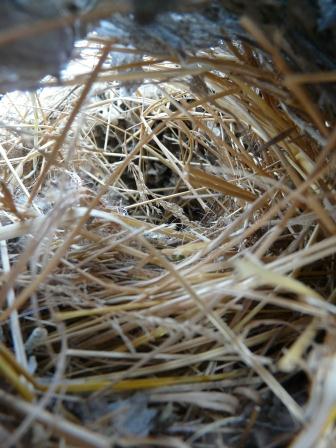
The nest was built against a wall, so it has no backing. Now that the nest is down we can easily see inside: another nest! House sparrows had climbed into the old insect nest, added some bedding of their own, then set up shop to breed.

bald faced hornet nest inside

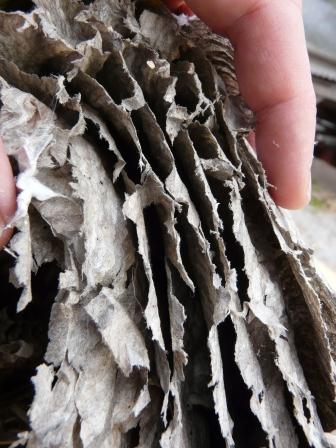
This was a stroke of avian genius. No chipmunk or squirrel would be stupid enough to try to raid this nest. (In the tropics, some birds take this further, protecting themselves from raiding monkeys by nesting next to active wasp nests.) The nest also comes with its own insulation system. The hornets build multiple layers of cellulose around the core of their nest, allowing them to stay warm through the night and thereby start work earlier than most insects (see The Thermal Warriors by Bernd Heinrich for more on the the various ways that insects manipulate their thermal environments). The incubating mother bird no doubt benefited from the extra warmth.

bald faced hornet nest wall

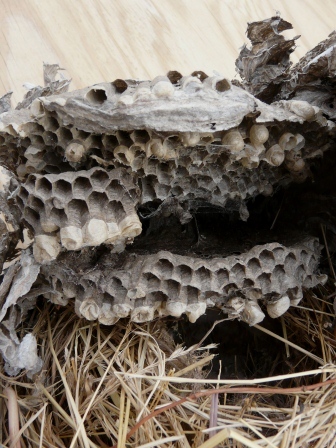
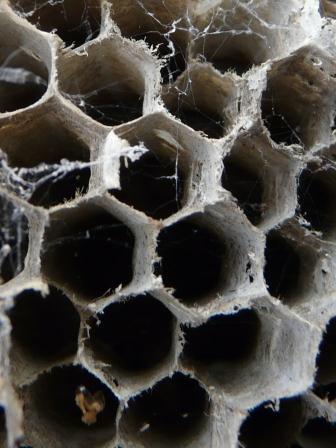
The nest retained its old comb, revealing the hornets’ kinship with bees. Here are the hexagonal arrays again, but this time built from chewed wood, not wax.

bald faced hornet nest comb

bald faced hornet nest comb close

Entomological enthusiasts should note that although we call these insects “hornets,” they are more accurately called “wasps” or “yellowjacket wasps.” True hornets belong to the genus Vespa and have bulkier heads and abdomens than the more slender “yellowjacket” species (Dolichovespula and Vespula).

I’ll close with my thanks to Sandy for bringing this remarkable nest-in-a-nest to my attention.

Wrestling with privet on Bluebell Island

Sharp blades and muscles: These are the lab tools used lately by my class. We’ve been mapping and eradicating privet from Bluebell Island, a local hotspot for wildflowers. Privet is a non-native invader and it overshadows and kills native plants.

Setting up the mapping transect.

Setting up the mapping transect.

The View from Lazy Point used as a field clipboard. The class  combines field work with discussions of readings, so hardback books find multiple uses. I hope Carl Safina would approve.

The View from Lazy Point used as a field clipboard. The class combines field work with discussions of readings, so hardback books find multiple uses. I hope Carl Safina would approve of the students’ improvised use of his fabulous book.

This project started in 2001 when my Ecology class measured and mapped every privet stem on the east side of the island where the flower populations are concentrated. I repeated the project in 2007 with my Seminar in Ecology and Biodiversity, then this year with the Advanced Ecology and Biodiversity class.

We uproot the privet plants...

We uproot the privet plants. Easy to do when they are small…

...not so easy when they are big. Katie pulled this one by hand. All that work on the swim team has paid off.

…not so easy when they are big. Katie pulled this one by hand. All that work on the swim team has paid off. No need to pull out the saw.

We’re building an interesting dataset. There are not too many places where we have long-term data on the details of how invasive plants respond to attempts at control. Along with this scientific goal, we’re hoping to leave the island in much better shape for wildflowers.

What have we found? At first glance, the project seems to be failing spectacularly. There are many, many more privet plants within the project area now than there were in 2001.
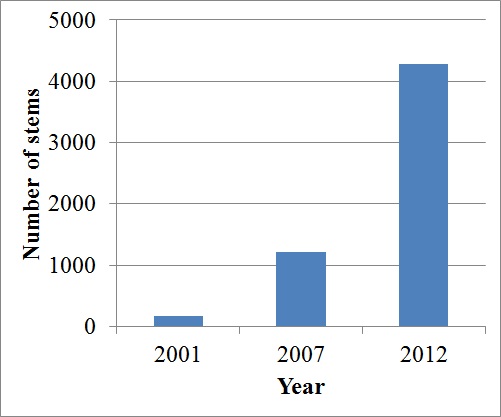
Total number of privet stems increased over time.

Total number of privet stems increased over time.

But this graph does not capture the whole story. The vast majority of the stems in 2012 are tiny little sprouts, reaching to knee-height. In 2001, the stems reached over our heads and were casting dense shade.
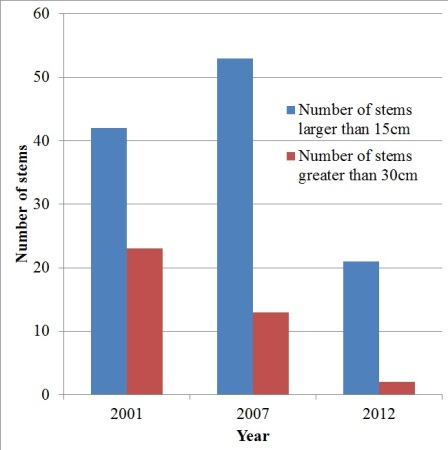
The number of large plants has decreased over time.

The number of large plants (>15 or 30 mm in diameter) has decreased over time.

The average (mean) size of stems decreased over time. The graph also shows that the variability in stem diameter (standard error of the mean) also decreased over time.

The average (mean) size of stems decreased over time. The graph also shows that the variability in stem diameter (standard error of the mean) also decreased over time.

So we’ve lost big plants and gained lots of little seedlings. It seems that the removal of large privet plants allows light to reach the ground which encourages both wildflowers and new privet plants. Long term success will depend on continued visits to the island to stop new privet sprouts from getting too big. The rest of the island, outside the study area, serves as an interesting contrast. It is overrun with large privet plants and the wildflower populations are dying out. Eradication of privet over the whole island would be a more major undertaking than could be accomplished by one class, even with many days’ work. Fire and goats might help.

Tyler Johnson prepared this map of the location of every privet stem (2007 data) in Dr. Chris Van De Ven's GIS class. We'll be expanding the mapping analysis in coming months to include all three sapling periods, examining whether the spatial distribution of privet has shifted over time.

Tyler Johnson prepared this map of the location of every privet stem (2007 data) in Dr. Chris Van De Ven’s GIS class. We’ll be expanding the mapping analysis in coming months to include all three sampling periods, examining whether the spatial distribution of privet has shifted over time.

Bluebell Island is owned by the South Cumberland Regional Land Trust and was bought with contributions from naturalists in Sewanee and beyond. It hosts dense populations of bluebells, trout lilies (including white trout lily), and even the rare dwarf trillium. I’m grateful to the SCRLT board for their continued support for this work, a project that started when I served on the board but has now extended for more years than I at first imagined.

Privet is not the only threat to the island’s famous wildflower display. Gill-over-the-ground is another non-native plant species that has made inroads on the island, as has exotic honeysuckle. In addition, poachers have dug significant numbers of plants over the years. About ten years ago they hit the island so hard that many parts looked as if they had been rototilled. The bluebells gradually regrew. This year, the trespassers hit again, digging large patches. I’m pretty sure that one of these patches encompasses the only known plant of the dwarf trillium in this part of Tennessee, so this rare species may now be extirpated from the island. The poachers are targeting bluebells, but the tiny trillium plant got taken as collateral damage. I may be wrong – we’ll know in the spring – but the digging crosses the exact spot where the plant lives. So if you’re tempted by the pretty bluebells for sale at the nursery, I’d advise you to skip them unless the seller can prove to you that they were nursery-propagated.

Despite the pressures, Bluebell Island is still a marvelous place. In addition to the flowers, old trees provide great habitat for woodpeckers, owls, and wood ducks. Beavers and mink swim the river. Migrant birds ply the riverbanks in the spring. Butterflies are abundant in summer. The river itself is different on every visit. It runs clear and calm in winter dry spells; swells silty and trashy in the floods; then courses bluegreen in the warm algal summer months. Suwannee is a river, but Sewanee is not; so I enjoy my visits off “the mountain” to see some real flow.

Beavers came around after us and snacked on the discarded privet stems.

Beavers came around after us and snacked on the discarded privet stems.

I’m grateful to the many cohorts of Sewanee students who have yanked, sawed, tweaked, measured, mapped, and analyzed these thousands of privet stems.
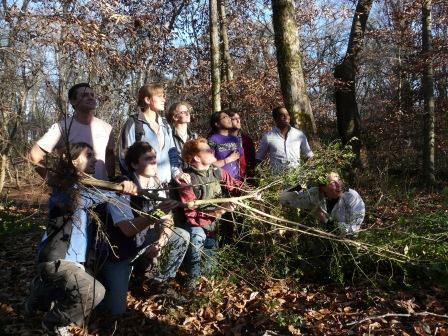
Sewanee's Bio 315 class in "gaze at the sun as if something inspiring and important was happening" pose after pulling 4275 privet stems. The largest vanquished stem is held as a trophy. We omitted the blooding ceremony.

Sewanee’s Bio 315 class in “gaze at the sun as if something inspiring and important were happening” pose after pulling 4275 privet stems. The largest vanquished stem is held as a trophy. We omitted the blooding ceremony.

Bee comb

This week I took advantage of what may be the last warm, sunny days of the season to tidy up the bee hives for winter. I removed unneeded boxes of frames from the tops of the hives and shuffled frames within the boxes to keep as much honey in the hive as possible. Thus prepared, winter hives are less likely to blow over in storms and, more important, all the honey is gathered into one place within the hive. In cold winters, bees huddle in a ball around their honey stores, slowly eating the honey as fuel to keep them warm (the center of the hive is as warm as human body temperature). If honey is thinly dispersed, the balmy bee ball cannot form.

I had forgotten just how beautiful the wax combs of honeybees are. The near-perfect six-sided geometry, repeated hundreds of times is a fabulous piece of natural architecture.

This slideshow requires JavaScript.

The wax is secreted from chinks in the abdominal exoskeleton of worker bees. The bees then mold the wax into the six-sided pattern using chewed wax particles. This task falls to middle-aged (2-3 week old bees) worker bees. Younger workers look after the brood; older workers leave the hive and forage.

This weekend marks the 153rd anniversary of the publication of On The Origin of Species. It is therefore fitting to include here Mr. Darwin’s thoughts on the wonders of beeswax.

He must be a dull man who can examine the exquisite structure of a comb, so beautifully adapted to its end, without enthusiastic admiration. We hear from mathematicians that bees have practically solved a recondite problem, and have made their cells of the proper shape to hold the greatest possible amount of honey, with the least possible consumption of precious wax in their construction. It has been remarked that a skilful workman, with fitting tools and measures, would find it very difficult to make cells of wax of the true form, though this is perfectly effected by a crowd of bees working in a dark hive. Grant whatever instincts you please, and it seems at first quite inconceivable how they can make all the necessary angles and planes, or even perceive when they are correctly made. But the difficulty is not nearly so great as it at first appears: all this beautiful work can be shown, I think, to follow from a few very simple instincts. (First edition, Chapter VII, page 224).

He elaborated these thoughts with a series of calculations and experiments, summarized in a recent essay at the Darwin Correspondence Project. As you might expect, Darwin concluded that natural mechanisms could explain the structure of bee comb and that sophisticated combs could have evolved from simple beginnings.

This naturalistic view contrasts with the opinions of Darwin’s contemporaries. After reading Darwin’s passage, I pulled down Langstroth’s Hive and the Honey-bee, an important review of bee biology and bee-keeping published in 1859 (the 4th edition, 1878, is the one that I have on hand; post-Darwinian for sure, although Darwin is not mentioned). Langstroth writes of comb:

To an intelligent and candid mind, the smallest piece of honey-comb is a perfect demonstration that there is a “GREAT FIRST CAUSE.”

These enraptured references to the Divine are peppered throughout his work.

Langstroth was a priest, but depression kept him from many of the usual priestly duties. Instead, he studied insects, especially honey bees. Although his theology seems unsophisticated to modern ears, his entomology was not. His careful studies of bee behavior transformed bee-keeping. In particular, these studies led to him a new design of bee hive, a design that is still the preferred hive for most bee-keepers, especially in North America. Unless you’re eating honey from wild nests, you can almost guarantee that the honey in your kitchen came from a Langstroth hive. I use a modified design: Langstroth in the upper portion (from which come the photos in this post) and open in the lower part (no photos — I never open this part, leaving it for the bees to do as they will).

Winter birds

This afternoon, I heard the querulous call of my first yellow-bellied sapsucker of the season. This migratory woodpecker breeds in mixed coniferous woodlands in the northern forests, then winters in the southern U. S. and in Mexico. Unlike their woodpecker cousins, sapsuckers prefer to feed on live trees. They take a delicate approach to drilling, making horizontal lines of holes from which they drink sap and eat sap-tippling insects. With the sapsucker’s arrival, Sewanee’s woodpecker count is up to seven species. The others are: pileated, hairy, downy, red-bellied, red-headed, and northern flicker. (The endangered red-cockaded woopecker used to breed in Savage Gulf, just north of here, but has been extirpated from Tennessee for more than thirty years.)

So far, this has been a good year for sightings of winter birds. Pine siskins have been quite abundant and I saw a pair of red-breasted nuthatches in early October. In some winters both these species are rare or absent. All this good birding for southerners results from hard times for the birds up north. When pine and hardwood seed crops are poor in Canada and the Northeast, birds are driven south by hunger.

According to Ron Pittaway of the Ontario Field Ornithologists, this will be a bad year for northern seed crops. His “bird forecast” focuses on Ontario, but what happens up north will be reflected in bird life across the country.

Humans add an interesting overlay to this natural year-to-year variation in food supply. As I note in The Forest Unseen, our love of birds results in the transport of millions of tons of sunflower seeds from the former prairies into bird feeders all over the country. This makes life easier for many birds, causing some of them to expand their winter ranges northward. Bird-hunting hawks therefore also linger in the northern woods. Our bribes have shifted the calculus of migration.

We know surprisingly little about how feeders affect the day-to-day behavior and ecology of birds. New technology, deployed (appropriately enough) at Sapsucker Woods where the Cornell Lab of Ornithology is located, is starting to shed some light into these questions. Least we humans feel left out, the same technology is being used to study our own “day-to-day behavior and ecology” and, like the birds, as long as the sunflower seeds keep coming, we’re happy to play along.

Stream bows

I came across some unexpected sights on my morning walk in Shakerag Hollow. Water was snaking its way through the tangle of rocks and leaf piles that form the boundaries of the little streams on the mountain slope. As the water flowed, the barriers in its way created little falls which emptied into eddies in pools below. All this tumbling motion stirred up air bubbles that turned in slow circles on surface of the pools.

I watched this gentle gyration for some time before my eye caught what was happening below. The bubbles acted as lenses, refracting the sunlight that was coming in at a low angle through the trees. The streambed was covered in underwater stars, each one gliding behind a bubble.

As the light angled through the bubbles, its constituent wavelengths were teased out. Seen close, the stars were edged with prismatic color. Rain can bow the light, even when the rain is old and earth-bound (or, if we look forward, so young that it has not yet risen to the sky). Bubbles were not the only objects drifting on the water’s surface. Leaves and the shells of hickory nuts floated past.

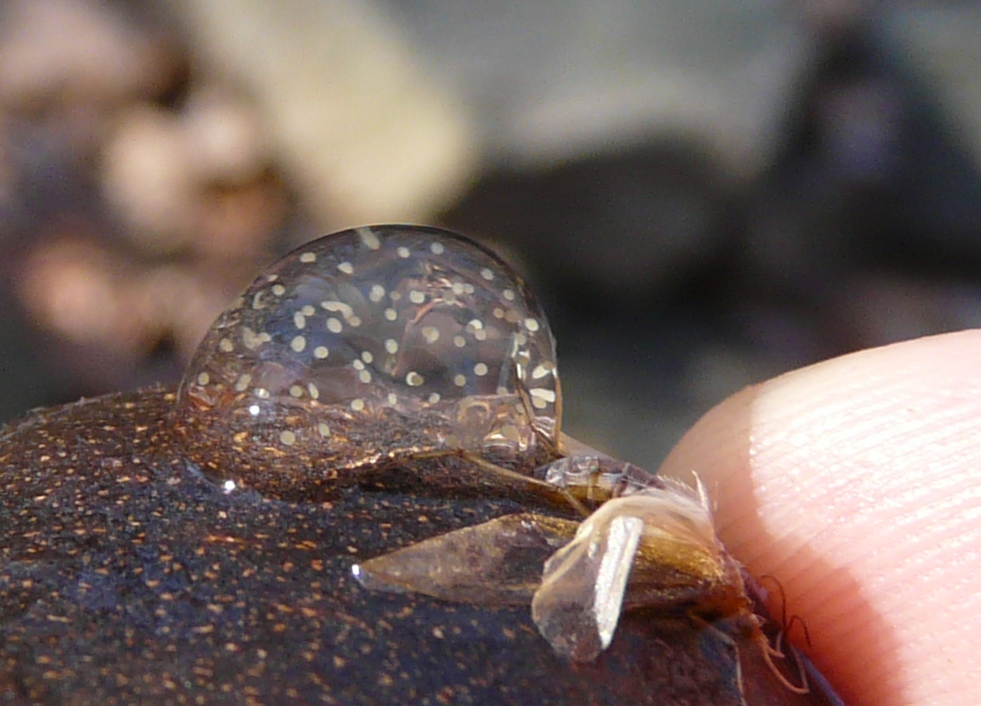
One such hickory shell had some passengers, a dying caddisfly and a cluster of minute eggs encased within a blob of jelly.

I’m guessing that the eggs were deposited by an aquatic snail. (I’d be happy to be corrected or further enlightened about this guess —  I have found no adult snails in this stream which makes me suspect that I’m mistaken. Addendum: these are caddisfly eggs. Thank you David Johnson and Dave McLain for clarifing.) The caddisfly probably flew here from downstream to lay eggs in the water. The adults of many stream insects have an instinct to move upstream when they are ready to breed, counteracting the inevitable downstream flow of aquatic larvae and nymphs.

I took particular pleasure in seeing these two rafters. This is the stream that a few months ago was choked with silt from erosion on the golf course construction site. I took the eggs and the recolonizing caddisfly as signs that, although the stream is still severely impacted by sediment, some aquatic animals have persisted here and others are returning. Soon, I hope, young caddisflies and snails will join the bubbles and stars swimming and crawling in the stream’s waters.