Literary protest, Jan 15th.

On MKL Day, January 15th, I’ll be joining other writers at a literary protest and march. PEN America and Writers Resist are co-organizing these events in response to threats to the press and to free expression under the Trump presidency.

The literary protest is on the steps of the New York Public Library. It will include readings of “inaugural” poems by American poet laureates Robert Pinsky and Rita Dove. The march will deliver a petition in support of press freedoms to the Trump transition team.

Please consider joining all living US Poets Laureate and over 150,000 others by signing the petition in defense of freedom of expression and a free press. If you’ll be in New York on the 15th, you can register to attend the literary protest and march here (or show up on the day, 2 p.m. on the steps of the New York Public Library’s Schwarzman Building at 42nd St.). Seventy five other Writers Resist events are happening across the country on the same day, listed here.

PEN America’s overview of the protest and summary of programs describe the many ways that the organization helps defend press freedoms in the US and abroad.


Some good news about land conservation from the Southern Cumberlands

From the Open Space Institute:

“In a series of six targeted land conservation projects completed within a short six-month period, nearly 13,000 acres have been acquired and added to Tennessee state parks and wildlife management areas.”

These lands add to the 17,000 acres already protected by OSI in the last few years in this region. The grants that made possible these projects aim to protect biodiversity in a changing climate. The conservation lands will also provide public access to open space and encourage sustainable forest management.

Partners in these projects included The Nature Conservancy, The Conservation Fund, The Land Trust for Tennessee, and the State of Tennessee (TN Wildlife Resources Agency and TN Dept Environment and Conservation).

Read the full press release here.


Tree guards of New York: story fragments.

The rails, gratings, and fences that enclose the trunks of New York’s street trees are signifiers and indicia. Some of the nature of the human community is revealed in these constructions. A sampling of this diversity follows, photos mostly from Brooklyn, a few from Manhattan. Each is a sculpture — sometimes self-consciously so, sometimes without such intention — or a fragment of narrative captured in concrete, metal, wood, and soil. I’ve photographed these tree surrounds in many seasons. Those that follow are from late December, 2016.

(Click on any of these images to see them in slideshow format:)


Post-truth chestnuts?

After editorial discussions that were “a bit more serious and somber …[than] in some other years,” Oxford Dictionaries has named “post-truth” as its international word of 2016. But of course we’re not “post” any truths, especially not the truths of biology and physics that don’t bend in the foul winds of demagogues.

Nor in the errors of bloggers like me. Some taxonomic truths have come to light about the not-so-somber matter of tree identification. So, with many thanks, I share my colleague Dr. Hill Craddock’s take on the “chestnuts” from my last post.

He writes that the plants in the “photo could be in the genus Castanea, with the true chestnuts…but I think they may really be fruits of trees in the genus CastanopsisCastanopsis is a large genus (more than 100 species) of Asian trees closely related to, and very much resembling Castanea.  Some species share characteristics of Quercus [oaks] and Lithocarpus [“stone oaks”].”

So, the chestnuts from China (see additional photo below) are in fact close relatives of chestnuts, sometimes called “chinkapin”. These trees are evergreen and generally not frost-hardy.

Dr. Craddock continues with “a curiosity:  ‘Shii’ is the Japanese name for Castanopsis.  Shiitake (Lentinula edodes) are grown traditionally on Castanopsis cuspidata in Japan, although in the US, they are mostly grown on oaks, or other hardwoods. Shiitake literally means ‘Castanopsis mushroom.'” So, next time you are eating some US-grown shiitake mushrooms, consider their genus-crossing journey. I’d be interested to know whether the different tree substrates result in different experiences on the palate. Does oak-grown shiitake taste the same as Castanopsis shiitake? I know that local shiitake growers here in Tennessee claim a much richer flavor for shiitake grown on solid logs rather than sawdust bricks. Perhaps the species of wood also makes a difference?

I send many thanks to Hill Craddock for taking the time to share his knowledge and to Todd Crabtree for making the inquiry that led to our exchange.

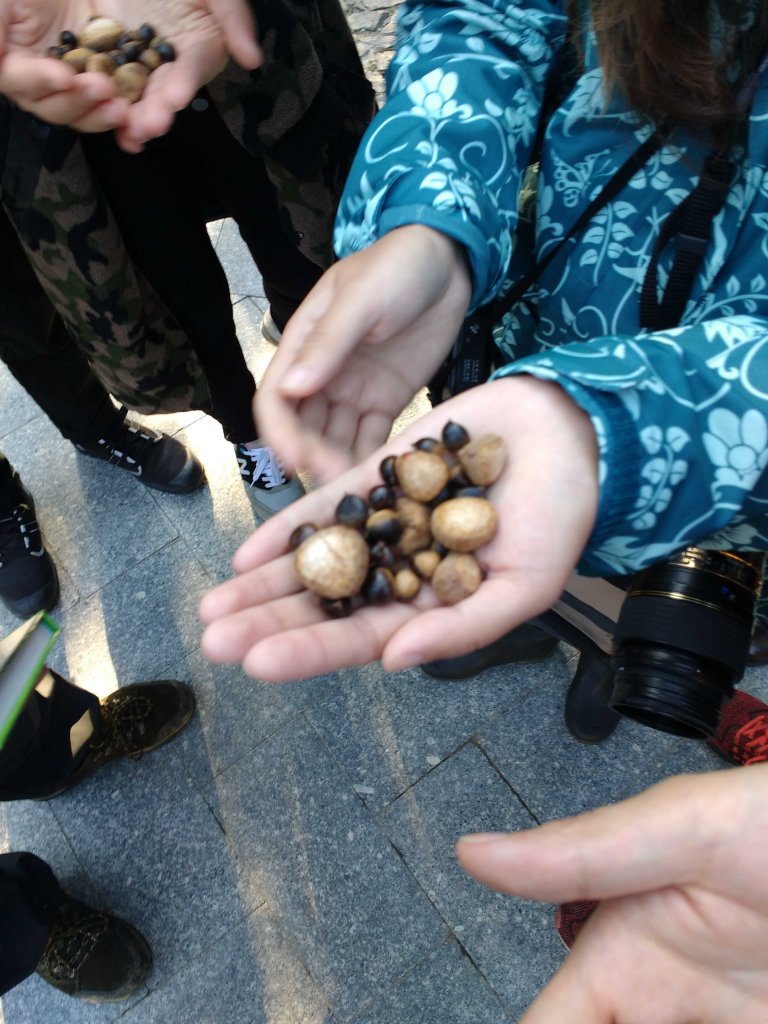
Truthiness in nuts. Castanopsis.

Truthiness in nuts. Castanopsis in southern China.

Glimpses of botanical and avian diversity at Nan Kun Shan Forest Park and Crosswaters Ecolodge

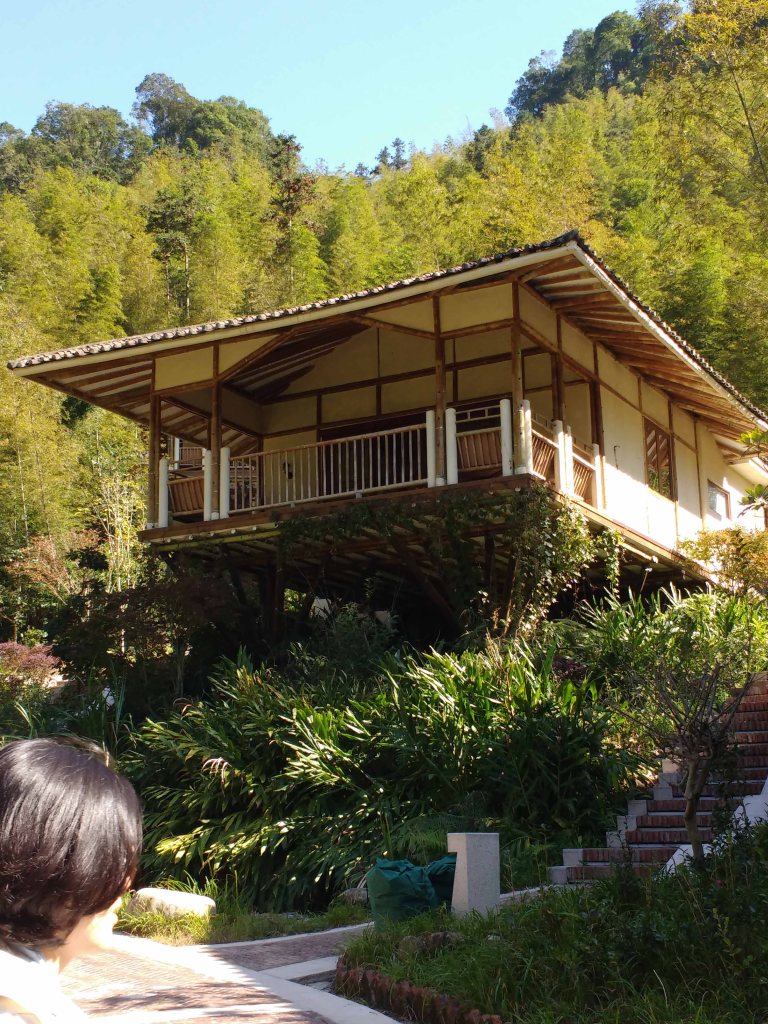
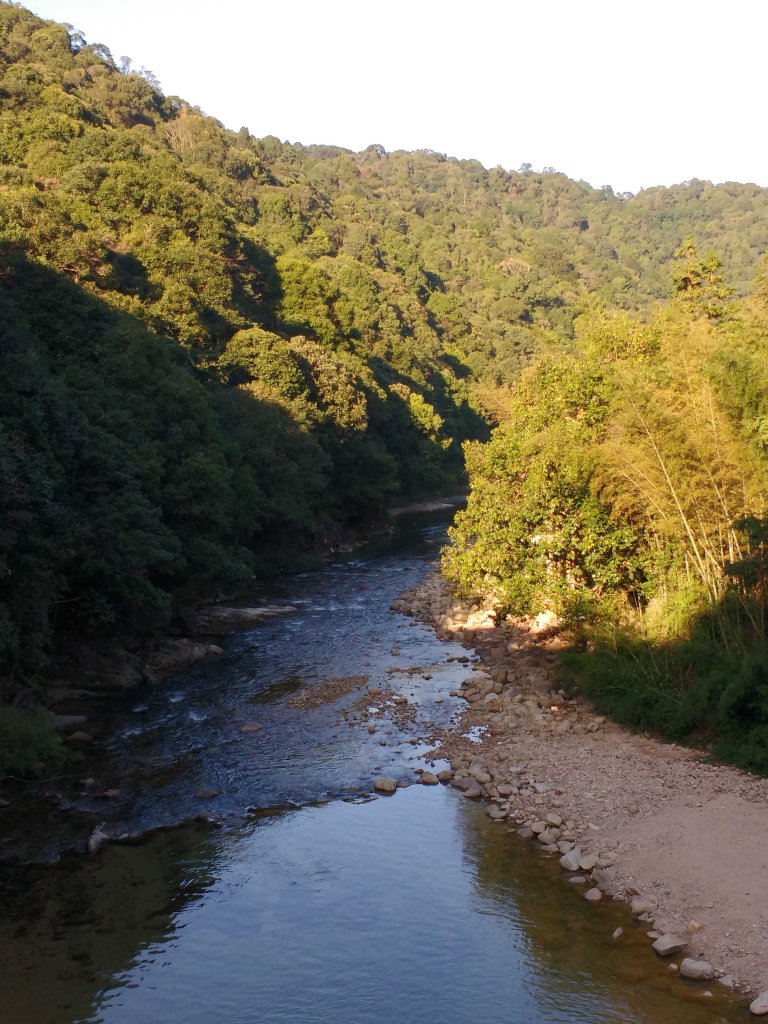
Our Chinese hosts kindly arranged a short visit to the forests Nan Kun Shan Forest Park. Driving inland from Shenzhen we first passed around the mega-city of Guangzhou — one of China’s tech hubs (the e-device that you are now reading with likely came from there) — which sits amid the anastomosing branches of many large rivers. From these urban flooplains we  passed into low hills, mostly managed for timber and fruit production, then to the steep-flanked mountains. In the mountains, protected forest parks are interspersed with vacation resorts and small villages. One of China’s first ecotourism projects is located here, the Crosswaters Ecolodge. The American Society of Landscape Architects gave Crosswaters an “Honor Award,” writing that it is, “tremendously inspiring to see a project in China that is designed as a celebration of its natural and cultural place. Impressive and extraordinary resourcefulness in salvaged and native materials make a more elegant and beautiful environment. For projects in this region it stands out for using found and salvaged local materials.” Guests stay in rooms and cabins made from locally-harvested bamboo, built in riverside forest clearings:

crosswaters3

The plant life in this region is an interesting mix of subtropical and temperate species. Here, bamboo grows alongside banana and oaks. Callicarpa bodinieri (or perhaps japonica), Asian relative of American beautyberry, is common in the understory.

Botanical confluence: subtropics meets the temperate zone.

Botanical confluence: subtropics meets the temperate zone.

A familiar face. Smaller, denser fruit clusters than the American species.

A familiar face. Smaller, denser fruit clusters than the American species.

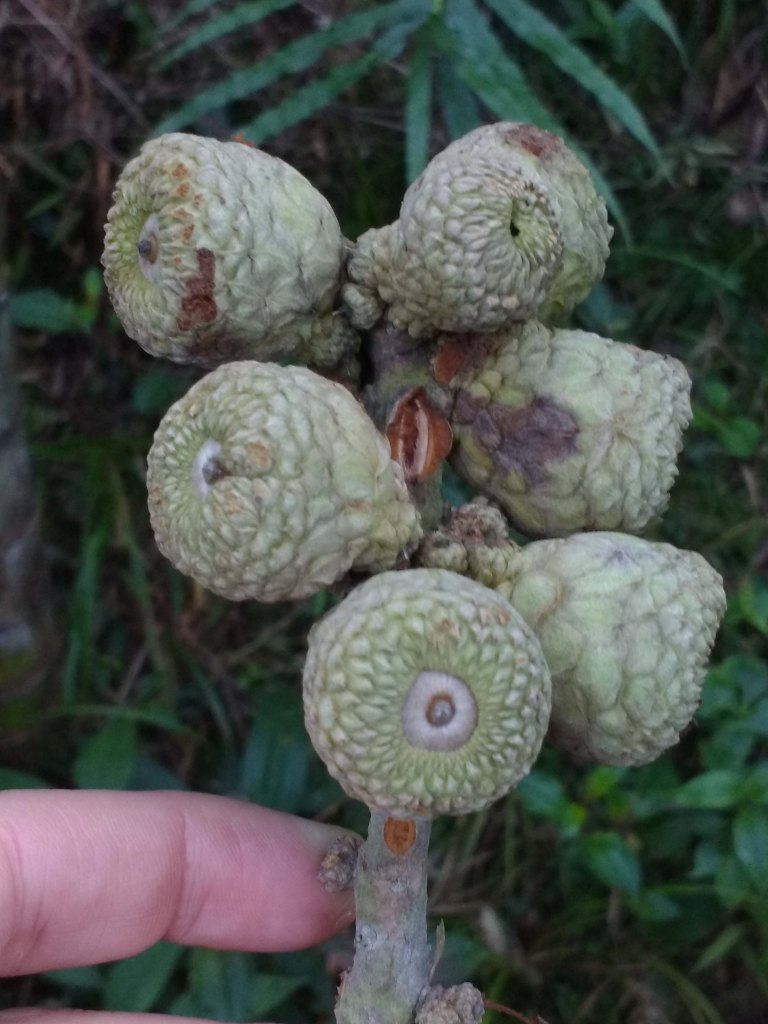
quercusquery

This oak or oak relative grows on the slopes that had not been converted to bamboo groves. I’m working on finding species/generic names…suggestions are very welcome!

quercusquery2

Two different species of Castanea (relative of the American chestnut) grew on the slopes above the river:

chinese-chestnut

Two sizes of chestnut. Neither looked or tasted like Castanea mollissima, the Chinese chestnut grown in cultivation in the US. Four other species of Castanea grow in south Asia.

Birds in this region are also spectacular:

Red-billed blue magpie. Photo by Charles Lam, Hong Kong. Creative Commons copyright 2.0.

Red-billed blue magpie, distant relative of crows and blue jays. Photo by Charles Lam, Hong Kong. Creative Commons copyright 2.0.

Black-throated tit. Relative of chickadees. Photo by Prateik Kulkarni. Creative Commons copyright 4.0.

Black-throated tit. Relative of chickadees. Photo by Prateik Kulkarni. Creative Commons copyright 4.0.

Plumbeous water redstart. These birds cling to rocks in streams, then fly up over the water to snatch insects from the air. Member of the Old World flyctacher family. Photo by Ron Knight, Creative Commons copyright 2.0.

Plumbeous water redstart. These birds cling to rocks in streams, then fly up over the water to snatch insects from the air. Member of the Old World flycatcher family. Photo by Ron Knight, Creative Commons copyright 2.0.

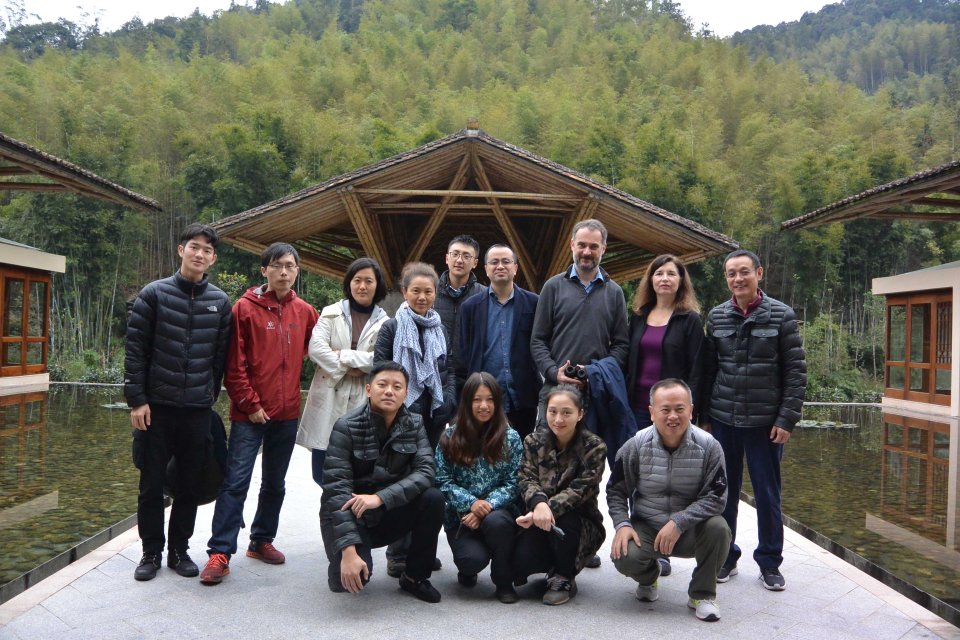
Our hosts were, as everywhere in China, extraordinarily welcoming. Part of our group, standing in front of the bamboo bridge at Crosswaters:

crosswaters2

View of the forest from an observation tower at Crosswaters:

crosswaters


Dapeng Nature Book Award

Words from The Forest Unseen have loosed their tie to the English language and traveled abroad, now in nine languages. The book has been particularly well received in China, news that until last month came to me indirectly through my editors and agents. In early November, though, I received an email inviting me to China to receive a literary award. The Dapeng Nature Book Award is China’s first prize for books about the natural world. The Forest Unseen won the “international” category and last week Katie and I traveled to Shenzhen to join Chinese award winners and their colleagues in environmental and science writing, children’s literature, and translation.

The edition of my book in China (看不见的森林, The Commercial Press, Hong Kong) was edited by Yu Jiehong, translated by Xiong Jiao, and illustrated by Nian Gao. A Taiwanese edition in traditional characters (森林祕境, Cite Publishing, Taiwan) was translated by Xiao Baosen. That my words would have worth in Chinese is due to my colleagues’ great skill and linguistic artistry.

The Dapeng awards are part of the city of Shenzhen’s month-long celebration of the written word. Shenzhen is an international hub for technology and has grown from a rural outpost to a city of twenty million people in just thirty years. As the city has grown it has kept half of its land area for parks and natural areas. The city also is home to a large public library, high-tech book lending machines (photo below), and the world’s largest bookstores. This convergence of commitment to nature and to literature makes the city the ideal location for a celebration of the Chinese tradition of nature writing. Few other cultures have poetic and philosophical traditions that are so profoundly ecological. The cultural and political upheavals of the last 150 years in China have at times broken or frayed the continuity of these traditions, but these connections are now being remade and expanded.

It was a great honor to have my work recognized and to meet editors, writers, and ecologists working in China. I offer special thanks to Nan Zhaoxu, Yan Ying, and Zhang Jinkai for their generous welcome and hospitality, and to Zhang Boran for his amazing work as translator.

With some of our hosts and colleagues, at OCT wetlands nature center in Shenzhen.

With some of our hosts and colleagues, at OCT wetlands nature center in Shenzhen.

Part of the skyline of Shenzhen, seen through mangroves on the bay that separates the city from Hong Kong.

Part of the skyline of Shenzhen, seen through mangroves on the bay that separates the city from Hong Kong.

Book “lending machine” from Shenzhen public library. These are available throughout the city.

Shenzhen from the 18th floor of a hotel, looking across apartment complexes towards the administartive center. Skyscrapers line the central zone, inlcuding the Ping An Finance Centre, fourth tallest building in the world. Just visible is the 150 hectare Lianhuashan Park at the north end. To the northeast, behind the skyscrapers lies 15,000 acres of Tang Lang Hill Country Park.

Shenzhen from the 18th floor of a hotel, looking across apartment complexes towards the administrative center. Skyscrapers line the central zone, including the Ping An Finance Centre, fourth tallest building in the world. Just visible in the distance beyond the central convention and civic centers is the 370 acre Lianhuashan Park. To the northeast, behind the skyscrapers, lies 15,000 acres of forest and walkways in Tang Lang Hill Country Park.

Wood crackle

The forest is full of strange and expected voices these days…

Here’s one, from a week or so ago. It was a dry day, following two months of record-breaking dry days. The sun was barely down. From the edge of a suburban woodlot, ear-sparkles came from the treetops, like the fizz and pop of a small pine-wood fire or the crackle of water droplets in hot bacon grease.


We walked into the woods with flashlights to find the source of the sound. An intermittent rain of velvety seed pods greeted us, the popped remnants of wisteria fruits. In the dry air they were all dehiscing at once, flicking seeds away from the mother plant in tiny explosive releases.

These are large vines, reaching all the way to the forest canopy. They’ve topped some trees, smothering them. Their vines muscle and squeeze. The seeds are loaded with toxins, so next year will see more colonists tendril-climbing the forest scaffold.

img_20161110_163312566

“More than 100 college presidents issue joint letter to President-elect Donald Trump”

This news from the University of the South’s website:

“Vice-Chancellor John McCardell is one of 110 college and university presidents urging Donald Trump to take a more forceful stand against “harassment, hate and acts of violence.” The campus leaders have issued a joint letter to President-elect Trump.” Read the full article here.

Thank you, Vice-Chancellor and President McCardell, for taking this stand and asking president-elect Trump to make good on his promise to be a president for “all Americans.”

Senator Corker tells me: “If you don’t like it, leave”

Who should come walking the other way down the trail over the weekend but our very own GOP senator, Bob Corker? I greeted him then told him how deeply ashamed I was to be from a state where our senator will not denounce Trump for boasting of sexual assault. Corker has been silent on this matter and on the racism and hate that the T-monster has spewed into our country these last months (judge for yourself: see addenda below for links to his statements). I told him that as a Tennessean I was deeply ashamed of his silence.

Corker’s response? “If you don’t like it, then you should leave the state.”

He then turned the conversation to attack me: “It’s people like you who won’t accept the results of the election who are deeply dividing this country.” “What have you ever done to contribute to this state?” Well, I did not say that I disputed the election, merely that I was ashamed of my senator. And my contributions? Modest, for sure, but irrelevant to the question: “Why have you not, Senator Corker, denounced Trumps’ boasts of sexual assault?” Or any other of Trump’s outrages?

He responded only with attacks on my character and complaints about the uncivil way that I was disrupting his restful Sunday walk “in nature.” Then he repeated his charge to me: “If you don’t like it, leave.”

No, Senator, if you don’t like your constituents using their First Amendment rights to express their deep dismay and disgust at your failure to take a stand against odious statements, then maybe you’re the one who needs to book the U-Haul van. Pack your bags and leave Washington. Take your silence in the face of Trump’s vile words back to your Chattanooga mansion and ponder why a group of hikers — immigrants, women, LGBTQ, and Latinos — would be so distraught to see your smirking countenance sauntering through the woods.

Yes, we are ashamed of you. No, we are not leaving.

Update 7 hours after original post:

I just got a call from a newspaper reporter who told me that Senator Corker’s office claims that I said I was ashamed to be from a state that voted for Trump. This is absolutely untrue. I said I was ashamed that Senator Corker had stood by Trump through all of Trump’s vile pronouncements. Ashamed of Corker: yes. I said nothing about the votes of my fellow Tennesseans. Corker’s also claimed that I was profane and aggressive. I’m afraid my profanity was no match for that of Mr Trump and I showed no aggression. Anger, for sure, but I stood at a respectful distance and listened to Corker. First Amendment speech is not aggression, it’s a right. Grabbing women, punishing them for abortions, egging on rallies toward violence: now that’s aggression.
Addenda added after post was first published:

Three witnesses can vouch what what Senator Corker said to me.

“Anonymous” comment in the comment section is coming from U.S. House of Representatives IP address 143.228.129.9. Evidently some in Washington think that it is OK to use government network addresses to make anonymous comments on blogs.

Nashville Scene coverage here. Chattanooga Times here. Tennessean here.

Corker’s official website (search for Trump”).  Refusal to withdraw endorsement here. Calls Trump’s foreign policy “very thoughtful.” Corker campaigns with Trump in NC. Comparison of Corker to other Republicans on Trump.