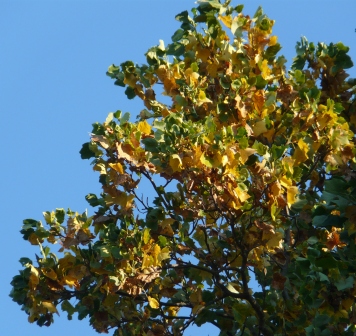
The golden leaves of Ginkgo trees are just spectacular this week.

I have a special fondness for this species: its kin date back to the Permian (>250 million years ago), so the Paleozoic lives on right here on our campus lawns. The Ginkgo is also remarkably robust and is able to live in even the most polluted cities. Ginkgo trees were among the few living creatures to survive the horrors of the atomic bombs that were dropped onto Japan. Survivors, indeed.
In addition, the species refuses to conform to our narrow notions of botanical beauty. It is dioecious (female and males are separate individuals) and female trees are currently scattering their extremely pungent seeds all over tidy lawns (the smell is butyric acid — rancid butter). The philosophical underpinning of a lawn denies the realities of biology: death and sex are nowhere in evidence on a “nice” lawn. The Ginkgo violates these standards with great flair. I can smell the trees from at least fifty meters away.
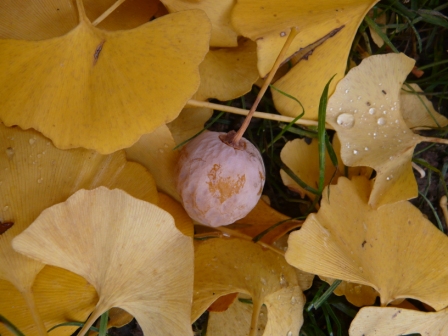 Squirrels can smell them too. When I took my Field Investigations class to see the Ginkgos, we counted ten gray squirrels under one tree, gathering the seeds. The squirrels were as fat as bear cubs. A great harvest. Humans also like the cleaned centers of the seeds, but be warned, the fleshy outer layer is highly allergenic to some people.
Ginkgos are gymnosperms, so they technically don’t make true “fruits.” The fleshy outer layer is actually just the soft husk of the seed, not formed from an ovary wall as with true fruits. (Botany, it turns out, is mostly about sexual organs, an obsession that got Linnaeus into trouble — a colleague reportedly called his focus on sexuality “loathsome harlotry.”)





 David George Haskell