Category Archives: Travels

Inching into the future

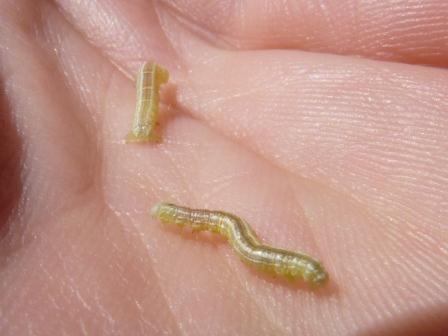
I’m visiting the University of Richmond where, just like Sewanee, spring is in full force and many weeks early. In addition to great people and beautiful buildings, the campus is populated by millions of inchworm caterpillars. Just walking between buildings results in the acquisition of half a dozen hitch-hikers, each one hanging by a silk thread from above, presumably drfiting down to new feeding areas or places to pupate. These caterpillars belong to the Geometrid moths, a family of brown moths named for the looping walking habit of the caterpillars — they appear to “measure, metron, the Earth,Geo,” as they walk along.

These seemingly insignificant creatures are one of the hinges on which our changing world swings.

The caterpillars come out when the oaks and other trees first unfurl their leaves. The young leaves have not yet had time to accumulate toxins to deter the inchworms, so the little caterpillars feast quickly, then their numbers dwindle.

Migrant birds time their arrival to catch the burst of caterpillars (food!). But, lately, the caterpillars are emerging so early that by the time the migrant birds arrive, the party is over. In Europe, this mistiming is so severe that it has caused significant population declines in some birds.

How or whether these dissonant changes in tempo will resolve is unclear.

The High Line

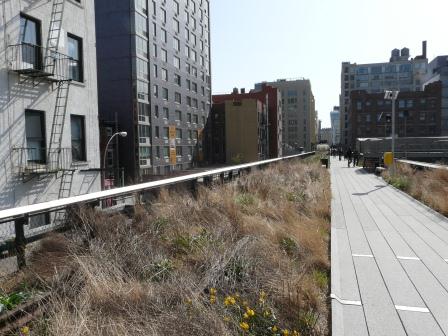
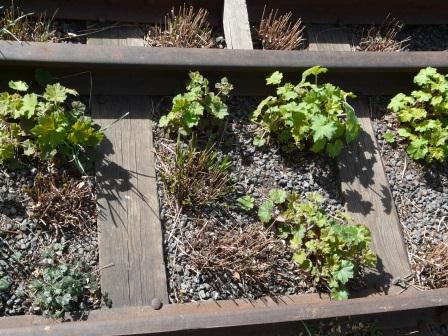
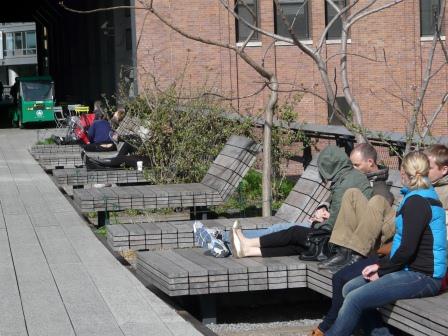
During my trip to New York, I made a visit to the High Line, surely one of the more interesting urban parks in the world. The park swings through West Chelsea and neighboring areas of the city, running along a disused elevated train line. The old tracks are still in place, forming the backdrop to varied plantings of native and ornamental plants. A wide walkway runs the length of the park, liberally scattered with benches and overlooks. I’d read about the park many times and was eager to visit.


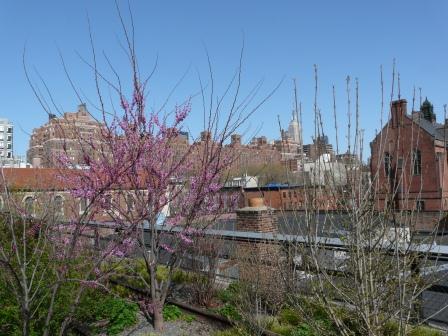
The elevation of the park gives a feeling of both separation (walking above the streets) and connection (seeing roofs and buildings up close). As a New Yorker friend told me, “now you know what it feels like to be a pigeon.”

Ornithological insight is not the only fruit of this remarkable project. What was a derelict and ugly piece of infrastructure has become a thing of beauty. The affinity that people feel for the park is reflected in the many nearby ads for real estate. The creators of the park have created desirable habitat for Homo sapiens, it seems.

The unspoken rules among walkers on the High Line are more congenial than those of the world below. This is a place where ambling is OK — a verb that gets trampled in the surrounding streets.

Puget Sound

After my talks in Seattle, Olympia, and Tacoma, I spent Saturday in Tacoma with my friend Peter Wimberger. We were in graduate school together back in the early 1990s and we have a shared affinity for natural history, helping our students see the world through the eyes of evolutionary biology, and eating salmon. He was kind enough to take me on a tour of some good bird-watching spots on Puget Sound.

A different world from the forests of Tennessee.

Douglas firs, western cedars, Pacific yews. Ever Green. Tree trunks thicker than any that have grown in most eastern forests for hundreds of years. There is no “ground,” no litter layer; instead, moss, moss, moss, as if a bryophyte blizzard had passed through, leaving drifts everywhere.

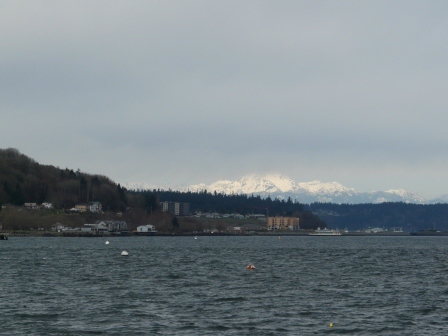
And on the water: murrelets, goldeneyes, harlequin ducks, scoters, loons, red-necked grebes. These are birds of cool rocky coasts, of Alaskan inlets, of moutain lakes, of streams running out from mountain glaciers. Look up from the water, and there are the snowy mountains rising behind wooded slopes and coast-hugging cities.

We conducted our bird-watching through binoculars and a scope, out of range of my modest, weak-lensed camera. But, a few ducks were bobbing close to shore. These Barrow’s goldeneyes were close to the dock. I’d never seen this species before. It is distinguished from its cousin, the common goldeneye, by the bright orange beak of the female and the crescent-shaped white patch on the male’s head. They winter on the coasts, but move inland to mountain lakes to breed, building nests in holes in dead trees. They feed by flipping their compact bodies forward and diving under the surface with a little splash. They swim down to grab mussels and other invertebrates from the rocky bottom. Their eyes are, indeed, golden — just visible in this photo.

Next stop, Newark, NJ…

Poultry Art installation

During my brief visit to Olympia, I stayed at Fertile Ground, a beautiful b&b right next to the public library where I gave my talk. Fertile Ground also serves as a hub for urban ag, art, and community building.

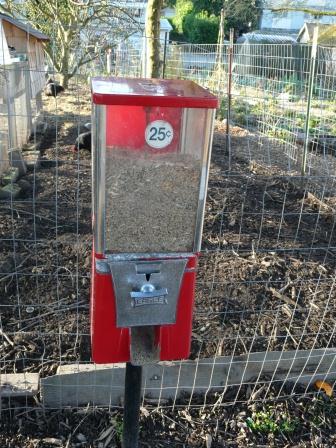
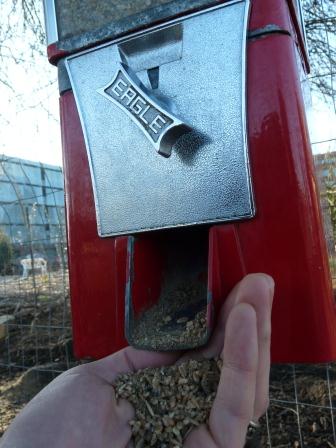
A small chicken pen sits next to the sidewalk, with hens scratching away within sight of the multistory office buildings and parking lots near downtown. The stroke of genius, though, is the chicken feed dispenser, right there on the sidewalk. Put in your quarter, turn the dial, and get a handful of feed to throw to the hens.

 There is something very rewarding about getting a handful of grain for your quarter, then tossing it to the hens (who know very well what is coming when someone approaches the dispenser). Like Vegas slot-machines, but the payoff is three hens in a row — winner!

I talked to Gail at Fertile Ground about this project of hers. Apparently, local kids love to put in their change and feed the birds. For me, this was the crowning achievement of the project: kids using quarters to get bird seed instead of sugary gumballs; kids playing Happy Birds (feathery real!) instead of Angry Birds (pixely fake!); and kids able to get a smile during their walk home.

Ocean

The Pike Place market in Seattle is piled high with seafood, especially seafood from the Pacific. The smell and the look of it make me mighty hungry, like a bear that needs to fatten up on the flesh of salmon. Part of the hunger is for the sea itself, I think. After all, we came from the sea and every cell in our bodies carries the salty water inside, an ionic memory of our ancestry.

So, do we, also, go well with butter and lemon?

Fishes are not the only ocean creatures on display. Invertebrates, especially my friends the molluscs, were also abundantly displayed, some pre-cooked (crabs), some just plain ol’ dead (squid, octopus), and others awaiting the future tucked into their shells (clams).

This slideshow requires JavaScript.

The abundance on display in the fish market belies the state of our oceans. The seas are thinner, diminished. Large predatory fish are down 80% compared to the days before industrial fishing. We take so much from the oceans that we’ve become an evolutionary force, changing the genetic code of fishes. Massive “by-catch” of seabirds threatens the survival of a large fraction of these species. The red snappers in the slideshow above are a good example — many of their populations are a disaster of bad management. These days, much “red snapper” in stores is actually some other species, mislabeled as snapper, thus hiding the truth from us hungry bears.

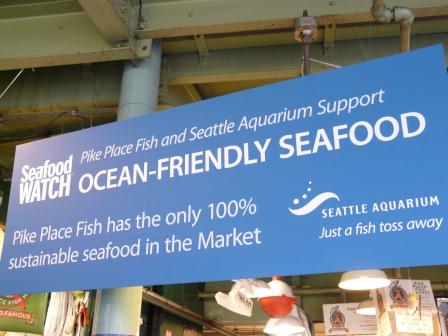
To be fair to the Pike Place folks, much of their seafood comes from Alaska, where fisheries are generally well-managed. And, more and more people care, leading to the following sign over one stall. Hope is the thing with feathers fins.

Down under

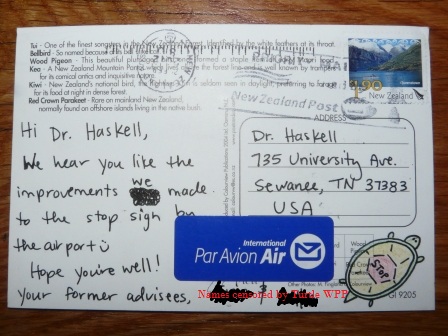
Several weeks ago I posted a short homage to the Sign Bandit of Jumpoff Road who had defaced public property with a turtle-honoring artwork. Today, I received a postcard that lifts the carapace on this mystery. Shortly after the Deed was Done, the honorable malfeasants entered the Turtle Witness Protection Program and were relocated south, far south.

Bandidas: you make me proud. If you ever sneak back into this country, a beer awaits you. In the meantime, go find a tuatara. Although New Zealand has no native turtles (a few marine ones visit the coasts), the tuatara more than makes up for it. These lizard-like critters have been lumbering along on their own branch of the evolutionary tree for 220 million years.

I made a drive-by check-in of the installation just to check on its status last night…still there.


Microsafari bycatch

Our search for the mini-creatures of the world also turned up some interesting macro-organisms. Spend a few hours in the woods with a bunch of biologists and you’ll see a good array of remarkable critters. Here is a selection.

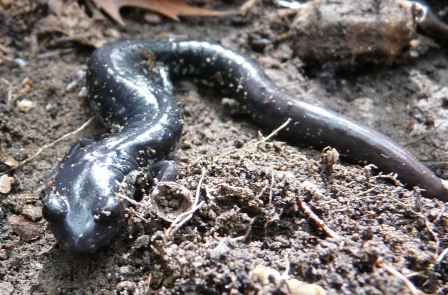
Zigzag salamander (Plethodon dorsalis/ventralis -- can't tell which without a DNA-o-tron), found under a limestone slab. This species is strongly associated with karst limestone, especially along streams and near springs. The females lay their eggs in caves and brood the eggs until they hatch. These are long, skinny salamanders, like pencils.

Slimy salamander (Plethodon glutinosus), also found under a rock. Black with silver spots: beautiful. When handled, they produce gluey defensive slime that gums up your fingers.

Admiring Plethodon glutinosus

...and slimy makes her escape

Box turtle (Terrapene carolina) shell. The colored plates are made from keratin, the same material as our hair and fingernails.

The same turtle shell seen from below. The animal’s spine is visible and, above that, the carapace which is made from fused ribs combined with dermal bone. So, evolution has flipped the ribs of turtles onto their backs and fused them into a solid plate.

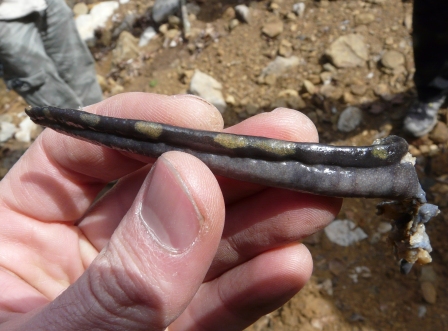
The tail of a spotted salamander...evidently a raccoon or some other predator ate well. We found spotted salamander eggs in a nearby pool, so life goes on, the torch has been passed, etc, etc ...fill in your own favorite death-surmounting cliche here...

Hepatica nobilis. Most Hepatica here are white or pale purple. This one was unashamedly ultra-purple. Yeah, the torch got passed to this one alright.

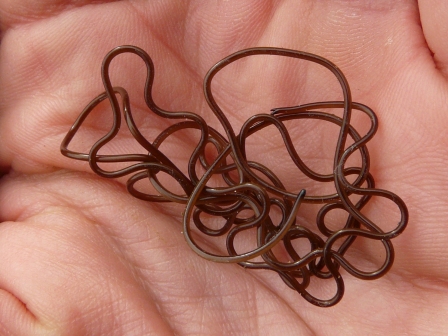
A nematomorph, also called a “horsehair worm.” These are parasites inside the bodies of insects. When the worm is ready to exit, it causes its host to jump suicidally into water, then the worm rips open the insect and emerges. These lovely critters feature in the first chapter of my book, The Forest Unseen -- nematomorphs surely embody one pole of nature’s range of cooperation and conflict.

Microsafari: Bear hunting

I spent much of Saturday on a trip organized by the Sewanee Herbarium, led by Paul Davison from the University of North Alabama. In addition to being a botanical expert, Paul is a master of finding the “wee beasties” (a phrase used by the pioneering microscopist Van Leeuwenhoek) that surround us: the micro-world of single-celled protists and tiny animals, all existing just beyond the limits of our vision. But, with some simple equipment and a hand lens or microscope, this world opens up for us. About 24 people came on the trip, a good mix of Sewanee biology students and faculty, along with community members.
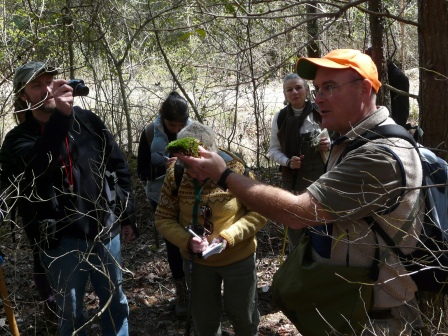
Paul Davsion discussing the "pin cushion" moss, Leucobryum.
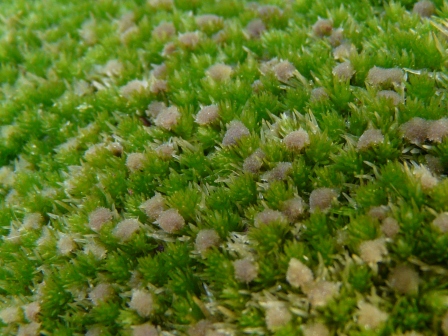
Curious structures growing in the Leucobryum moss: undescribed in the North American literature, apparently. Perhaps micro-male mosses growing within the larger female parts of the plant (the Archegonia, for lovers of botanico-jargon).
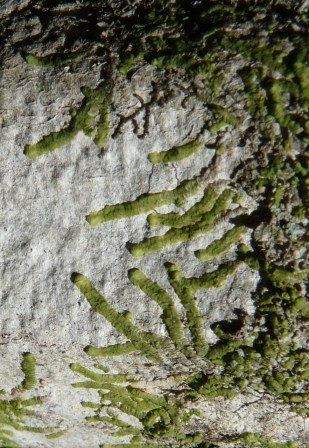
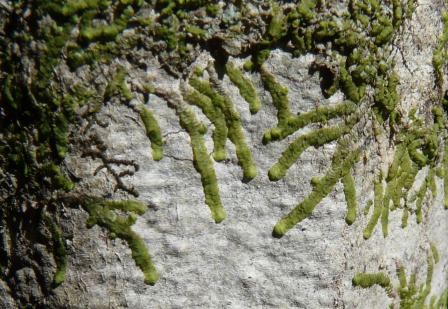
Leafy liverworts creeping across tree trunks.
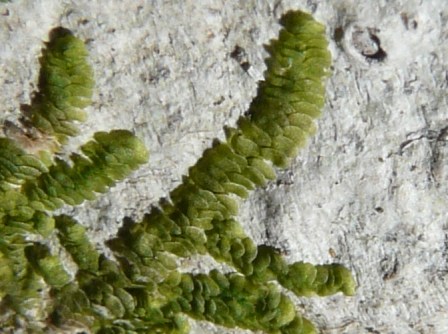
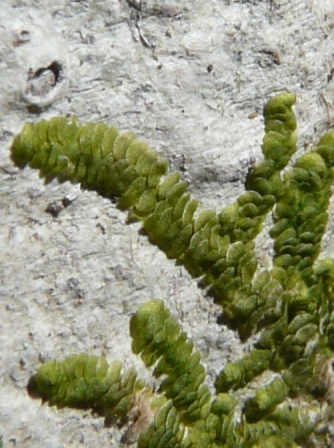
Seen close, the alternating scale-like flaps (not true leaves) of the liverwort are visible.

After a foray into Lost Cove, we returned to the lab to pull open the door to another world (amazingly, also the same world) by looking at critters under microscopes. We found legions of algal cells, whizzing crustacea, lumbering protists, and gliding flatworms.

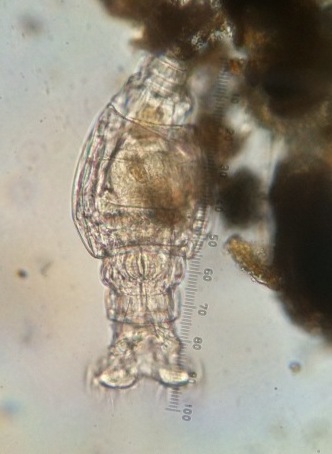
By holding my camera up to the microscope lens, I snapped a few shots of a couple of my favorites.
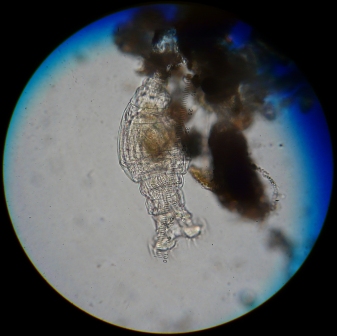
A rotifer, or "wheel animal". Its head is pointing down and its rear end is clasping some dead plant material (aka crud). the two Mickey Mouse ears are ciliated (cilia = hairs that stir the water) feeding devices, moving food into the mouth.
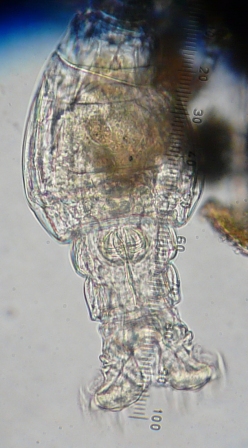
A close look at this shot shows the grinding pharynx that pulverizes food as it moves through the gut (look for the round structure to the left of the "60" mark).

Commercial break: go buy Apple products. Chris Waldrup sent me this photo that he took through the scope with his iPhone. Pretty darn good. Yes, I want one.
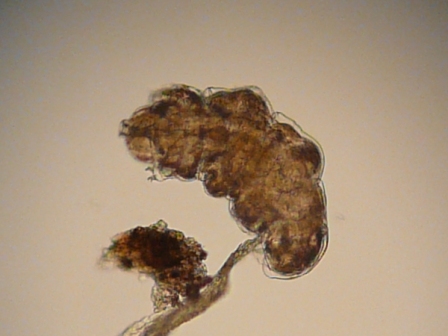
Now for the bear: this is a tardigrade, also called "waterbear" or "moss piglet" (with some crud to the left and below -- the waterbear is at the top). It was indeed living in some moss. They have eight little legs and amble along like bears. This one is stranded on its back with its front legs pointing to the left and its hose-like mouth just visible. Don't let the rolly-poly cuteness fool you: these are the toughest animals in the world, able to enter suspended animation and survive the deepest cold imaginable, vacuums, radiation blasts, utter dryness for years, and exposure to temperatures above the boiling point of water.
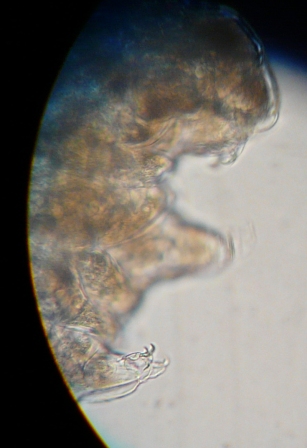
Tardigrade feet, equipped with claws for clinging to their mossy homes. They'll still be hanging on when Homo sapiens has turned to a layer of dust in the geological column. So far, tardigrades have been around for 600 million years. Modern humans, less than one tenth of one percent of that.

Thank you, Paul Davison, for leading the hunt. Thank you also to Jon Evans and Mary Priestley for organizing the event.
Cranes over Chattanooga

I was in Chattanooga yesterday and took an hour off to bike the Riverpark, a fabulous linear park that starts in downtown, then stretches for ten miles along the Tennessee River.

The highlight of the ride was a flock of sandhill cranes (Grus canadensis) overhead. They were flying along the river, wheeling occasionally in a big disorganized circle, then reforming into a northbound V. I suspect that they were looking for somewhere good to feed and were disappointed by the lack of swamps in the urban center, so they chose to move on. They are likely part of the congregation of overwintering cranes at Hiwasee Refuge, a gathering that numbers in the tens of thousands is the largest wintering aggregation of sandhills outside of Florida. These Tennessee birds return to the upper mid-west to breed.

This slideshow requires JavaScript.

Aldo Leopold wrote of these birds, “When we hear his call, we hear no mere bird. We hear the trumpet in the orchestra of evolution.” This is no accident — the trachea of these cranes coils within their sternum (chest bone) to make a resonating instrument very much like a trumpet. Both sexes call, often in vigorous duets.

For some remarkable footage of cranes in flight, see this almost dream-like series of shots of common cranes flying over Venice.

Rambling into YouTube

The “trailer” for my upcoming book, The Forest Unseen, is live on YouTube. I get kinda excited about twigs at one point. With good reason.

I’ve also been adding venues for readings/lectures, including a few on the west coast. The book itself will not be out for another month, but great reviews are coming in. The book’s website has the latest. After many years’ work, I am very excited about getting the book out into the world.