Category Archives: Bioacoustic revelry

Fledgling Hooded Warbler

My ears found this one for me. I was studying a beech tree when the mother’s chup chup calls grabbed my attention. She got closer and the calls jumped into a higher register, tink tink. Surely a nest must be close by. Junebug The Hound and I saw it at the same time: not a nest but a tiny fledgling in a blueberry bush.

fledgling hooded warblerEight days ago this creature was inside an egg. Twelve days before that, the bird was just an egg and a sperm cell, yet to unite. In a couple of months this youngster will, with luck, be in the forests of the Yucatan in Mexico.

May the big raccoon that I saw up a neighboring tree find its dinner elsewhere tonight.

17 year cicadas

The seventeen year cicadas are emerging in the Northeast, so they’ve been in the news quite a bit of late. One video in particular is worth watching: Sam Orr’s mix of time-lapse and real time video of the complete life cycle. He has been working on this project for several years and has filmed parts of the life cycle that are seldom seen. You can read more about his work here.

To learn more about where (and in what year) these creatures emerge, visit this page or this one.

For those lucky enough to live where the action is, remember what you’re hearing: seventeen years of stored sunlight being released all at once as acoustic energy. The terrestrial end product of nuclear fusion exploding into your consciousness.

Sewanee cicada: ours are on the thirteen year plan.

Sewanee cicada from back in 2011: ours are on the thirteen year plan.

For literary/musical engagement with these insects, I recommend David Rothenberg’s Bug Music, which has just recently been published. I was honored to “blurb” the book and here is what I had to say:

“Fabulous entomological jazz: David Rothenberg draws together disparate strands of inspiration and writes a new song, full of unexpected riffs and harmonies. Bug Music is a thought-provoking celebration of the acoustic bonds between humans and our insect cousins.”

In other words: a treat and an education for the mind and the ears.

Forest on Whidbey Island, Washington

An empire of moss and broadsword ferns. Douglas fir trees bend the sea wind. Reams of gold leaf — bigleaf maple — drop through thickets of hemlock and cedar.

Kinglets hammer the forest’s ceiling with sharp brads of sound. Then they drop, working the ferns. Ten of them, right here: hazed wings and stone-bright eyes. Sulfur headstripes; bright, they slice open the heavy green drapes.

Wads of old leaf caught in maple tree crotches, rotted mats lodged inside sprays of alder twigs. Seedlings take root there, above our heads. The soil’s upper boundary is fogged. In walking, we worm through soil passages, burrows of air.

This slideshow requires JavaScript.

Cicada killer

Stop and listen. Every tree is occupied by buzzing cicadas. Their vigor of their acoustic attack builds through the day, then dies away after dark, giving way to katydids.

We’re not the only species to tune into this sound. Cuckoos, blue jays, and other large-billed birds will grab cicadas when they can. But the champion hunter is the cicada killer, Sphecius speciosus, a large wasp that flies up into the trees in search of its prey.
The wasp grasps a cicada then tries to jab its stinger into the weak spots on the cicada’s exoskeleton. The cicada reacts violently — fighting for its life — buzzing its wings, writhing, and rolling. Often the tussling pair fall to the ground as they struggle. The cicada tries to break free while the wasp lances with the sharp stinger on the end of the abdomen. Spear and armor clash, then resolution comes. If the cicada can free itself, it takes wing and zooms away. The wasp does not follow, having no hope of recapture. But if the wasp’s poison finds its mark, the cicada falls into a deep sleep. This is no fairytale, no prince comes to waken the sleeper; instead, the mother wasp carries her prey to an underground tunnel where she buries it, alive but paralyzed, with a wasp egg. The larval wasp will fuel its growth by consuming the cicada.

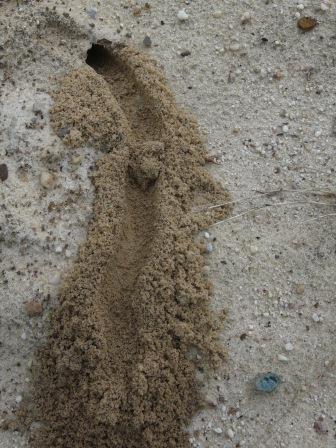
Cicada killers have been active these last several weeks. They prefer to build their tunnels in well-drained sand, so the upper portion of the Lake Cheston “beach” has numerous holes, as do other sandy areas in town.

Cicada killer with paralyzed cicada. The wasp was dragging her prey across the sand toward a burrow.

The wasp is almost as long as my thumb. They look fearsome, but don’t attack humans unless molested. Unlike yellowjackets and bees, cicada killers don’t defend their nests from intruders and can be observed at close range.

Entrance to nest burrow. The cicada pictured above was laid to “rest” here.

Cicadas are big insects and the wasps often struggle to carry them. I was swimming in Lake Cheston a few days ago when a low-flying creature — I thought at first a hummingbird — flew across the water, losing altitude as it went. When it reached the lake’s center, the flier hit the water’s surface, dropped its excess baggage and shot away. I swam out to retrieve the cargo: a cicada bobbing on the water. Back on shore, Junebug (the dog, not the insect), wanted a look. Lacking a burrow and an egg, we left the cicada to its unfortunate fate.

Back to 6th grade

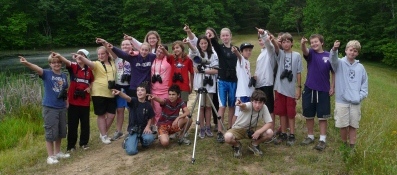
I started the day with an early morning visit to the Saint Andrew’s Sewanee 6th grade campout. Despite the early hour, the energy level was high. The birds were also active: in just a few minutes of quiet listening we heard nearly ten different species, right from the campground. We took a stroll around the lake and into the woods to find some more.

Pointing at a displaying red-winged blackbird. So what if we’re not all pointing in the same direction?

Thank you to Cindy Potter for the invitation to join the group, and to Cindy, Doug Burns, and Reid Fisher who camp out with the students. For many students, this is their first experience of camping. I was glad to learn that the whip-poor-wills had serenaded the campers over night.

Here is a bird in whose strain the story is told

I heard the first wood thrush this morning, singing in the thickets along Willie Six Rd. By the time I got my class out there, the bird was silent. Next year, I’ll reschedule this class to begin at 7am instead of 8am, for the whole darn semester. More in tune with reality, I think.

The wood thrush sings with pure notes, unadorned by harmonics, slightly offsetting the tones from the two sides of its throat. The result is gorgeous. Thoreau, as usual, had something to say about this:

“The wood thrush’s is no opera music; it is not so much the composition as the strain, the tone, — cool bars of melody from the atmospheres of everlasting morning or evening. It is the quality of the sound, not the sequence. In the peawai’s [Eastern wood-pewee] note there is some sultriness, but in the thrush’s, though heard at noon, there is the liquid coolness of things that are just drawn from the bottom of springs. The thrush alone declares the immortal wealth and vigor that is in the forest. Here is a bird in whose strain the story is told, though Nature waited for the science of aesthetics to discover it to man. Whenever a man hears it, he is young, and Nature is in her spring. Whenever he hears it, it is a new world and a free country, and the gates of heaven are not shut against him.” (from Thoreau’s Journals, July 5th, 1852)

The gates of heaven are not closed, agreed. But they are swinging shut, quite fast. Wood thrushes are in decline, the victims of fragmented forests, air-borne mercury from our coal plants, and lost wintering habitat. I culled the following graph from the Breeding Bird Survey. It shows an index of wood thrush abundance over the last forty years. In my lifetime, the species appears to have halved its abundance.

But, given a chance, these birds can bounce back. Indeed, it is likely that in many regions they were a lot less common in Thoreau’s day (the late 19th century was a time of massive deforestation) than they are now.

If you want a taste of heaven for yourself, The Music of Nature site has some nice footage and sound. But computer speakers and pixels are wan memories of reality. In the words of another bewhiskered New England word- and nature-lover, “You shall no longer take things at second or third hand, nor look through the eyes of the dead, nor feed on the spectres in books;/You shall not look through my eyes either, nor take things from me:/You shall listen to all sides, and filter them from yourself.”

Cranes over Chattanooga

I was in Chattanooga yesterday and took an hour off to bike the Riverpark, a fabulous linear park that starts in downtown, then stretches for ten miles along the Tennessee River.

The highlight of the ride was a flock of sandhill cranes (Grus canadensis) overhead. They were flying along the river, wheeling occasionally in a big disorganized circle, then reforming into a northbound V. I suspect that they were looking for somewhere good to feed and were disappointed by the lack of swamps in the urban center, so they chose to move on. They are likely part of the congregation of overwintering cranes at Hiwasee Refuge, a gathering that numbers in the tens of thousands is the largest wintering aggregation of sandhills outside of Florida. These Tennessee birds return to the upper mid-west to breed.

This slideshow requires JavaScript.

Aldo Leopold wrote of these birds, “When we hear his call, we hear no mere bird. We hear the trumpet in the orchestra of evolution.” This is no accident — the trachea of these cranes coils within their sternum (chest bone) to make a resonating instrument very much like a trumpet. Both sexes call, often in vigorous duets.

For some remarkable footage of cranes in flight, see this almost dream-like series of shots of common cranes flying over Venice.

Coyotes

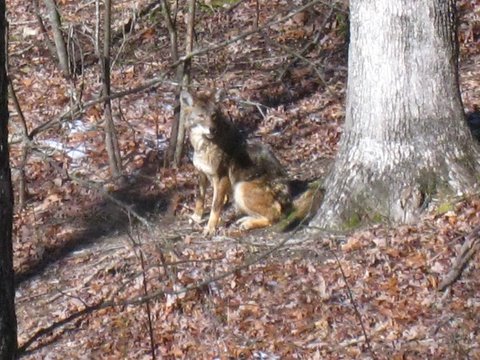
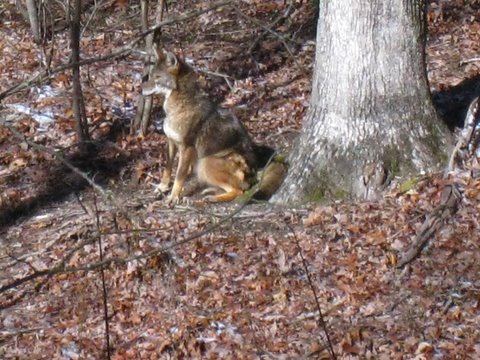
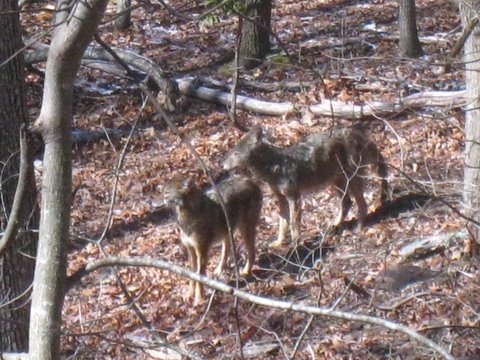
Harold Goldberg sent me these great photos of coyotes taken from his house in Sewanee. You can also see the photos in this week’s Messenger (I’ve held off on posting until the latest edition of the Messenger went live — no natural history scoops from me! :) )

At this time of year, coyotes are pairing up and breeding. Unlike many mammals, the male sticks around to help raise the young, as do some non-breeding pups from previous years. These family groups get very vocal when they reunite after hunting forays. I’ve heard their crazy yips and howls near our house for the last several nights – an acoustic dose of the wild. The goats and Junebug the Hound are not amused.

Coyotes have invaded our region from the Western states, partly replacing the ecological role of the wolves that used to roam here. But wolves sat atop the food chain, specializing in group hunts of large animals. As deer and forests were decimated in the wake of European arrival, the wolves disappeared, helped along by vigorous persecution. Coyotes are more flexible, eating small mammals, berries, insects, and whatever else is available and nutritious. This flexibility allows them to thrive in the fragmented, unpredictable world that we have created.

For those concerned about the abundance of deer in Sewanee, the arrival of coyotes is good news. Although they seldom take adults, coyotes do prey on fawns. For cat-lovers with outdoor pets, coyotes are cause for concern. Cats are a delicacy for most canids, including coyotes. This has some interesting ecological consequences. In California, areas with coyotes have thriving native bird populations, the result of predation by coyotes on cats (and behavioral changes in pet-owners – people are more likely to keep kitty indoors if they know that coyotes are on the prowl). This is a classic example of a “trophic cascade” in ecology – the effects of a top predator “cascade” down through the “trophic” (feeding)  levels in the system. My enemy’s predator is my friend.

Coyotes and wolves occupy interestingly different places in our cultural imagination. The wolf lives in that tense place between fear and desire (the Big Bad Wolf…ends up in bed…then slain…). Coyotes are more ambiguous. Most tales of coyotes regard them as playful, devious tricksters. These imaginings are fair reflections of ecology: the focused predator versus the jack-of-all-trades opportunist.

Listen for the trickster’s yodel…

Waay?

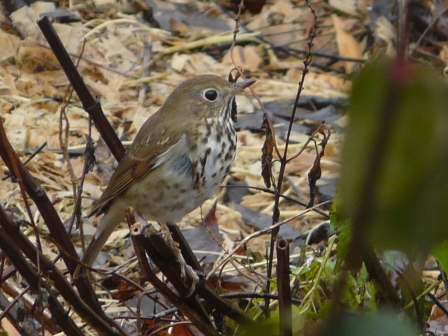
For several weeks now, I’ve been hearing a short sweet whistle from the treetops, but have been unable to identify (or even locate) the bird responsible for the sound. Usually the call comes just once or twice, then stops. The sound is high-pitched, like a titmouse call, but sweeter and inflected slightly in the middle. I had just about given up and dismissed the sound as an unusual titmouse, when a hermit thrush landed close to me in a small tree in the garden, cracked its beak slightly, and made the sound.

I’ve poked around on the web and cannot find any good recordings of this particular sound, although there are plenty of songs and calls from this species out there. The closest is the waay call on Lang Elliott’s site, but the sound I heard here is not nearly so nasal.

This morning, the thrush landed close enough to get a decent photo. Subtle beauty, but beauty nonetheless. I love the thin eyering.

(Grackles)*n

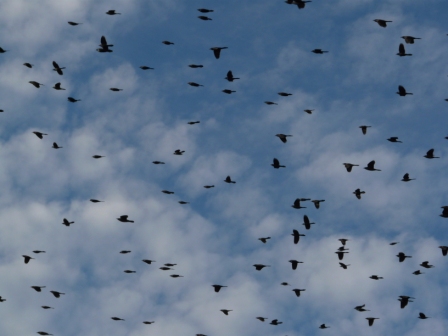
I heard them first, then they rose up from the adjacent field, winging toward me. I held still and they came right overhead, a storm of dark feathered electricity. Ten thousand? Twenty? Frankly, who cares about numbers — they were there; I was there. For a minute or two, they settled in the grass around me and in the trees behind. The sounds made by each bird, the grackles’ characteristic creaking and whistling, merged into a rhythmic drumming, like hail beating on a roof. Then, they were gone, leaving me alone, bound to the ground, with static coursing through me.