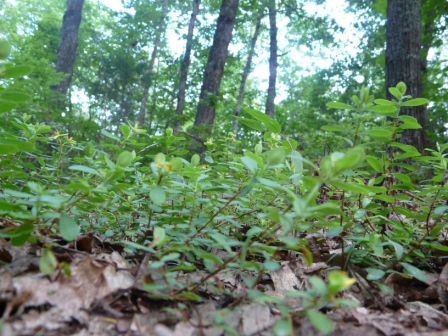
Growing close to the ground:

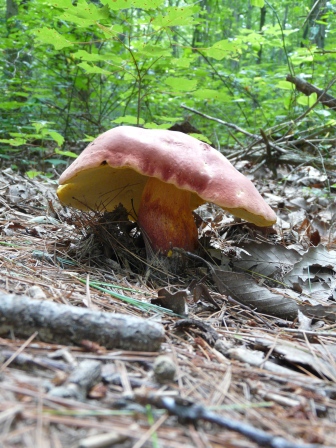
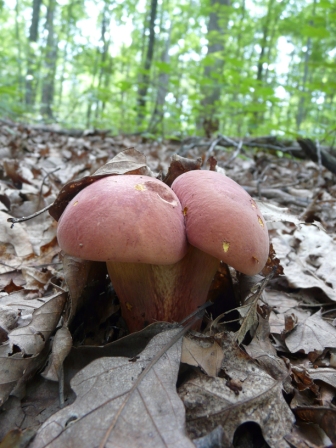
Small red 'shrooms, about 3-4 cm tall. I think they are Catharellus cinnabarinus, the Cinnabar Chanterelle

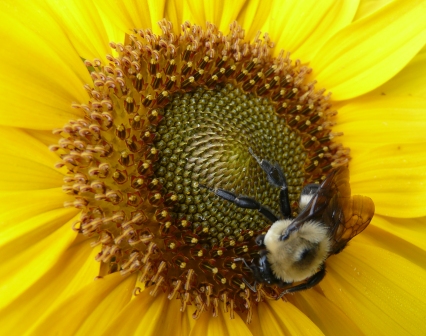
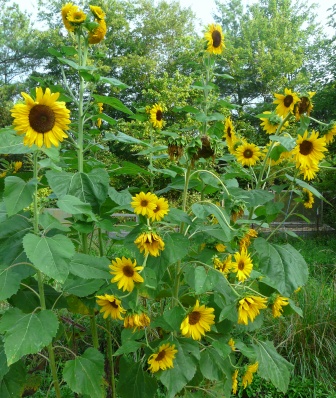
The number of spirals of florets in the center of the sunflower always follow the Fibonacci series. This is apparently the result of the angle between adjacent florets, which is about 137 degrees, or the "golden angle", giving the most efficient packing of florets into the head. Bees like golden, especially in the form of pollen.

This is likely the most faded swallowtail that I've seen. The scales on the outer halves of the forewings are completely worn away and most of the hindwings are gone, either abraded down or snatched away by predators. She (the blue gives away her sex) was enjoying her nectar, though, and may yet enjoy a few more days of sniffing out places to lay her eggs.
A worm-eating warbler was feeding in the shrubs outside our kitchen window this morning. Worm-eating warblers breed in the forest, never in town, so the bird’s presence here was a surprise and a sign that post-breeding dispersal has started. After they have bred, many species of bird wander through habitats that they would never breed in. This warbler is likely one of these amblers, drifting through the thickets in backyards now that its woodland nesting is complete. Next stop: the Caribbean or Mexico for the fall and winter.
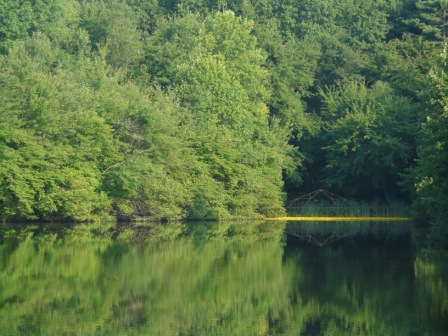
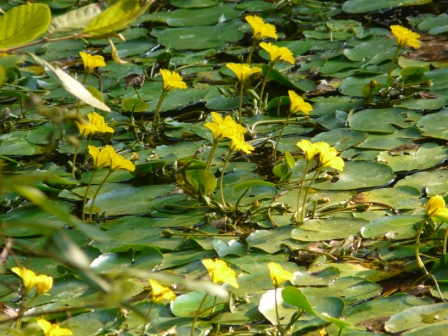
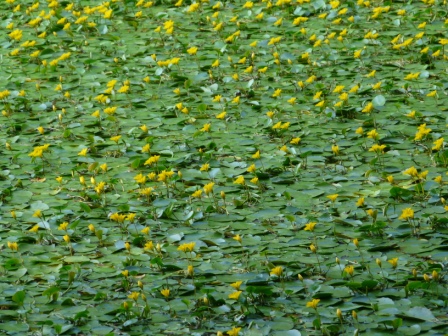
A bright streak of yellow shines from the end of Lake Cheston. These are the morning flowers of Nymphoides peltata, the “yellow floating heart.”
These beauties are considered dangerous. They are banned in Massachusetts and Connecticut. Oregon regards them as a class A weed. Their crime is to be immigrants who tend to thrive in American waters, growing in large mats that potentially compete with other plants. I find it hard to get too worked up about this “invasion” here: all lakes in Tennessee are unnatural, made by damming streams and rivers, so the floatinghearts are just one more layer of biological novelty. Wired Mag has a nice overview of a recent provocative article in the leading scientific journal Nature that questions the scientific and ethical merits of the current anti-exotic species bandwagon.
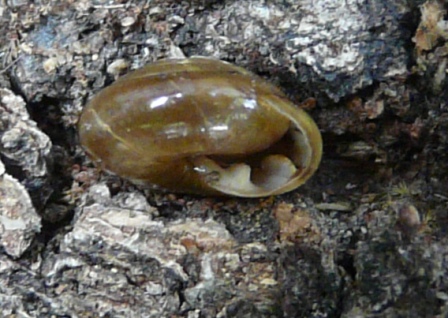
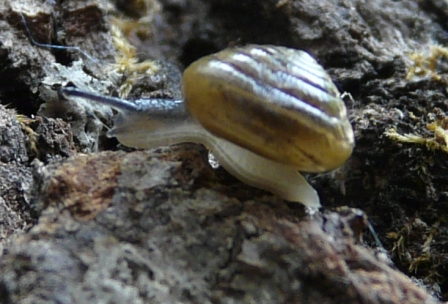
This small species of woodland snail caused some consternation last year when my students, Keri Bryan and Maggie Shipley, found several in the forests around here. The shells keyed out to Ventridens pilsbryi, but we were working with dead shells, not live individuals. One diagnostic character is the color of the body — “pale yellowish with some gray along the back” (instead of “dark” as in the gularis group) according to Hubricht’s original description.
Yesterday I found a live one in some leaf litter samples that students in the Sewanee Environmental Institute had gathered. The body is light, although not yellowish.
This beetle was running all over the leaf litter and around the base of trees, probing the ground with the end of its abdomen. It seemed to be laying eggs with a lance-like ovipositor. If my identification is correct, the larvae that hatch from the eggs will dig down into the soil and feed on tree roots.
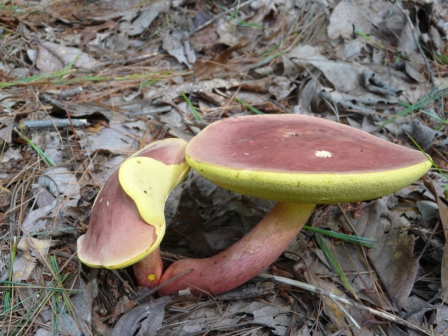
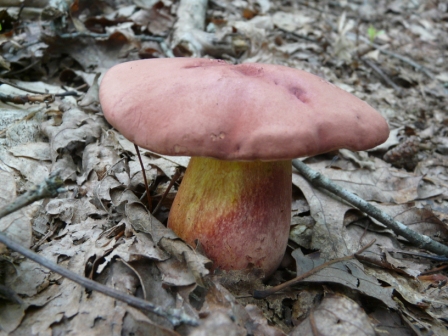
The Two-colored Bolete (Boletus bicolor) is poking up all over the forest. Each mushroom is an impressive six to ten inches across.
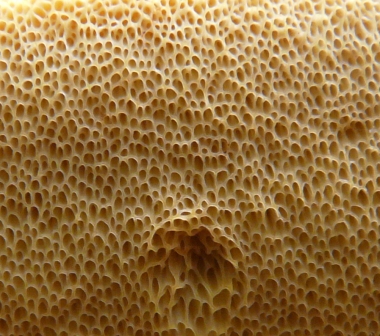
Unlike other mushrooms, the underside of bolete caps are covered with tiny pores rather than gills. These holes lead into tubes from which spores are shed.
Boletus bicolor is a mycorrhizal species — its below-ground parts are fused with the roots of oaks and other hardwoods. The trees supply the fungi with sugars; the fungi mine minerals from the soil and send them to the trees.