Author Archives: David George Haskell

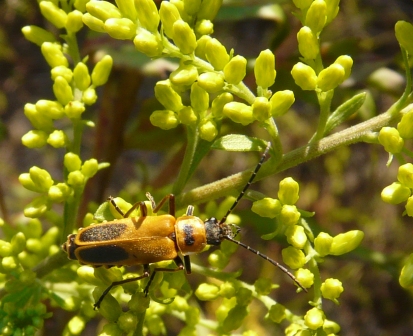
Yellow and black beetle — the Goldenrod Soldier

These beetles become very abundant in late summer and early autumn. As their name implies, they are fond of goldenrod flowers, but they are also common on asters and other late-blooming flowers. In addition to pollen and nectar, the adult beetles eat aphids and other herbivorous insects, so these beetles are a gardener’s friend. The larvae are also predaceous, feeding on the eggs and larvae of other insects.

Chauliognathus pensylvanicus (yes, spelled with no double "n"s, a leftover from the 18th century when De Geer described the species. Under the rules of zoological nomenclature, the original spelling cannot be "updated")

Other species in this family have red markings like British soldiers, hence the name.

Ironweed

The rain is finally over, leaving cold gray skies in its wake. The storm gave us a little more than six inches of rain. After the month of drought, this moisture is very welcome.

I inspected the ironweed patch at the end of the garden and found that the plants had withstood the rain. Not one of them was knocked down, even though they stand on skinny, four foot stems.

The color of their flowers is remarkable. I’ve been letting the flowers go to seed for several years, so we now have several dozen plants in a big patch. When the sun returns, the insects will swarm all over them, sipping their abundant nectar.

Microbial ecology: follow your nose

The arrival of tropical storm Lee has broken a month of drought. After weeks of heat and no rain, we’re getting a steady downpour that so far has lasted 24 hrs, with another day or so to come. Lee is an insistent fellow who may yet outstay his welcome.

One of the many benefits of the return of the rain is the reactivation of the microbes that have been in suspended animation in the dry soil. We can’t see them, but we can smell them. Their odors waft up to us as we walk — some are musty, some sharp, others are rounded and pleasant. The actinobacteria are particularly special. They smell of healthy, rich soil. These actinobacteria are a diverse group, some of whose members gave us chemicals that we use as antibiotics.

I’ve prepared an online experience of the richness of these creatures for you. Follow the instructions below:

Extracting honey

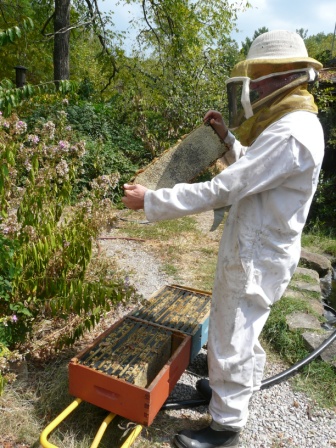
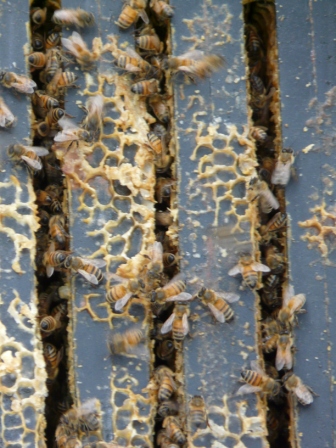
I took two boxes (called “supers”) of honey from our hives. Each super has ten rectangular frames that hang vertically inside the super. The bees store their honey inside wax cells on each frame.
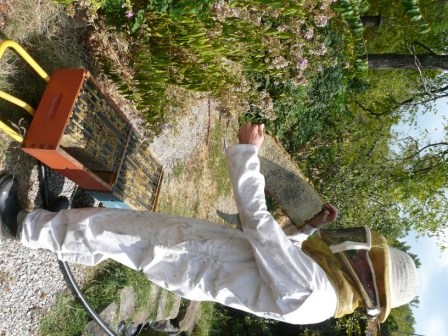
Inspecting frames of honey

Each hexagonal cell on the frame is full of honey and capped with a thin layer of wax.
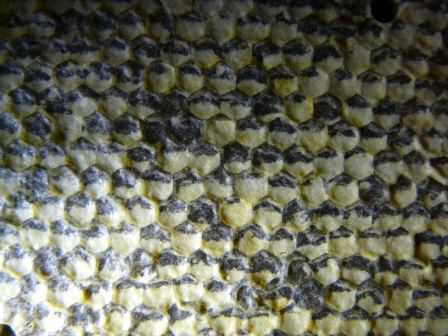
Cells full of honey

To get at the honey, I first scratch off the top layer of wax with a sharp fork made specially for the purpose. Some beekeepers prefer to use a hot knife to slice away the top surface.
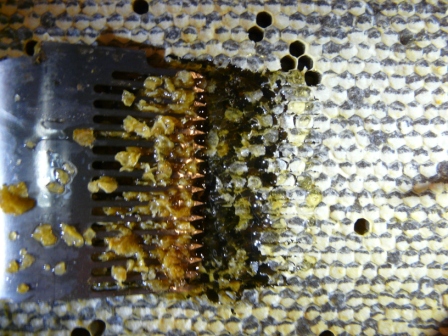
Getting at the honey: vandalism of the bee's careful constructions

Then I put the frames into a centrifugal extractor. This tall metal cylinder has baskets inside which hold the frames vertically. These baskets are then whirled around at an alarming speed by cranking the handle on the top of the machine. This whirling motion flings the honey out of the frames and onto the inside of the metal cylinder. The honey then flows down through a mesh filter into a storage area at the bottom of the cylinder.
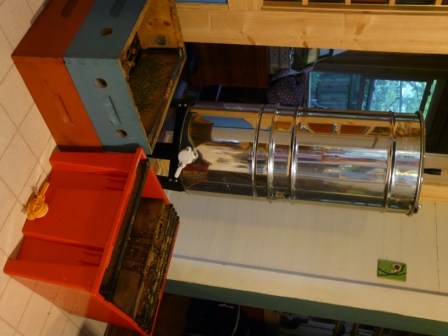
Honey frames (left), centrifugal extractor (center), and holding tank for opened frames (right)

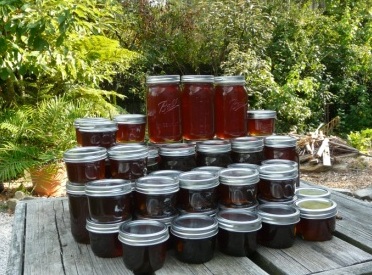
After all the frames have been spun, I pour the honey into glass jars.
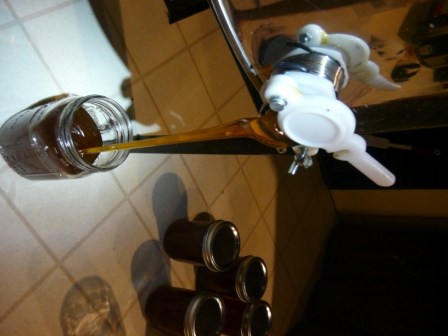
Flowing honey

The two supers had nearly six gallons of honey between them.

2011 honey harvest: the stored concentrated sweetness of Sewanee's forests and gardens

When I’m finished, I put the equipment and the emptied frames at the bottom of the garden. There, hundreds of bees come out to clean up the left-overs. Within a few hours, no trace of honey remains.

Bees gather for mop-up operations

Wriggling between frames to slurp up every last drop

I left each hive with one or two supers of honey to keep them happy through the winter.
Spicebush berries

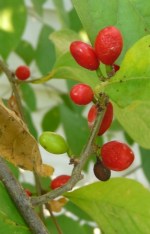
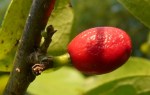
Berries on spicebush plants are now fully mature. Migrating birds love them, as do bears and other woodland animals. The berries are fairly fatty so they help animals to stock up on energy for either migration or hibernation. The spicebush plants have presumably timed the ripening of their fruits to coincide with the surge of migrant birds that are now moving through our forests.

I sampled a few berries and they taste like a cross between allspice and liquorice, neither of which are high on my list of flavor preferences but then I’m not a wood thrush or a bear. The aftertaste lingers and matures into a sharp cayenne. According to Foster and Duke’s Medicinal Plants and Herbs, Native Americans used tea from the berries for coughs and other ailments and they squeezed oil from the berries to rub into rheumatic joints.

Clicking on a thumbnail will open a larger image.

Lesser angle-wing katydids

They start singing about an hour after dark, calling with short bursts of high-pitched sound. Each call is somewhat like a can of dried peas being shaken rapidly. In the following recording, the lesser-angle wings call five times. You’ll also hear the common true katydid singing “di-di-did” in the background. Crickets are also singing in this clip — they form a continuous band of sound against which the katydids play.

Lesser angle-wing katydid, Microcentrum retinerve. This individual flew into the kitchen and posed briefly on the wall.

For comprehensive identification information on America’s many katydids (including sound files) see Walker and Moore’s excellent online guide.

Crisped

While the East Coast is getting blasted with rain and wind, here on the other side of the Appalachians, we’re dry, dry, dry.

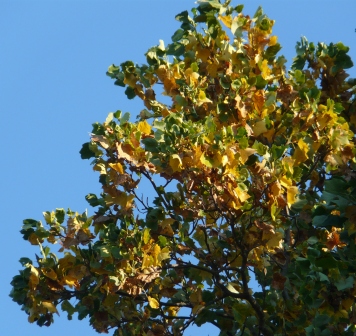
The tuliptrees have given up on the year and are shedding their crisped leaves.

Whereas the more drought-tolerant hickories and oaks retain their summer freshness.

You can pick out the tuliptrees from a distance. Their yellowing leaves stand out against the rest of the forest.

Why do tree species differ in their ability to withstand drought? McDowell et al.’s review sums things up nicely: “Numerous hypotheses to explain mechanisms of survival and mortality have been generated via theoretical, modeling, and experimental analyses. However, a broader framework that encompasses these different hypotheses is lacking, and most hypotheses remain untested.” Despite this state of ignorance, it appears that differences in the plumbing systems of trees provide a partial answer. Oaks and hickories have water-conducting vessels that let them squeeze a living out of  dry soil whereas the tuliptrees’ system stops working in drought, cutting off the water supply to the leaves. The particularities of the width and shape of the vessels account for these differences.