Author Archives: David George Haskell

Deck the… lab walls

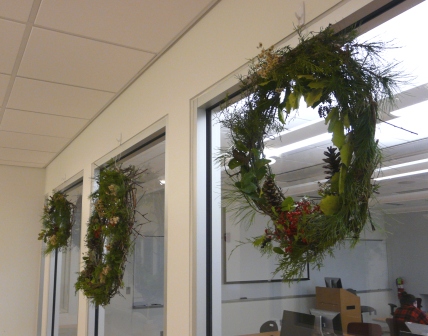
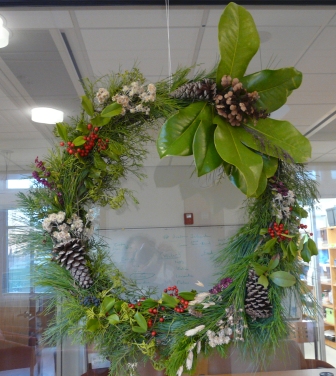
My colleague, Jon Evans, asks students in his Plant Systematics and Evolution class to produce a holiday wreath at the end of the semester. Their challenge: to build an attractive wreath using as many plant species as possible. Sewanee’s 13,000 acres have no shortage of plants to select from, over one thousand species at last count (of course, no rare species find their way into the wreaths).

The wreaths are hung on the walls in Spencer Hall, giving us all a nice boost as we work on final exams.

Luckily, the Microbiology class has chosen not to mount their ripe petri dishes on the adjoining walls.

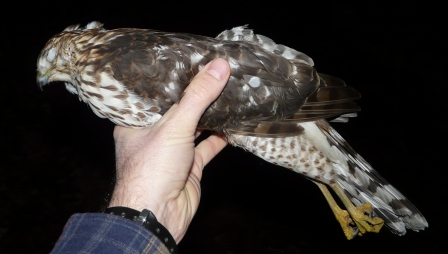
Immature Cooper’s Hawk

I got a call today from the Sewanee Children’s Center: a dead hawk was lying in the playground. On my way home, I stopped by and did an impromptu “show and tell” for the kids. Nothing is more interesting at 5pm than dead animals, it seems. Because Sewanee is a small town, I know which households some of the kids came from. Interestingly, those from homes with nature-loving/trail-hiking/garden-keeping parents were very keen to hold the bird (wash your hands afterward kiddo…) and feel its soft feathers and sharp toes. Those from iHomes shrunk back: ah, the horrors of nature.

The bird was a Cooper’s Hawk in its immature plumage. The bird was full grown, but had not yet molted into the adult breeding plumage. It may have hit a window and fallen to the playground below.

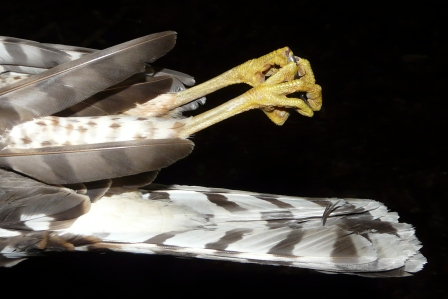
Cooper’s Hawks hunt other birds by chasing them down at high speeds in the forest canopy. To pull off this feat in the clutter of twigs and branches, the hawk has fairly short rounded wings and a long rudder-like tail. Its legs are also quite long — all the better to fish hiding birds out of tree holes.

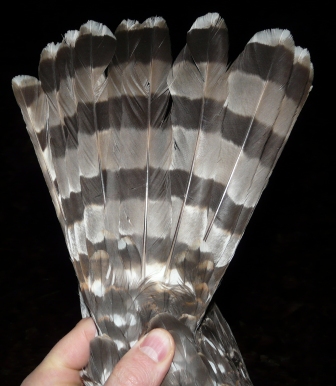
The look-alike Sharp-shinned Hawk can be hard to tell apart from Cooper’s Hawks. I’m calling this one a Cooper’s because of the broad white band at the end of its tail, the relatively fine streaks on the belly that taper off to mostly white, the somewhat rounded end to the tail, and the fact that it is larger than some (but not all, females can be quite big) “Sharpies.”

This bird is now in my freezer and will become a student’s Ornithology project next semester. I’d much rather the bird was alive, roosting in an oak tonight. But, because death has yet again paid an untimely visit, we may as well use its remains to learn more about the world.

Sewanee armadillo

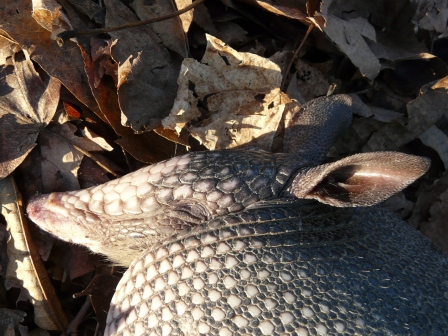
The Sewanee network of road-kill aficionados (thank you, Rachel), pointed me to this freshly killed nine-banded armadillo (Dasypus novemcinctus) on the side of Rte 41A, outside Stillpoint (a name that, for this little animal, came with uninflected irony).

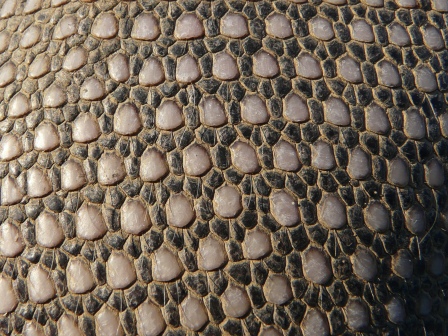
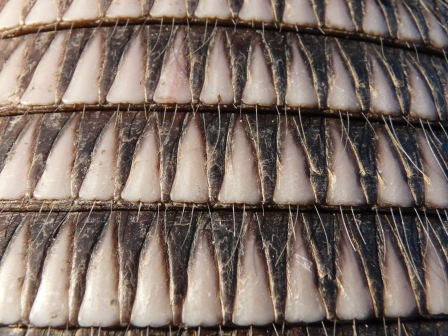
The “armored” skin of the armadillo is tessellated with striking patches of contrasting color. These patterns are made from little bony plates covered with leathery skin.
Armadillos are a recent arrival here in Sewanee and are still quite uncommon, although they are becoming abundant in the surrounding valleys. The first one was seen here about ten years ago on Gudger Rd. I then found one on the main highway through town, the first record in Sewanee itself. This latter specimen was also road-killed and is now in the mammal collection at the University of Tennessee. This week’s find is interesting because it comes at the start of winter. All the previous sightings have been in the warm months, suggesting perhaps that armadillos are moving up here from the valley in summer, but are not established year-round. Well, at least one made it to nearly the winter solstice.

Armadillos are champion diggers. Apparently, they can ruin a nice vegetable garden in one night. They excavate burrows to sleep in during the day and the entrance holes to these burrows are perfectly sized to catch unwary human feet, plunging unfortunate walkers into leg-twisting tunnels. The armadillo’s feet are well-equipped for this task:

But despite their tendency to dig where we don’t want them to, we should regard them with some awe, not with irritated condescension. They are members of a wonderfully strange group of mammals, the Xenarthrans, that originally evolved in South America. When the land bridge formed between North and South America, about three to five million years ago, these animals moved north, colonizing what is now the United States. This Sewanee armadillo had come a long way. Other members of the Xenarthra include additional armadillo species (incl. “pink fairy armadillo” and “screaming hairy armadillo” — did someone say “Muppets”?), sloths, and anteaters.

Is the resemblance to E. H. Shepard’s drawings of Piglet coincidental?

Cabbage beauty

Cabbage is not high on the list of plants that get mentioned in botanical love poems or odes to nature’s beauty. “Beloved, thou hast brought me many cabbages” — not likely. Stand aside and make room for hosts of daffodils (so angelic) or bunches of roses (so red, red).

But Brassica oleracea capitata has its own beauty, in a leafy, humble way.

The plant pictured above is particularly pleasing to my eye because the secret to growing cabbage in Sewanee’s climate has eluded me for many years. The springs are very cold, then suddenly switch to blazing heat; the cabbage looper caterpillars are abundant and bring with them an “all you can eat” attitude; and the late summer droughts are unfriendly to cabbage roots. Cabbage came from the wet, temperate climate of Northern Europe. It is out of place here.

But this year, I found a variety that seems to do well: Johnny’s “Storage No. 4” — evidently named by a modern Wordsworth. I helped the plants along with a little Bt to control to loopers, gave them some extra compost, and kept them moist during the summer heat. For a modest plant, they certainly like being pampered. If you’re looking for a cheap pastoral metaphor, there it is.

So far, they hold well in the chill, even in snow.

Ruddy Duck

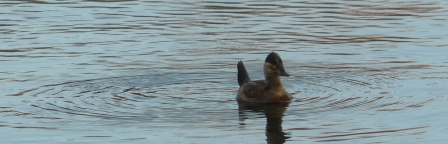
This lone, female Ruddy Duck has been paddling around Lake Cheston for the last two weeks. Unlike mallards and other “dabbling” ducks that feed by poking around on the surface of the water, ruddy ducks dive down and feed on aquatic invertebrates under the surface. Their dive starts with a short leap, then the birds take a vigorous plunge, propelling themselves through the water with strokes of their feet (they have some of the largest feet of any waterbird). They stay down for about half a minute at a time as they probe the bottom of the lake. Midge larvae are their favorite food.

Ruddy ducks are “stiff tailed” ducks. The photos above show the bird with these spiky feathers cocked, but they are more often held down, flat against the water surface.

The male, who has a blue beak and “ruddy” plumage, makes one of the best sounds of all American birds, utterly charming in its goofiness. The accompanying display is just as compelling.

This species breeds mostly in the “prairie pothole” region of the upper midwest and Canada, then winters along the coasts and on southern lakes. This is the first one I’ve seen in Sewanee, although they can be fairly common on the larger lakes around Winchester and Stevenson.

(Grackles)*n

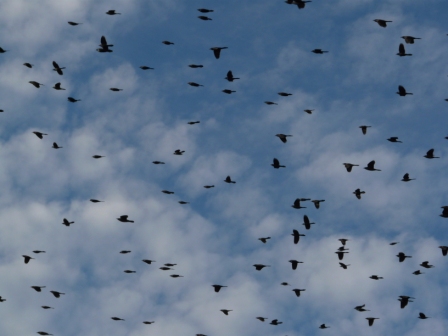
I heard them first, then they rose up from the adjacent field, winging toward me. I held still and they came right overhead, a storm of dark feathered electricity. Ten thousand? Twenty? Frankly, who cares about numbers — they were there; I was there. For a minute or two, they settled in the grass around me and in the trees behind. The sounds made by each bird, the grackles’ characteristic creaking and whistling, merged into a rhythmic drumming, like hail beating on a roof. Then, they were gone, leaving me alone, bound to the ground, with static coursing through me.

Mistletoe

A single mistletoe plant is growing near the top of an ash tree behind Shenanigans and Woody’s Bikes. Mistletoe is not common in Sewanee, although it can be quite abundant on the lower slopes of the coves.

American mistletoe, Phoradendron leucarpum (literally, the "white-seeded tree thief")

Recently, biologists have realized that mistletoe is a very important part of the ecology of forests. In fact, mistletoe has such a major effect on other species that it has been called a “keystone species,” one of the major determinants of a forest community’s vitality. How so? Mistletoe steals some of its host tree’s food and combines this with the food that it makes for itself through photosynthesis. This combination of a big trust fund (the tree) and a steady job (the mistletoe’s own leaves) allows the plant to live large, offering abundant nectar in the early spring and fat, nutritious fruit later in the year.

Bees love the nectar which comes earlier in the year than the nectar of most other flower species. Birds and many climbing mammals adore the fruit. The pulp of the fruit is sticky, ensuring that it will stick to branches after it has passed through the bird. More, the seed is often so gummy that it sticks to the birds’ feathers. Birds have to grab the seed, then wipe it off on a branch — a perfect way for the mistletoe seed to get placed exactly where it needs to be. So, this small plant is used by dozens of invertebrate and vertebrate animals. One butterfly, the great purple hairstreak, has gone so far as to become wholly dependent on the plant. Its caterpillars will eat nothing else.

In other parts of the world, including the western U.S., different mistletoe species provide a similar range of services. Some even provide favored nesting areas for many birds. A review of mistletoe biology a few years ago stated that, “…the widespread perception of mistletoes as destructive weeds needs to be challenged. Many landholders, managers, and even biologists regard mistletoes as invasive pests, damaging to individual trees and detrimental to forest health. [But] …mistletoes have a substantial positive role in many forests and woodlands, and should be given appropriate recognition.” (from: Watson, D. M.. 2001. Mistletoe — a keystone resource in forests and woodlands worldwide. Annu. Rev. Ecol. Syst. 32:219–49)

Of course, mistletoe has other roles in the ecology of our world. So, I’ll sit and do my end-of-semester grading under the thief, ever hopeful that songbirds will visit.

’tis the season to ponder descent with modification

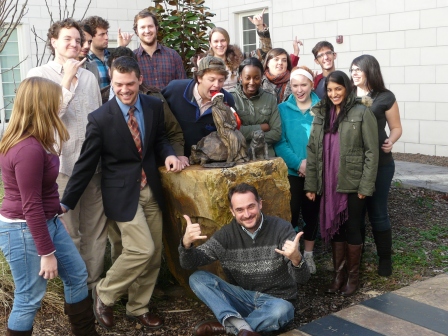
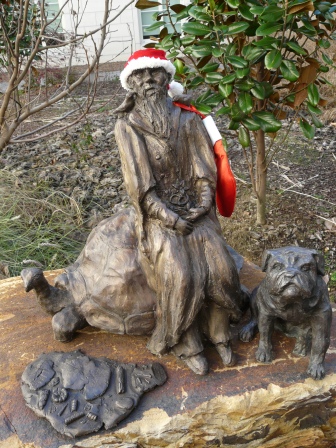
Here in Sewanee, we take our dead, bearded patriarchs seriously. Socrates, Shakespeare, Darwin, Muir, God, God Jr., and Santa Claus all have their devotees and proselytes. Never mind that some are more convincingly bearded than others (biologists note with satisfaction that Shakespeare’s ratty bristles are unimpressive next to Darwin’s substantial cloud), the important thing is that these men are dressed right. With the Advent part of the Advent semester upon us, it was time to give Darwin some bling. So, today, on the final Biodiversity Friday of the semester, my Biodiversity class visited Darwin’s Garden one last time and arrayed our Victorian gentleman in seasonal finery.

Darwin’s Garden is located in the atrium at the center of Spencer Hall. It is a celebration of life’s history, with a walkway divided into the various periods in Earth’s history, starting with the Cambrian. Darwin was sculpted by Sewanee Biology graduate Jeanie Stephenson who did a fabulous job of including many of Darwin’s favorite creatures in her sculpture: finches, orchids, Galapagos tortoises, fossils, and even an earthworm on his shoe. Darwin’s bulldog stands close by.

We’ve used the garden throughout the semester to get a sense of how events in life’s history relate to each other and to understand the passage of time. It was fun to cap off the semester with, well, a cap for our guide through this journey, Mr. Darwin, the evolutionary biologists’ Virgil.