Author Archives: David George Haskell

Cranes over Chattanooga

I was in Chattanooga yesterday and took an hour off to bike the Riverpark, a fabulous linear park that starts in downtown, then stretches for ten miles along the Tennessee River.

The highlight of the ride was a flock of sandhill cranes (Grus canadensis) overhead. They were flying along the river, wheeling occasionally in a big disorganized circle, then reforming into a northbound V. I suspect that they were looking for somewhere good to feed and were disappointed by the lack of swamps in the urban center, so they chose to move on. They are likely part of the congregation of overwintering cranes at Hiwasee Refuge, a gathering that numbers in the tens of thousands is the largest wintering aggregation of sandhills outside of Florida. These Tennessee birds return to the upper mid-west to breed.

This slideshow requires JavaScript.

Aldo Leopold wrote of these birds, “When we hear his call, we hear no mere bird. We hear the trumpet in the orchestra of evolution.” This is no accident — the trachea of these cranes coils within their sternum (chest bone) to make a resonating instrument very much like a trumpet. Both sexes call, often in vigorous duets.

For some remarkable footage of cranes in flight, see this almost dream-like series of shots of common cranes flying over Venice.

Little blooms

Gray, gray day: you will not win.

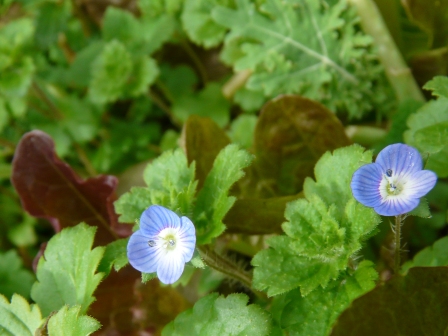
As an antidote to the unrelenting rain and murk, here are a couple of tiny beauties that I photographed earlier this week. Both were growing between lettuce plants as “weeds” in my cold frames.

Bird's-eye Speedwell, Veronica persica. So small that ten of these flowers would fit onto my thumb-nail.

Wikipedia says that this species has "no known horticultural uses." Unbidden beauty is utility enough for me.

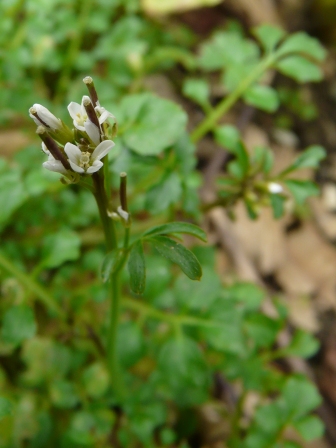
Small-flowered bittercress, Cardamine parviflora.

Each flower is about as big as a grain of rice.

This is the first year that either of these species has shown up in the cold frames. Their seeds may have come with compost from other parts of the garden or as “extras” in packets of lettuce seeds.

Rambling into YouTube

The “trailer” for my upcoming book, The Forest Unseen, is live on YouTube. I get kinda excited about twigs at one point. With good reason.

I’ve also been adding venues for readings/lectures, including a few on the west coast. The book itself will not be out for another month, but great reviews are coming in. The book’s website has the latest. After many years’ work, I am very excited about getting the book out into the world.

Coyotes

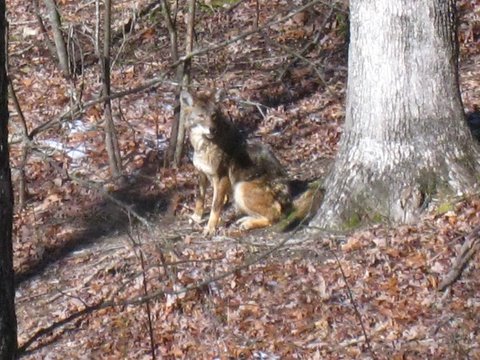
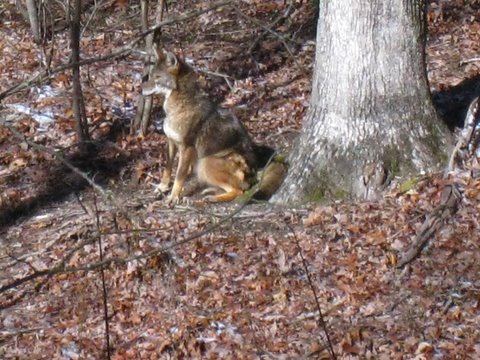
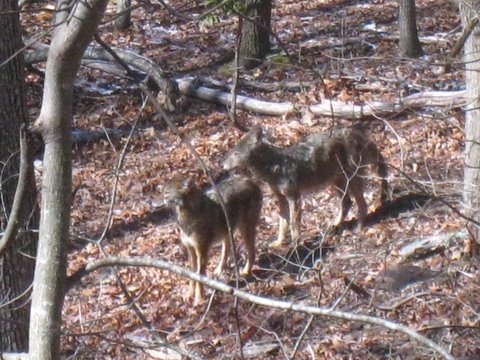
Harold Goldberg sent me these great photos of coyotes taken from his house in Sewanee. You can also see the photos in this week’s Messenger (I’ve held off on posting until the latest edition of the Messenger went live — no natural history scoops from me! :) )

At this time of year, coyotes are pairing up and breeding. Unlike many mammals, the male sticks around to help raise the young, as do some non-breeding pups from previous years. These family groups get very vocal when they reunite after hunting forays. I’ve heard their crazy yips and howls near our house for the last several nights – an acoustic dose of the wild. The goats and Junebug the Hound are not amused.

Coyotes have invaded our region from the Western states, partly replacing the ecological role of the wolves that used to roam here. But wolves sat atop the food chain, specializing in group hunts of large animals. As deer and forests were decimated in the wake of European arrival, the wolves disappeared, helped along by vigorous persecution. Coyotes are more flexible, eating small mammals, berries, insects, and whatever else is available and nutritious. This flexibility allows them to thrive in the fragmented, unpredictable world that we have created.

For those concerned about the abundance of deer in Sewanee, the arrival of coyotes is good news. Although they seldom take adults, coyotes do prey on fawns. For cat-lovers with outdoor pets, coyotes are cause for concern. Cats are a delicacy for most canids, including coyotes. This has some interesting ecological consequences. In California, areas with coyotes have thriving native bird populations, the result of predation by coyotes on cats (and behavioral changes in pet-owners – people are more likely to keep kitty indoors if they know that coyotes are on the prowl). This is a classic example of a “trophic cascade” in ecology – the effects of a top predator “cascade” down through the “trophic” (feeding)  levels in the system. My enemy’s predator is my friend.

Coyotes and wolves occupy interestingly different places in our cultural imagination. The wolf lives in that tense place between fear and desire (the Big Bad Wolf…ends up in bed…then slain…). Coyotes are more ambiguous. Most tales of coyotes regard them as playful, devious tricksters. These imaginings are fair reflections of ecology: the focused predator versus the jack-of-all-trades opportunist.

Listen for the trickster’s yodel…

Coda to Chuck D’s birthday

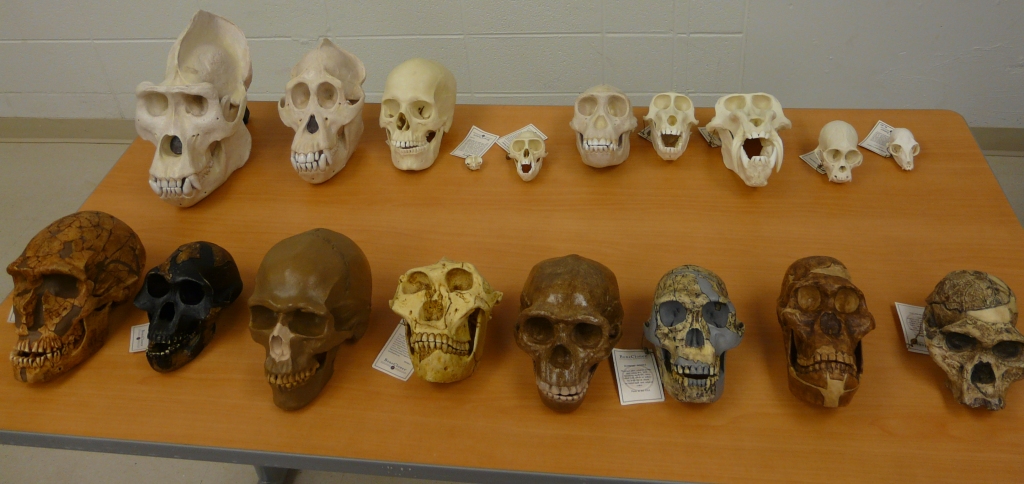
…the unity and diversity of life, illustrated by skull replicas of living primates (back row) and extinct putative human relatives (front row). Unity of form is plainly visible (short snouts, bony brain case, binocular vision, jaw arrangement) = the mark of kinship. Variations on the primate “theme” are also in evidence (teeth, skull size, muscle attachments, brain size) = ecological diversity. We measured these skulls and talked about their significance in Intro Bio this week.

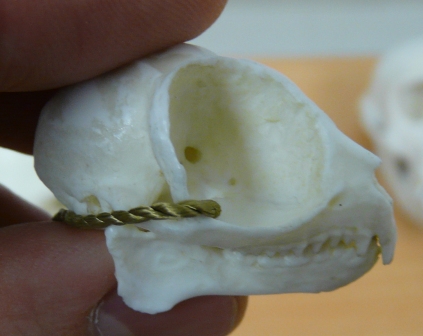
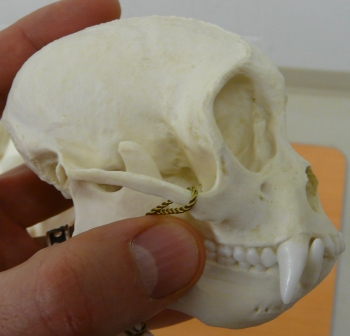
A few cool living relatives:

Tarsier: a nocturnal (BIG eyes) insectivore (sharp little teeth)

Capuchin — strong premolars for cracking nuts, big ol’ canines for social “interactions”

The largest living great ape — massive sagittal crest (ridge of bone on top of head) for attachment of HUGE chewing muscles used to chomp on stems and leaves. The ape-cow.

Happy 203rd Birthday, Charles Darwin

“It is interesting to contemplate an entangled bank, clothed with many plants of many kinds, with birds singing on the bushes, with various insects flitting about, and with worms crawling through the damp earth, and to reflect that these elaborately constructed forms, so different from each other, and dependent on each other in so complex a manner, have all been produced by laws acting around us … There is grandeur in this view of life, with its several powers, having been originally breathed into a few forms or into one; and that, whilst this planet has gone cycling on according to the fixed law of gravity, from so simple a beginning endless forms most beautiful and most wonderful have been, and are being, evolved.” Charles Darwin, concluding paragraph from the first edition of On The Origin of Species.

Charles Darwin by John Maller Collier. The image is from the WikiMedia Commons.

Robert Pinsky on movement and grunting

Robert Pinsky spoke in the Hunter Lecture Series in Chattanooga a couple of nights ago. I knew I was in for a good evening when I swung into Moccasin Bend on I-24 and the biggest moon I’ve ever seen appeared, a massive golden orb in the blue dusk over the city lights. I was moved to invoke aloud the name of a Hebrew man-god. I had no camera, so was free from the temptation to risk my life by pulling over for a shot, and I was forced to just enjoy Lady Moon’s full spectacle. On top of that miracle, I found an unoccupied free parking spot near UTC.

Pinsky did not read his poems (bummer), but instead gave a great talk (bummer erased) about art, education, the evolution of grunting, the physicality of poetry, and the Favorite Poems project. In other words, here was another Rambler (albeit a three-time poet laureate, so an über-rambler). I had a great time.

I will not attempt to give an abstract of his talk, but instead I’ll share a few interesting ideas and links to his great online poetry videos.

One of the questions he asked was, “why has an unpromising little ape [Homo sapiens] done so well when so many other species have more impressive physical attributes?” His answer: we cooperate, not just with those alive now, but with past and future generations. That sharing of knowledge is extraordinarily powerful. How do we accomplish this? Well, these days via the web. Before that, with the printed or scribbled word. But for most of our life as a species, by “moving and grunting in certain ways.” In other words, by dance, music and poetry (he left out story-telling, aka sitting around the fire BSing…). Art, he claimed, is the key feature of our species that has allowed us to thrive.

(Side thought: some skill with thrown rocks and spears probably helped. Give me poetry, but give me meat also. Poems about spears, maybe – Homer?)

After some discussion of taxi drivers in Russia, W. E. B. Du Bois, the Boston Arts Academy public high school, Robert Frost’s assessment of the poetry-college athletics nexus, the desirability of extending the educational philosophy of the ruling classes to all people (i.e., everyone gets to take art seriously, not just the aristocrats), and his experience of Aristotle as a college freshman, Pinsky made a convincing case that, for art, physical experience is central, not peripheral or ornamental. So, art is central to our existence as a species and the physicality of art is the ground on which all this is built. He illustrated this with some examples from the Favorite Poems project – “normal” people reading and talking about their favorite poems. These are not profs, critics, or specialists. Pinsky claimed that their giving voice to the poems allows us to “see the work of art happening in the reader,” a “deep connection” back over tens of thousands of years to the core of our nature as humans.

At a time when our lives often revolve around uploads and downloads to “the cloud,” with physicality reduced so often in our culture to tasteless gluttony and tawdry lust, his emphasis on artful embodiment was refreshing. Occupy: your body. I wonder how much of this embodiment can be captured in online videos? So asks the blogger through his Ethernet cable, coming to your Android (aye, language is telling).

Homo sapiens, let’s be the lightning that connects cloud to ground. We’re the one species that can do it. Yes, we can have both; sparks fly when they connect.

Ephemeral pond

On Saturday morning, I visited the large ephemeral pond at the end of Brakefield Road. This pond, like all ephemeral ponds or “vernal pools,” fills with water in the early winter, stays wet through the spring, then dries up completely in either summer or early fall. The peculiar hydrology keeps fish out – they obviously can’t survive the dry spells – and creates an incredibly rich community of animals that thrive in the absence of fish predation. The abundance and diversity of salamanders and crustaceans in these pools is unrivalled; many of these species live nowhere else.

Although February has just started, spotted salamanders (Ambystoma maculatum) have already visited the pond, mated, and laid their eggs. The adults of this species lives underground in the surrounding forest and emerge only for a few nights in the spring. After breeding in the ponds, they burrow back down into the leaf litter and disappear from view for another year. This year’s breeding season got going very early. In most years, mating doesn’t happen until late February or early March.

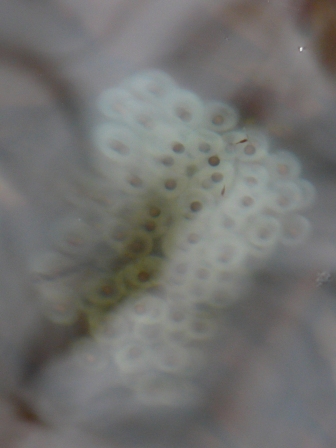
Spotted salamander egg mass seen through the wind-stirred light on the pond surface

I returned later, at night under a misty, drizzly moon, to see whether any salamanders were still in the pond.
Despite a thorough search, I couldn’t find any adult spotted salamanders, but I found dozens of egg masses attached to submerged twigs, especially in the center of the pond where the water was deepest (thigh-high: deeper than I expected). Illuminated with a flashlight these masses are quite stunning. The little embryos are visible within.

When these spotted salamander eggs hatch, they’ll feed on the diverse set of small crustaceans and larval insects that swarm through the pond’s water. Their cousins, the larvae of marbled salamanders (Ambystoma opacum), hatched in the early winter and have a head start on growth (I posted about a female marbled salamander guarding her eggs in this same pond last fall). This sets the stage for some inter-species struggles: the smaller larvae make good meals.

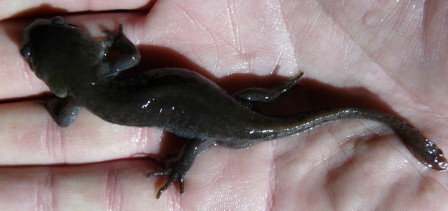
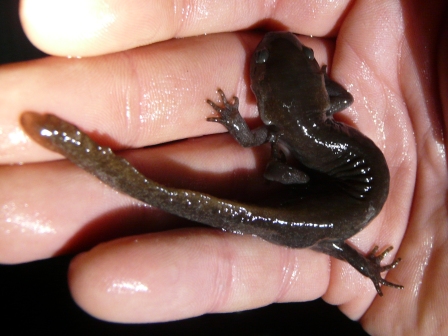
At the shallow end of the pond, I found a few mole salamanders (Ambystoma talpoideum). In our region, this species is found only at ephemeral ponds. Like spotted salamanders, they lay egg masses attached to small twigs in the pond, although the mole salamander has a smaller cluster of eggs (fewer than one hundred, rather than up to two hundred as in spotteds). The adult is also smaller, about half the length of the spotted.

Ephemeral ponds are in trouble – they have no legal protection in most states. The federal Supreme Court SWANCC decision removed Clean Water Act protections from these and other “isolated wetlands”) and these small pools tend not to get protected when residential development, tree plantations, or other habitat modifications happen in a forest. A few states have adopted their own protections, but Tennessee is not one of them, to my knowledge (and I’d be oh so happy to be corrected on that point if some recent legislative action has taken place).

Salamanders were not the only creatures on the move.

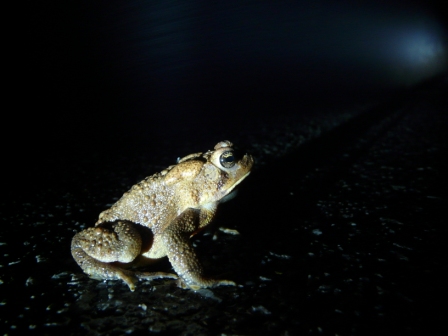
Toads were sitting on the paved roads in town.

I suspect that the toads were hunting stranded earthworms, which were everywhere.

Turning the flashlight around for a moment, another wet-skinned night wanderer was seen in the rain.

In closing, I’ll record a new life goal: to get some waders that don’t leak. The gallon or two of water that oozed into my boots was cold, cold. On the other hand: the feeling of icy water around my toes; the utter silence of the woods except for the patter of water drops in the dark pool; the spicy smell of wet leaves on the forest floor mingling with the slightly sulphurous odor of the black, sodden leaves on the pond margins; the feel of rain on my face. These things bring me back to my senses. Reframing: leaky boots are a doorway into experience. A new product line idea for LaCrosse boots?

The sign of a Saturday night well spent: wringing out your socks.

Merlin!

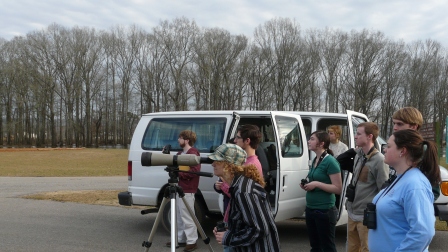
This lonesome old tree by the waterline has a special visitor perched at its top: a merlin visiting from Northern Canada. Merlins (Falco columbarius) are small falcons that breed in the boreal forest. They are uncommon winter visitors to our region. We found the bird at the end of our class visit to Crow Creek Wildlife Refuge near Stevenson, AL.

Merlin, condensed to about 2 pixels. Great views through the scope, though.

Merlins are spectacular little birds. They sit and wait for an unsuspecting songbird to fly past, then they explode into rapid flight and chase down the prey, catching it in midair. They are the fighter jets of the bird world: fast, maneuverable, and uncompromisingly fierce. “…no falsifying dream/Between my hooked head and hooked feet”.

Scoping

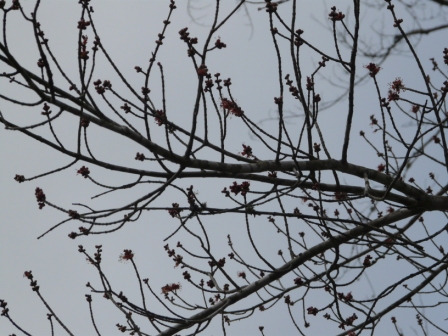
The warm weather turned up some other unusual phenomena: great-blue herons standing over their big stick nests, maples in bloom, and chorus frogs singing. This is a very peculiar January — prolonged warm weather has unlocked all kinds of activity that in normal years would not happen for another month.

Red maple flowers...on Jan 31st

In summer, the water in the Crow Creek Refuge is carpeted with the large round leaves of American Lotus (Nelumbo lutea; also called Water Chinquapin). Now, the plants are invisible (their stems are underwater in the mud) except for the strange seed receptacles that litter the shoreline like organic showerheads.

Seeds fit inside the holes on the top surface.

We also found a rare specimen of Florus plasticus washed up on shore.

The pollinator of this flower is unknown, but it probably requires a battery.

Limestone foray

I rambled halfway down the mountain to visit some caves this morning. The Cumberland Plateau is a layer-cake of rock: the top layer is sandstone, the bottom is limestone. Sandstone does not dissolve in water, but limestone does. Over millions of years, this dissolution of rock by water has gouged holes in the lower reaches of the mountainside, creating an impressive network of caves.

From the outside, looking in.

From the inside, looking out.

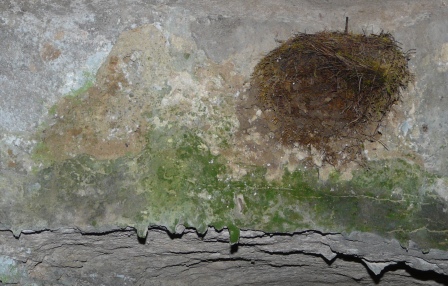
A phoebe nest on the inner wall of the cave, about fifty feet back from the entrance. These nestlings were raised in near darkness. Their first flight out into the world must have been a revelation.

"Solomon's Temple" cave entrance. No Ark of the Covenant here, just limestone-adapted spleenwort ferns.

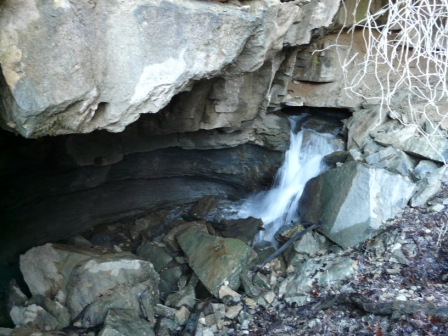
An underground stream surfaces briefly at the base of the cliffs. Inside the cave, this stream roars away at the bottom of large pits. I was by myself, so I did not scramble into the cave to see them again -- rule number one of caving is 'don't go inside dangerous caves alone'.

Multiple layers of eroding and fractured rock: another reason for caution.

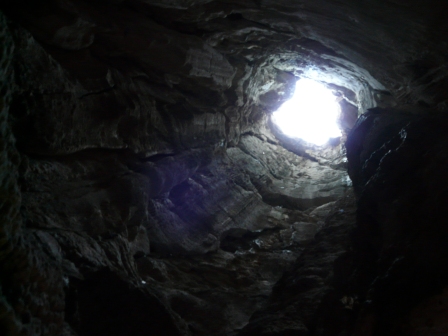
My favorite spot around these caves. This is a vertical tube, about twelve feet wide, running straight down from a hole on the forest floor, emerging far below in a pile of debris on the side of the cliff face.

Just below the cliffs and caves, I found the first wildflower of the the year, “pepper-and-salt” or “harbinger-of-spring”, Erigenia bulbosa. It seems a little early to be harbinging the spring — we’ve got plenty of winter to go yet — but it is good to be reminded that spring will come. These little flowers belong to the carrot family and their tuberous root is supposedly edible. I’d rather leave them rooted and feed on the hope they offer.