I lean my face toward the beech branch and set off a Rio Carnival of dancing insects. Each tiny aphid is dwarfed by the white plumes that arch from the rear of its abdomen. They don’t samba, but they do shake their tail-feathers, pulsing in a loosely coordinated dance as they shuffle along the branch. From a distance the massed white has a creepy air, like the heartbeat of a blighted, molded animal; from closer, the aphids look like flecks of possessed, animated candy floss.

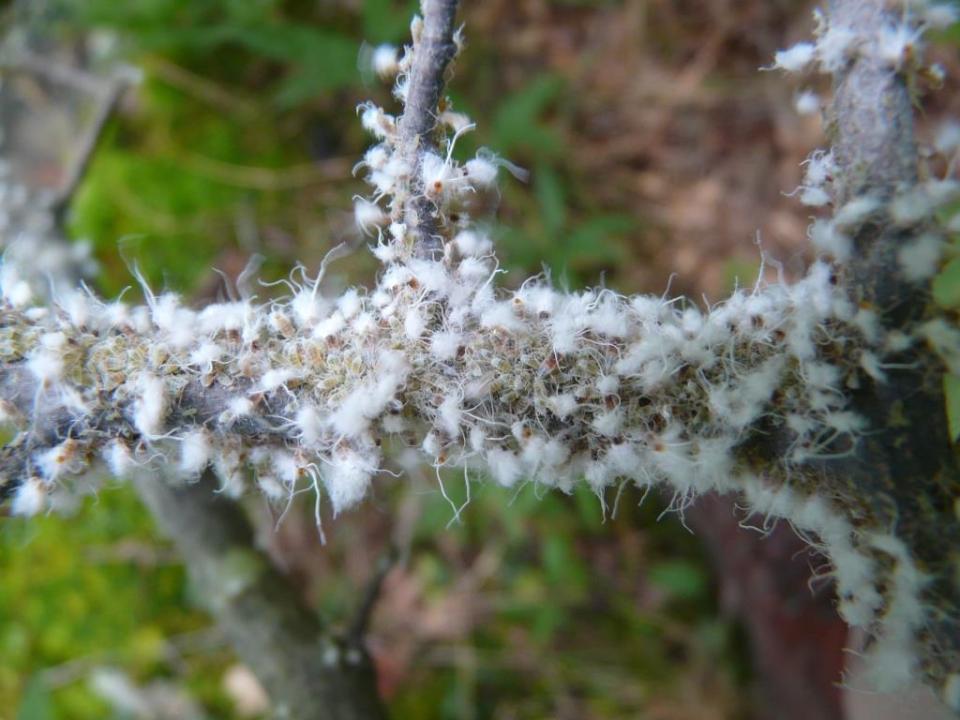 It is only the larger aphids that are adorned in this way. Smaller ones are gathered in a crèche where they squirm their pallid bodies over each other, snuggling into the mass as the larger insects walk over them. Under the twig, this mass swells and a light poke from my pencil reveals — it is hard to say what — a blob, a flattened jellybean, an unformed lump of the same pallid insect flesh.
These odd creatures are beech aphids, Grylloprociphilus imbricator, sometimes called “beech blight aphids” (although they are not a fungal blight) or boogie-woogie aphids (although their left hand piano shuffle is not up to par). Their dance is a defensive warning: insects that amble into the colony will be jabbed by the piercing mouthparts of the older aphids. They are too weak to hurt humans or other large animals, but the creepy-looking dance is enough to make most creatures hesitate for a moment. Any mammal or bird that ignores the warning and takes a bite will get a mouthful of tangling wax as the plumes on the insects’ backs break away. I tongued one or two and can report no apparent defensive chemicals, although who knows what my taste buds missed.
The colony is comprised entirely of clones. A foundress — the blob that was so well hidden in the squirming mass — picked this twig weeks ago and started giving birth to little aphids, genetic clones of herself. The young female aphids feed, grow and defend the colony. Later, some of these offspring will mature into winged forms (alates) that disperse and found new colonies, again reproducing asexually. Then in the fall, some males will be produced allowing a little genetic mixing before the winter.
This species is widely distributed and are quite often encountered in yards. Yet details of its life history are, as far as my literature searches can tell me, mostly undescribed: When does the switch to sexual reproduction happen? How does the foundress feed or is she fed by her kids? How and where do they overwinter? How many asexual generations are completed within a year? What kinds of predators and parasites plague the colonies? Some the species’ close kin (other wooly and gall-forming insects in the subfamily Eriosomatinae of the Aphididae) have ant-like life histories, forming solider castes within the colony. Grylloprociphilus seems less specialized, but without detailed life history studies, we can’t say more.
Aphids feed by using their sharp mouthparts to sup on the sweet phloem sap of plants. This sugar-laden juice is poor in protein, so they have to process a lot of sap to get their dinner. The insects discard excess sugar, coating the leaves and ground below the colony with sticky “honeydew.” This makes the colony quite a hub of activity. As I watched, at least four species of hover fly and one species of fruit fly visited the leaves to feed on the sweetness. And a fungus species, Scorias spongiosa, specializes on the honeydew of the beech aphid, growing nowhere else.
So as the carnival passes, candy gets thrown to the crowd.

Syrphid fly, “hover” or “flower” fly. One of several that visited the colony.
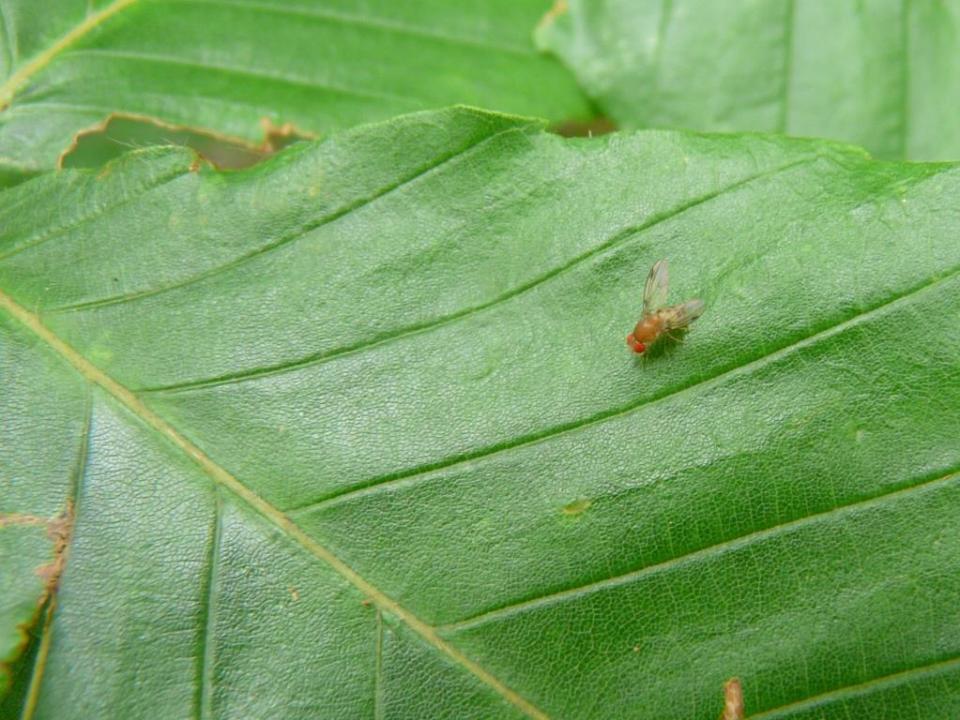
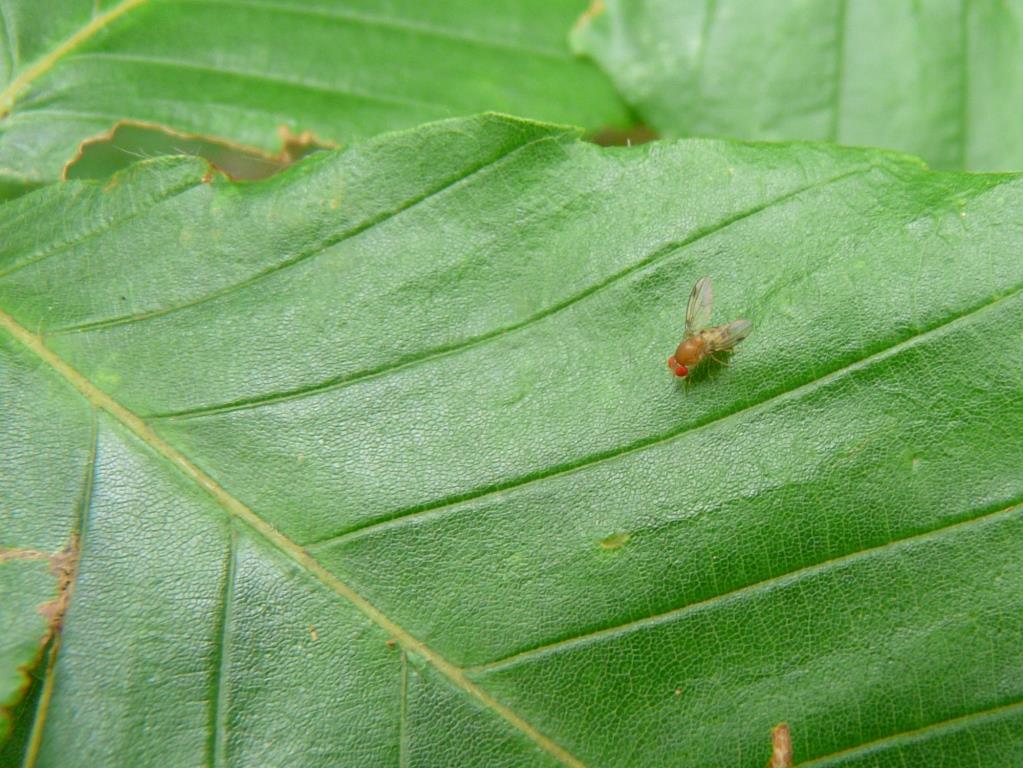
Tiny red-eyed Tephritid fly or “fruit fly,” slurping on honeydew.
 Unlike all other land snails and slugs in our region, this species belongs to the family Helicinidae, a group of mostly tropical land snails that are more closely related to the marine snails than they are to other terrestrial snails. The animal’s body reveals this kinship: it has an operculum (a “trap door”) with which it seals its shell when withdrawn, it has just one pair of antennae (other land snails have two pairs), and its eyes are located at the base of the tentacles instead of at their tips. These seemingly minor differences indicate a deep divergence, analogous perhaps to the difference between a bird and a bat. Like birds and bats, the two lineages of snails independently evolved the ability to live in a new habitat — creeping onto land. Not quite as impressive as taking wing, but then what use is a radula in the air?














 David George Haskell