Yearly Archives: 2012

Microsafari: Bear hunting

I spent much of Saturday on a trip organized by the Sewanee Herbarium, led by Paul Davison from the University of North Alabama. In addition to being a botanical expert, Paul is a master of finding the “wee beasties” (a phrase used by the pioneering microscopist Van Leeuwenhoek) that surround us: the micro-world of single-celled protists and tiny animals, all existing just beyond the limits of our vision. But, with some simple equipment and a hand lens or microscope, this world opens up for us. About 24 people came on the trip, a good mix of Sewanee biology students and faculty, along with community members.
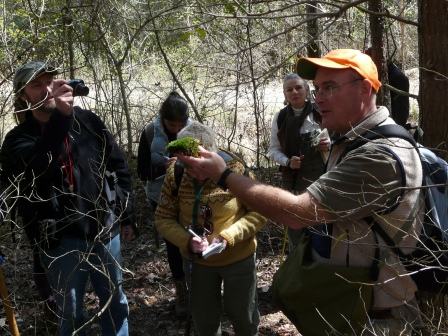
Paul Davsion discussing the "pin cushion" moss, Leucobryum.

Curious structures growing in the Leucobryum moss: undescribed in the North American literature, apparently. Perhaps micro-male mosses growing within the larger female parts of the plant (the Archegonia, for lovers of botanico-jargon).
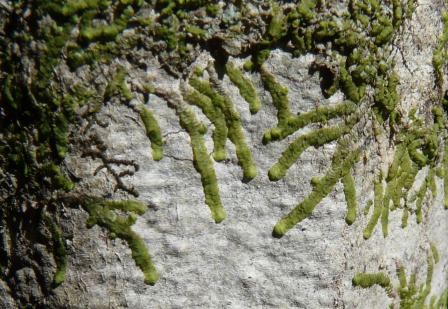
Leafy liverworts creeping across tree trunks.
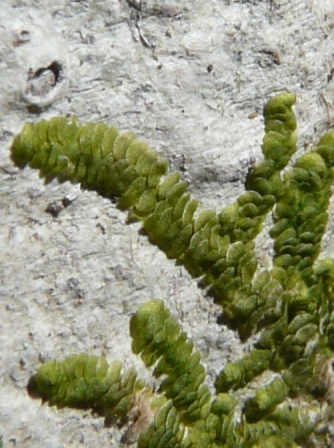
Seen close, the alternating scale-like flaps (not true leaves) of the liverwort are visible.

After a foray into Lost Cove, we returned to the lab to pull open the door to another world (amazingly, also the same world) by looking at critters under microscopes. We found legions of algal cells, whizzing crustacea, lumbering protists, and gliding flatworms.

By holding my camera up to the microscope lens, I snapped a few shots of a couple of my favorites.
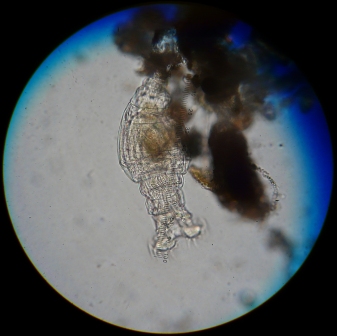
A rotifer, or "wheel animal". Its head is pointing down and its rear end is clasping some dead plant material (aka crud). the two Mickey Mouse ears are ciliated (cilia = hairs that stir the water) feeding devices, moving food into the mouth.
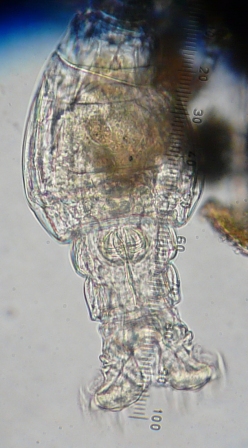
A close look at this shot shows the grinding pharynx that pulverizes food as it moves through the gut (look for the round structure to the left of the "60" mark).
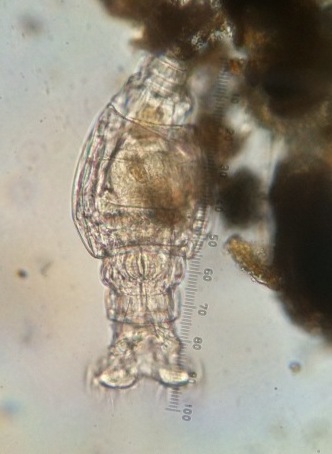
Commercial break: go buy Apple products. Chris Waldrup sent me this photo that he took through the scope with his iPhone. Pretty darn good. Yes, I want one.

Now for the bear: this is a tardigrade, also called "waterbear" or "moss piglet" (with some crud to the left and below -- the waterbear is at the top). It was indeed living in some moss. They have eight little legs and amble along like bears. This one is stranded on its back with its front legs pointing to the left and its hose-like mouth just visible. Don't let the rolly-poly cuteness fool you: these are the toughest animals in the world, able to enter suspended animation and survive the deepest cold imaginable, vacuums, radiation blasts, utter dryness for years, and exposure to temperatures above the boiling point of water.
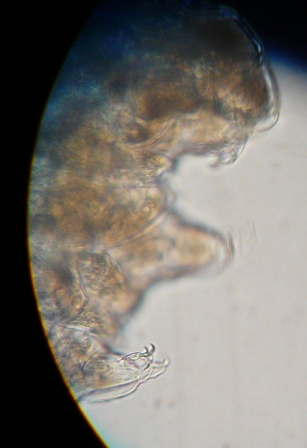
Tardigrade feet, equipped with claws for clinging to their mossy homes. They'll still be hanging on when Homo sapiens has turned to a layer of dust in the geological column. So far, tardigrades have been around for 600 million years. Modern humans, less than one tenth of one percent of that.

Thank you, Paul Davison, for leading the hunt. Thank you also to Jon Evans and Mary Priestley for organizing the event.

Cute larvae. Adults are a different story.

Looking down on this fast-flowing stream in Shakerag Hollow we see wavy lines on the submerged rocks. Moss? Algae? No, ...

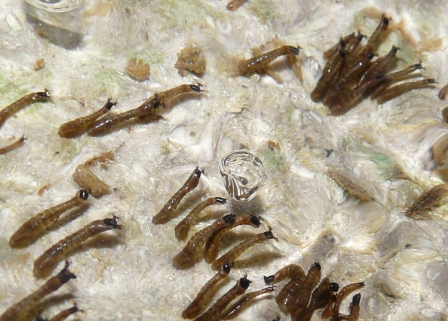
...these are clusters of blackfly larvae (Fanily Simuliidae). Each larva is attached to the rock with claspers on its rear end; silky threads provide additional anchorage. They prefer the fastest flowing parts of the stream, so these attachments are strong.

With a flash photo, we can see the larvae leaning with the current. They thrive in the oxygenated water of unpolluted streams.

Two fan-like feeding appendages crown each animal. The fans are used to sieve bacteria, algae, and small pieces of plant material from the flowing water. In good conditions, every few seconds the fans sweep food into the animal's mouth.

After a few weeks, the larvae pupate underwater (still attached to the rock in flowing water), then emerge as the infamous flying adults. Males feed on nectar, but females want blood. Unlike the swarms that emerge in northern states, blackflies are seldom numerous here.

To turn, turn will be our delight…

…’till by turning, turning we come ’round right.

This venerable cedar stands at the base of Shakerag Hollow, on the edge of an overgrown old pasture that has now turned to woodland. The tree’s original apex is pointing directly to the right and is almost rotted away. Decades ago another tree must have fallen on the main stem and bent the trunk down. Side branches then took over, growing straight up from what was formerly the side of the tree. The grain of the wood is contorted and twisted like old rope. Gnarly.

Waxwing invasion

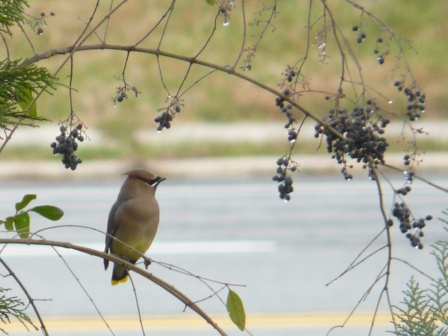
Flocks of hundreds of cedar waxwings descended on Sewanee this week. They travel in nomadic groups, searching for sugary fruits. Unlike most birds in our region, waxwings feed almost exclusively on fruit for much of the year. In Sewanee, they are sporadically common in the spring and fall, but very scarce in summertime. Most of the birds that are here this week will move north and east to breed. Look for them perched in tight clusters in the treetops or fluttering around fruiting shrubs.

The waxwings’ high-pitched calls (up to 8kHz, nearly twice as high as the highest piano note) are distinctive, but they test the limit of our hearing. For many people, the calls are inaudible except at close range when the sound gets loud enough to cross the ears’ detection threshold. As we age, we naturally lose hearing in the high range, although this can be accelerated by exposure to loud noise (earplugs are a naturalist’s best friend…).

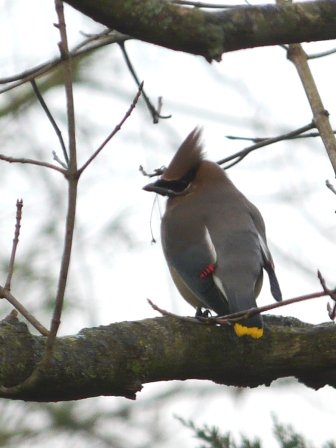
Waxwings are named for the tiny red “flags” on the end of some of their wing feathers. Although these little flags look like wax, they are made of the same material, keratin, as the rest of the feather, infused with red pigment. Young birds have fewer flags, so these red marks may act as social signals through which older birds can avoid breeding with inexperienced youngsters. Older birds have higher breeding success, so it is to their advantage to stick together.

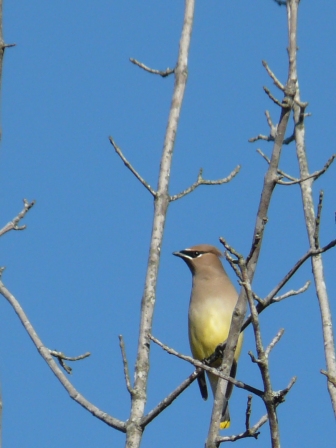
The yellow bar across the end of the waxwings’ tails is also produced by a pigment in the feathers. Over the last forty years, waxwings with orange-banded tails have appeared, especially in the north-eastern parts of the continent. At first, scientists speculated that this was a new mutation, spreading through natural selection. Further study showed that no genetic change was involved. Instead, the waxwings were feeding on the fruits of an invasive plant, Morrow’s honeysuckle, that contained orange pigment. If a molting waxwing feeds on this honeysuckle, the new feathers will pick up the orange pigment. In addition, all the fat in their bodies gets stained. I think of waxwings every time I see someone sucking on a blue slurpee. Surely their insides must be turning blue; maybe the hair will follow.

The photos on this page show the various ways that the waxwings use their silky crests to signal to each other — flat, cocked, and spiky. This expressiveness, combined with their eye-bands and overall silky plumage makes them one of the sharper-dressed birds in our region. Classy.

My account draws on information in: Witmer, M. C., D. J. Mountjoy and L. Elliot. 1997. Cedar Waxwing (Bombycilla cedrorum), The Birds of North America Online (A. Poole, Ed.). Ithaca: Cornell Lab of Ornithology. doi:10.2173/bna.309  The lead author on this paper is Mark Witmer, a colleague from grad school. He showed me the orange insides of a waxwing once — very cool.

Some early stirrings in Shakerag Hollow

After work yesterday I headed down into Shakerag Hollow to see what was stirring at the end of the warm afternoon. It was a pleasure to walk with just a shirt on my back — discarding the wintry weight and confining clutter of jackets and gloves and fleeces and hats. Ah!

Scarlet cup fungi (Sarcoscypha sp.were fruiting in one or two places on the side of the trail. They feed on decaying plant matter and grow their striking red “cups” throughout the year, but especially in cooler months. Spores are produced from the inner surface of the cup. These blow away (or are carried on mouse feet) to colonize more dead vegetation, of which there is no shortage on the forest floor. The scarlet cup is a favorite of mine –saturated with color at a time of year when the rest of the forest is mostly muted.

Bloodroot plants were poking up their flowers. Most were still tightly closed, but one or two had cracked open a little. The deeply incised leaves are held clasped against the stem, only relaxing into an open posture when the flower is mature or dead.

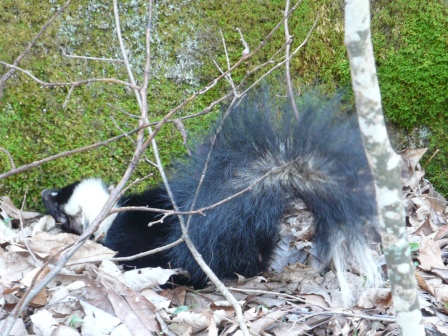
I was not the only mammal out and about in the balmy woods. Junebug the Hound found this skunk, but fortunately she paid attention to my bark: leave it! The skunk had its tail arched, ready to express its opinion.

Cranes over Chattanooga

I was in Chattanooga yesterday and took an hour off to bike the Riverpark, a fabulous linear park that starts in downtown, then stretches for ten miles along the Tennessee River.

The highlight of the ride was a flock of sandhill cranes (Grus canadensis) overhead. They were flying along the river, wheeling occasionally in a big disorganized circle, then reforming into a northbound V. I suspect that they were looking for somewhere good to feed and were disappointed by the lack of swamps in the urban center, so they chose to move on. They are likely part of the congregation of overwintering cranes at Hiwasee Refuge, a gathering that numbers in the tens of thousands is the largest wintering aggregation of sandhills outside of Florida. These Tennessee birds return to the upper mid-west to breed.

This slideshow requires JavaScript.

Aldo Leopold wrote of these birds, “When we hear his call, we hear no mere bird. We hear the trumpet in the orchestra of evolution.” This is no accident — the trachea of these cranes coils within their sternum (chest bone) to make a resonating instrument very much like a trumpet. Both sexes call, often in vigorous duets.

For some remarkable footage of cranes in flight, see this almost dream-like series of shots of common cranes flying over Venice.

Little blooms

Gray, gray day: you will not win.

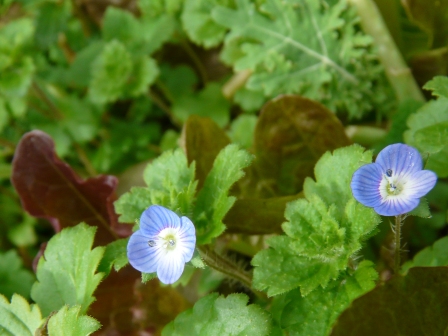
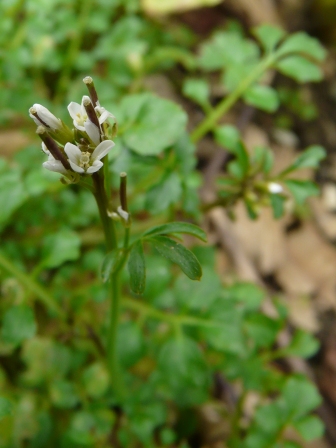
As an antidote to the unrelenting rain and murk, here are a couple of tiny beauties that I photographed earlier this week. Both were growing between lettuce plants as “weeds” in my cold frames.

Bird's-eye Speedwell, Veronica persica. So small that ten of these flowers would fit onto my thumb-nail.

Wikipedia says that this species has "no known horticultural uses." Unbidden beauty is utility enough for me.

Small-flowered bittercress, Cardamine parviflora.

Each flower is about as big as a grain of rice.

This is the first year that either of these species has shown up in the cold frames. Their seeds may have come with compost from other parts of the garden or as “extras” in packets of lettuce seeds.

Rambling into YouTube

The “trailer” for my upcoming book, The Forest Unseen, is live on YouTube. I get kinda excited about twigs at one point. With good reason.

I’ve also been adding venues for readings/lectures, including a few on the west coast. The book itself will not be out for another month, but great reviews are coming in. The book’s website has the latest. After many years’ work, I am very excited about getting the book out into the world.

Coyotes

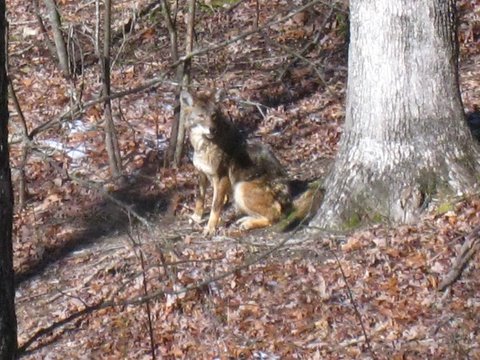
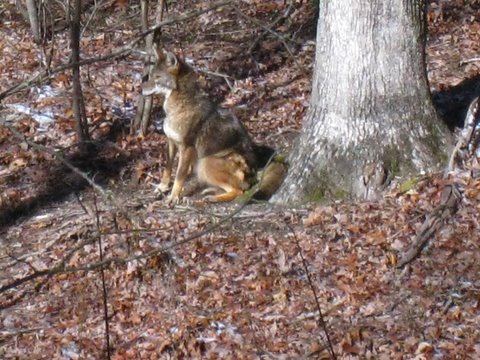
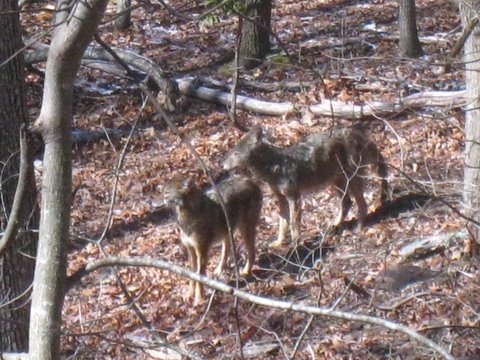
Harold Goldberg sent me these great photos of coyotes taken from his house in Sewanee. You can also see the photos in this week’s Messenger (I’ve held off on posting until the latest edition of the Messenger went live — no natural history scoops from me! :) )

At this time of year, coyotes are pairing up and breeding. Unlike many mammals, the male sticks around to help raise the young, as do some non-breeding pups from previous years. These family groups get very vocal when they reunite after hunting forays. I’ve heard their crazy yips and howls near our house for the last several nights – an acoustic dose of the wild. The goats and Junebug the Hound are not amused.

Coyotes have invaded our region from the Western states, partly replacing the ecological role of the wolves that used to roam here. But wolves sat atop the food chain, specializing in group hunts of large animals. As deer and forests were decimated in the wake of European arrival, the wolves disappeared, helped along by vigorous persecution. Coyotes are more flexible, eating small mammals, berries, insects, and whatever else is available and nutritious. This flexibility allows them to thrive in the fragmented, unpredictable world that we have created.

For those concerned about the abundance of deer in Sewanee, the arrival of coyotes is good news. Although they seldom take adults, coyotes do prey on fawns. For cat-lovers with outdoor pets, coyotes are cause for concern. Cats are a delicacy for most canids, including coyotes. This has some interesting ecological consequences. In California, areas with coyotes have thriving native bird populations, the result of predation by coyotes on cats (and behavioral changes in pet-owners – people are more likely to keep kitty indoors if they know that coyotes are on the prowl). This is a classic example of a “trophic cascade” in ecology – the effects of a top predator “cascade” down through the “trophic” (feeding)  levels in the system. My enemy’s predator is my friend.

Coyotes and wolves occupy interestingly different places in our cultural imagination. The wolf lives in that tense place between fear and desire (the Big Bad Wolf…ends up in bed…then slain…). Coyotes are more ambiguous. Most tales of coyotes regard them as playful, devious tricksters. These imaginings are fair reflections of ecology: the focused predator versus the jack-of-all-trades opportunist.

Listen for the trickster’s yodel…

Coda to Chuck D’s birthday

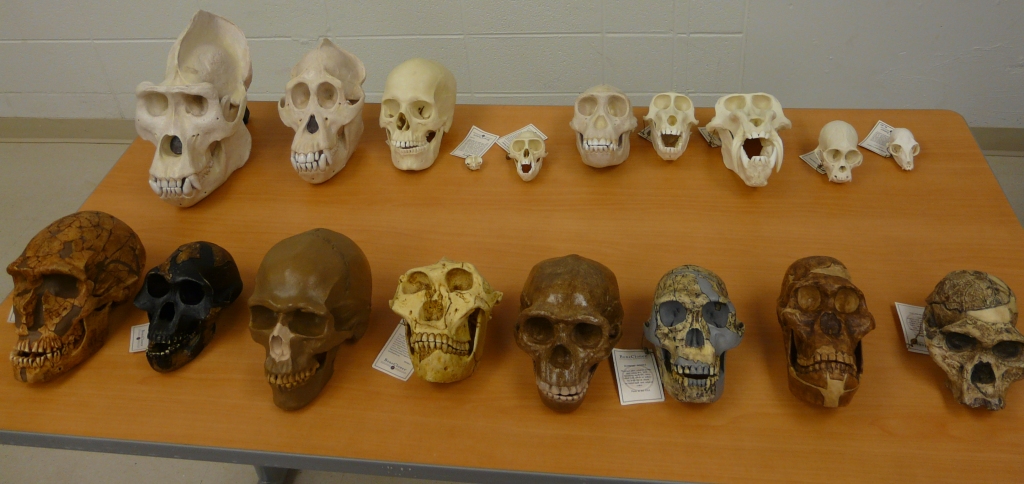
…the unity and diversity of life, illustrated by skull replicas of living primates (back row) and extinct putative human relatives (front row). Unity of form is plainly visible (short snouts, bony brain case, binocular vision, jaw arrangement) = the mark of kinship. Variations on the primate “theme” are also in evidence (teeth, skull size, muscle attachments, brain size) = ecological diversity. We measured these skulls and talked about their significance in Intro Bio this week.

A few cool living relatives:

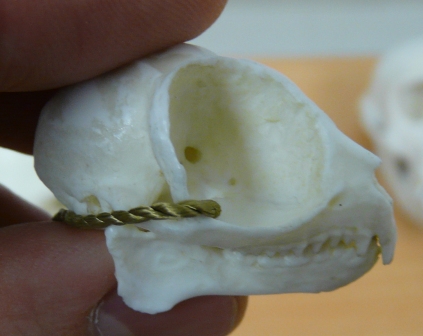
Tarsier: a nocturnal (BIG eyes) insectivore (sharp little teeth)

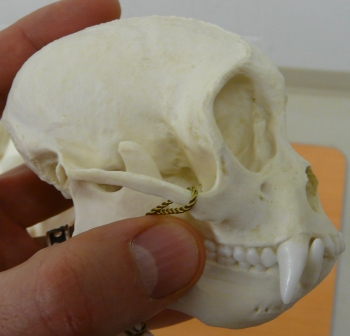
Capuchin — strong premolars for cracking nuts, big ol’ canines for social “interactions”

The largest living great ape — massive sagittal crest (ridge of bone on top of head) for attachment of HUGE chewing muscles used to chomp on stems and leaves. The ape-cow.