Yearly Archives: 2012

Here is a bird in whose strain the story is told

I heard the first wood thrush this morning, singing in the thickets along Willie Six Rd. By the time I got my class out there, the bird was silent. Next year, I’ll reschedule this class to begin at 7am instead of 8am, for the whole darn semester. More in tune with reality, I think.

The wood thrush sings with pure notes, unadorned by harmonics, slightly offsetting the tones from the two sides of its throat. The result is gorgeous. Thoreau, as usual, had something to say about this:

“The wood thrush’s is no opera music; it is not so much the composition as the strain, the tone, — cool bars of melody from the atmospheres of everlasting morning or evening. It is the quality of the sound, not the sequence. In the peawai’s [Eastern wood-pewee] note there is some sultriness, but in the thrush’s, though heard at noon, there is the liquid coolness of things that are just drawn from the bottom of springs. The thrush alone declares the immortal wealth and vigor that is in the forest. Here is a bird in whose strain the story is told, though Nature waited for the science of aesthetics to discover it to man. Whenever a man hears it, he is young, and Nature is in her spring. Whenever he hears it, it is a new world and a free country, and the gates of heaven are not shut against him.” (from Thoreau’s Journals, July 5th, 1852)

The gates of heaven are not closed, agreed. But they are swinging shut, quite fast. Wood thrushes are in decline, the victims of fragmented forests, air-borne mercury from our coal plants, and lost wintering habitat. I culled the following graph from the Breeding Bird Survey. It shows an index of wood thrush abundance over the last forty years. In my lifetime, the species appears to have halved its abundance.

But, given a chance, these birds can bounce back. Indeed, it is likely that in many regions they were a lot less common in Thoreau’s day (the late 19th century was a time of massive deforestation) than they are now.

If you want a taste of heaven for yourself, The Music of Nature site has some nice footage and sound. But computer speakers and pixels are wan memories of reality. In the words of another bewhiskered New England word- and nature-lover, “You shall no longer take things at second or third hand, nor look through the eyes of the dead, nor feed on the spectres in books;/You shall not look through my eyes either, nor take things from me:/You shall listen to all sides, and filter them from yourself.”
Valley of dry bones

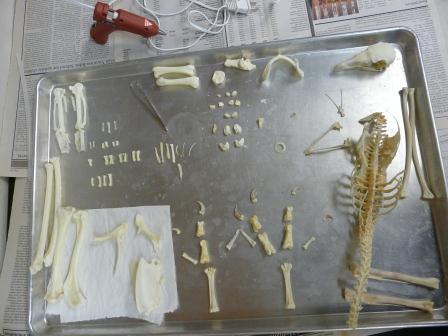
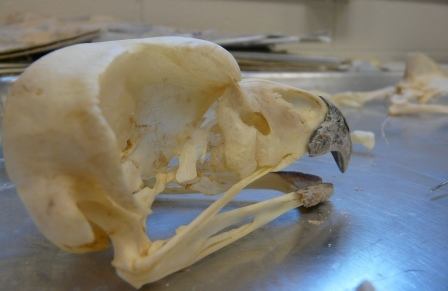
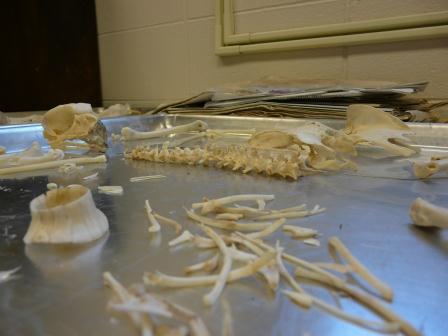
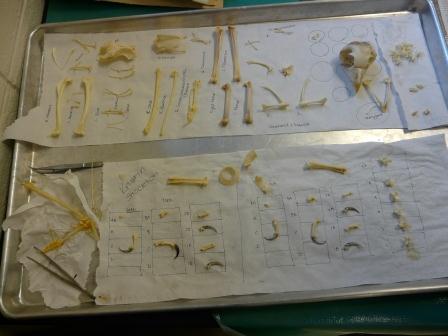
Students in my Ornithology class complete a term paper of bone. Each student is given a dead bird (window- and road-killed). The task: dissect and study the bird, then strip its bones bare (with the help of flesh-eating beetles), and finally re-articulate the skeleton (using the magic powers of the hot glue gun). The project sits at the junction of zoology, horror, and arts-and-crafts.

The bones are presently all cleaned up and ready to be put back together (owls and vultures shown below).

“the valley … was full of bones,/…and, behold, there were very many in the open valley; and, lo, they were very dry/…there was a noise, and behold a shaking, and the bones came together, bone to his bone”

Extra credit for breathing on the slain that they might live.

Paddling with Carson and Byron

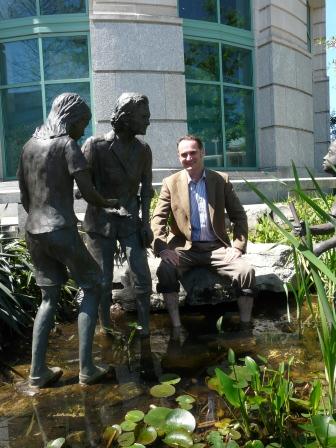
The entrance to the North Carolina Museum of Natural Sciences has a sculpture and native plant garden honoring the great writer Rachel Carson.

Carson is sculpted with her trousers rolled up, feet in a pond, showing two children the creatures in the water. Despite being dressed for oration instead of investigation, I decided to join her for a paddle. Stephen Garrett, a friend and former student who came to my talk was kind enough to take a photo or two. He was also kind enough not to say anything about my unsophisticated camera gear (he’s a pro, so I hesitated to hand over my little pixel-snatching machine).

cooooold

Child, Genius, and Grinnin' Fool.

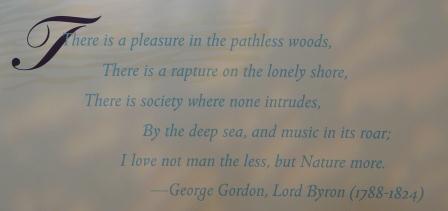
The Museum also had this nice quote painted in large print across one of its walls. In my experience, Lord Byron is not someone often featured in the halls of science or natural history museums. It is a pity that they left off the last four lines, “From these our interviews, in which I steal/From all I may be, or have been before,/To mingle with the Universe, and feel/What I can ne’er express, yet cannot all conceal.” ..stealing away from past and future, to the inexpressible present…nicely done.

“Lonely” the museum was not. There were an impressive number of people visiting its excellent exhibits. And, on April 20th, the museum will open a big new wing featuring “How Do We Know?” exhibits — e.g., “Dinosaurs taste like chicken — How do we know?” Good question. (I hear one answer from my Tennessee grilling friends: Yessir, but here in Tennessee our chickens taste a little better ‘n that, it’s in how you cook’em. Those Raleigh folks don’t know how its done.)

If you’re headed to Raleigh, I strongly recommend a visit (but not yet — the whole museum closes tomorrow to complete the last stages of construction).

Inky cap

I made a quick visit to Shakerag Hollow this morning and found the biggest Inky Cap mushroom that I’ve ever seen (genus Coprinus, probably — but see here for identification complications). It stood about a foot tall, growing right next to the trail.

Inky Caps are named for the dripping black goo that edges their caps. Like other mushrooms, spores are produced under the cap. Unlike other mushrooms, the cap liquifies after the spores have been released. Spores mature first on the outer edge of the cap, so the cap shrinks as the spores are released. This keeps the edge of the cap adjacent to the mature spores, letting them catch the best air currents. Liquefaction through self-digestion is somewhat horrifying but also strangely beautiful process (Salvador Dali, anyone?).

Celandine Poppies

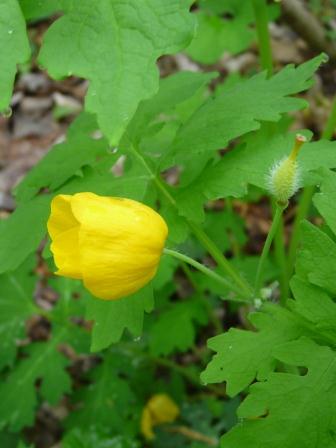
On my return to Sewanee, I made a trip down Shakerag Hollow to see whether I had missed the blooms of my favorite spring flowers, celandine poppies (Stylophorum diphyllum). These are short-lived flowers, easily damaged by rain, a fragility that somehow makes them all the more compelling.

Most had set seed already, with hairy pods hanging below the leaves.

But a few flowers remained. This is one of the few yellow-flowered species in the spring (in this patch of woods, they are the only one).

Ants play an important part in the life history of this species. The small fruits that fall from the pods have large ant-attracting food packages, elaiosomes, attached to them. The ants drag off the fruits, eat the attractant, then discard the fruit. In this way, the poppy seeds are “planted” in the good fertile soil of an ant waste heap. Thank you, ants.


Inching into the future

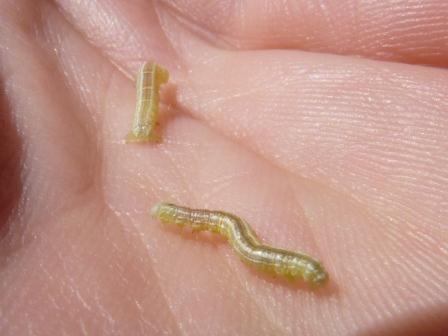
I’m visiting the University of Richmond where, just like Sewanee, spring is in full force and many weeks early. In addition to great people and beautiful buildings, the campus is populated by millions of inchworm caterpillars. Just walking between buildings results in the acquisition of half a dozen hitch-hikers, each one hanging by a silk thread from above, presumably drfiting down to new feeding areas or places to pupate. These caterpillars belong to the Geometrid moths, a family of brown moths named for the looping walking habit of the caterpillars — they appear to “measure, metron, the Earth,Geo,” as they walk along.

These seemingly insignificant creatures are one of the hinges on which our changing world swings.

The caterpillars come out when the oaks and other trees first unfurl their leaves. The young leaves have not yet had time to accumulate toxins to deter the inchworms, so the little caterpillars feast quickly, then their numbers dwindle.

Migrant birds time their arrival to catch the burst of caterpillars (food!). But, lately, the caterpillars are emerging so early that by the time the migrant birds arrive, the party is over. In Europe, this mistiming is so severe that it has caused significant population declines in some birds.

How or whether these dissonant changes in tempo will resolve is unclear.

The High Line

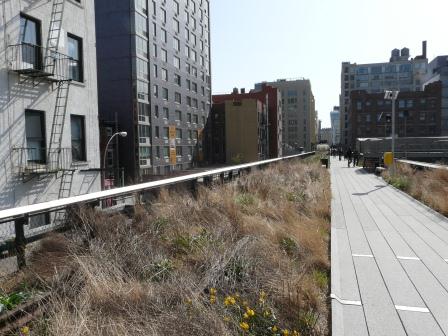
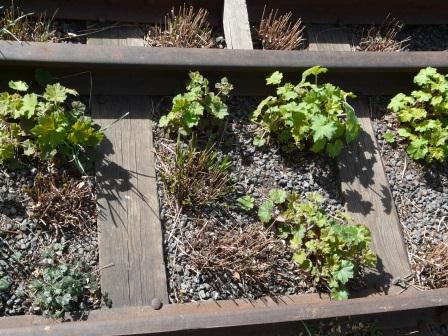
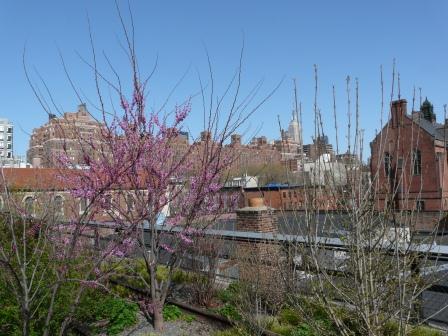
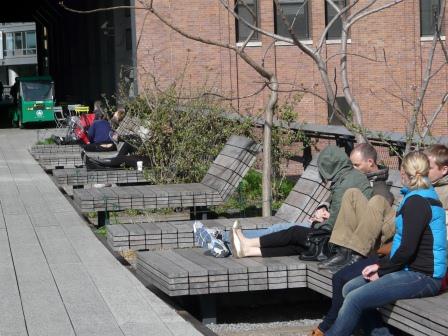
During my trip to New York, I made a visit to the High Line, surely one of the more interesting urban parks in the world. The park swings through West Chelsea and neighboring areas of the city, running along a disused elevated train line. The old tracks are still in place, forming the backdrop to varied plantings of native and ornamental plants. A wide walkway runs the length of the park, liberally scattered with benches and overlooks. I’d read about the park many times and was eager to visit.


The elevation of the park gives a feeling of both separation (walking above the streets) and connection (seeing roofs and buildings up close). As a New Yorker friend told me, “now you know what it feels like to be a pigeon.”

Ornithological insight is not the only fruit of this remarkable project. What was a derelict and ugly piece of infrastructure has become a thing of beauty. The affinity that people feel for the park is reflected in the many nearby ads for real estate. The creators of the park have created desirable habitat for Homo sapiens, it seems.

The unspoken rules among walkers on the High Line are more congenial than those of the world below. This is a place where ambling is OK — a verb that gets trampled in the surrounding streets.

Puget Sound

After my talks in Seattle, Olympia, and Tacoma, I spent Saturday in Tacoma with my friend Peter Wimberger. We were in graduate school together back in the early 1990s and we have a shared affinity for natural history, helping our students see the world through the eyes of evolutionary biology, and eating salmon. He was kind enough to take me on a tour of some good bird-watching spots on Puget Sound.

A different world from the forests of Tennessee.

Douglas firs, western cedars, Pacific yews. Ever Green. Tree trunks thicker than any that have grown in most eastern forests for hundreds of years. There is no “ground,” no litter layer; instead, moss, moss, moss, as if a bryophyte blizzard had passed through, leaving drifts everywhere.

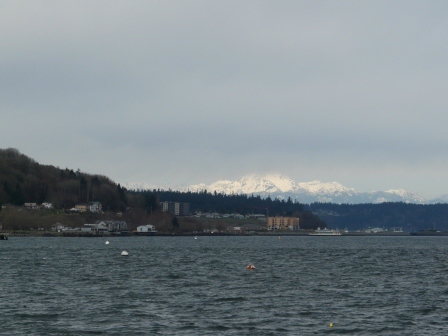
And on the water: murrelets, goldeneyes, harlequin ducks, scoters, loons, red-necked grebes. These are birds of cool rocky coasts, of Alaskan inlets, of moutain lakes, of streams running out from mountain glaciers. Look up from the water, and there are the snowy mountains rising behind wooded slopes and coast-hugging cities.

We conducted our bird-watching through binoculars and a scope, out of range of my modest, weak-lensed camera. But, a few ducks were bobbing close to shore. These Barrow’s goldeneyes were close to the dock. I’d never seen this species before. It is distinguished from its cousin, the common goldeneye, by the bright orange beak of the female and the crescent-shaped white patch on the male’s head. They winter on the coasts, but move inland to mountain lakes to breed, building nests in holes in dead trees. They feed by flipping their compact bodies forward and diving under the surface with a little splash. They swim down to grab mussels and other invertebrates from the rocky bottom. Their eyes are, indeed, golden — just visible in this photo.

Next stop, Newark, NJ…

Poultry Art installation

During my brief visit to Olympia, I stayed at Fertile Ground, a beautiful b&b right next to the public library where I gave my talk. Fertile Ground also serves as a hub for urban ag, art, and community building.

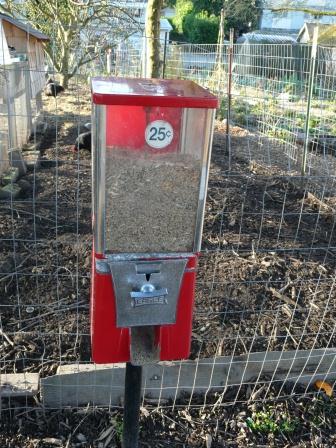
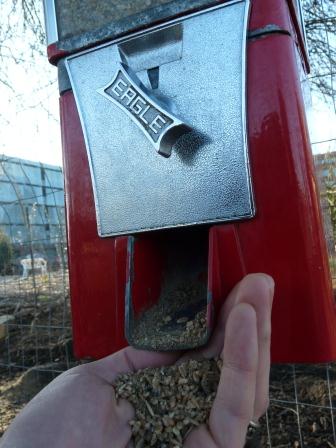
A small chicken pen sits next to the sidewalk, with hens scratching away within sight of the multistory office buildings and parking lots near downtown. The stroke of genius, though, is the chicken feed dispenser, right there on the sidewalk. Put in your quarter, turn the dial, and get a handful of feed to throw to the hens.

 There is something very rewarding about getting a handful of grain for your quarter, then tossing it to the hens (who know very well what is coming when someone approaches the dispenser). Like Vegas slot-machines, but the payoff is three hens in a row — winner!

I talked to Gail at Fertile Ground about this project of hers. Apparently, local kids love to put in their change and feed the birds. For me, this was the crowning achievement of the project: kids using quarters to get bird seed instead of sugary gumballs; kids playing Happy Birds (feathery real!) instead of Angry Birds (pixely fake!); and kids able to get a smile during their walk home.