Category Archives: Travels

Happy 203rd Birthday, Charles Darwin

“It is interesting to contemplate an entangled bank, clothed with many plants of many kinds, with birds singing on the bushes, with various insects flitting about, and with worms crawling through the damp earth, and to reflect that these elaborately constructed forms, so different from each other, and dependent on each other in so complex a manner, have all been produced by laws acting around us … There is grandeur in this view of life, with its several powers, having been originally breathed into a few forms or into one; and that, whilst this planet has gone cycling on according to the fixed law of gravity, from so simple a beginning endless forms most beautiful and most wonderful have been, and are being, evolved.” Charles Darwin, concluding paragraph from the first edition of On The Origin of Species.

Charles Darwin by John Maller Collier. The image is from the WikiMedia Commons.

Robert Pinsky on movement and grunting

Robert Pinsky spoke in the Hunter Lecture Series in Chattanooga a couple of nights ago. I knew I was in for a good evening when I swung into Moccasin Bend on I-24 and the biggest moon I’ve ever seen appeared, a massive golden orb in the blue dusk over the city lights. I was moved to invoke aloud the name of a Hebrew man-god. I had no camera, so was free from the temptation to risk my life by pulling over for a shot, and I was forced to just enjoy Lady Moon’s full spectacle. On top of that miracle, I found an unoccupied free parking spot near UTC.

Pinsky did not read his poems (bummer), but instead gave a great talk (bummer erased) about art, education, the evolution of grunting, the physicality of poetry, and the Favorite Poems project. In other words, here was another Rambler (albeit a three-time poet laureate, so an über-rambler). I had a great time.

I will not attempt to give an abstract of his talk, but instead I’ll share a few interesting ideas and links to his great online poetry videos.

One of the questions he asked was, “why has an unpromising little ape [Homo sapiens] done so well when so many other species have more impressive physical attributes?” His answer: we cooperate, not just with those alive now, but with past and future generations. That sharing of knowledge is extraordinarily powerful. How do we accomplish this? Well, these days via the web. Before that, with the printed or scribbled word. But for most of our life as a species, by “moving and grunting in certain ways.” In other words, by dance, music and poetry (he left out story-telling, aka sitting around the fire BSing…). Art, he claimed, is the key feature of our species that has allowed us to thrive.

(Side thought: some skill with thrown rocks and spears probably helped. Give me poetry, but give me meat also. Poems about spears, maybe – Homer?)

After some discussion of taxi drivers in Russia, W. E. B. Du Bois, the Boston Arts Academy public high school, Robert Frost’s assessment of the poetry-college athletics nexus, the desirability of extending the educational philosophy of the ruling classes to all people (i.e., everyone gets to take art seriously, not just the aristocrats), and his experience of Aristotle as a college freshman, Pinsky made a convincing case that, for art, physical experience is central, not peripheral or ornamental. So, art is central to our existence as a species and the physicality of art is the ground on which all this is built. He illustrated this with some examples from the Favorite Poems project – “normal” people reading and talking about their favorite poems. These are not profs, critics, or specialists. Pinsky claimed that their giving voice to the poems allows us to “see the work of art happening in the reader,” a “deep connection” back over tens of thousands of years to the core of our nature as humans.

At a time when our lives often revolve around uploads and downloads to “the cloud,” with physicality reduced so often in our culture to tasteless gluttony and tawdry lust, his emphasis on artful embodiment was refreshing. Occupy: your body. I wonder how much of this embodiment can be captured in online videos? So asks the blogger through his Ethernet cable, coming to your Android (aye, language is telling).

Homo sapiens, let’s be the lightning that connects cloud to ground. We’re the one species that can do it. Yes, we can have both; sparks fly when they connect.

Merlin!

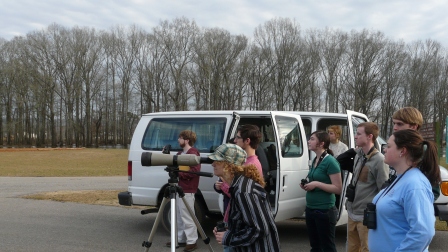
This lonesome old tree by the waterline has a special visitor perched at its top: a merlin visiting from Northern Canada. Merlins (Falco columbarius) are small falcons that breed in the boreal forest. They are uncommon winter visitors to our region. We found the bird at the end of our class visit to Crow Creek Wildlife Refuge near Stevenson, AL.

Merlin, condensed to about 2 pixels. Great views through the scope, though.

Merlins are spectacular little birds. They sit and wait for an unsuspecting songbird to fly past, then they explode into rapid flight and chase down the prey, catching it in midair. They are the fighter jets of the bird world: fast, maneuverable, and uncompromisingly fierce. “…no falsifying dream/Between my hooked head and hooked feet”.

Scoping

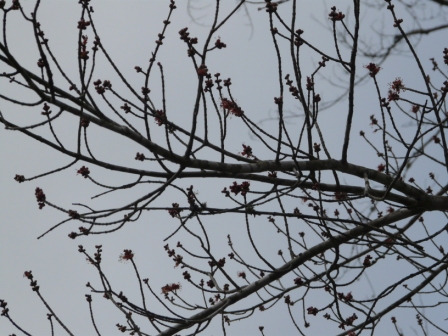
The warm weather turned up some other unusual phenomena: great-blue herons standing over their big stick nests, maples in bloom, and chorus frogs singing. This is a very peculiar January — prolonged warm weather has unlocked all kinds of activity that in normal years would not happen for another month.

Red maple flowers...on Jan 31st

In summer, the water in the Crow Creek Refuge is carpeted with the large round leaves of American Lotus (Nelumbo lutea; also called Water Chinquapin). Now, the plants are invisible (their stems are underwater in the mud) except for the strange seed receptacles that litter the shoreline like organic showerheads.

Seeds fit inside the holes on the top surface.

We also found a rare specimen of Florus plasticus washed up on shore.

The pollinator of this flower is unknown, but it probably requires a battery.

Woods Reservoir Trip

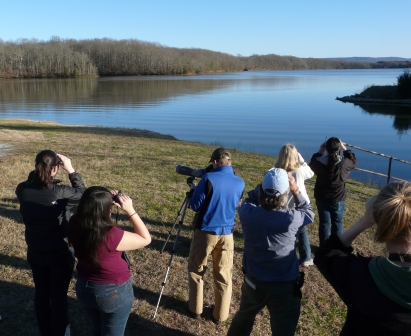
Yesterday, I took my Ornithology class to Woods Reservoir to look for ducks and other waterbirds. Many of these species overwinter here in the south before heading back north to breed in the boreal forest, the prairie-potholes, or the arctic. The weather was as warm and balmy as I’ve experienced in January and the duck count reflected this: we see fewer ducks during extended warm spells, presumably because they have not been pushed south by hard weather up north. However, we did see a good assortment, with the coots leading the count, as usual.

Many of the waterbirds that we saw are fish-eaters (loons, grebes, herons, mergansers). Unfortunately for them, Woods Reservoir is contaminated with PCBs and the fish bioacummulate these toxins and pass them up the food chain to the birds. The PCBs came from the Air Force’s Arnold Engineering Development Center (Woods Reservoir was built in 1952 to provide cooling water for the site). The Tennessee Department of Public Health has issued an advisory that recommends no human consumption of catfish caught from Woods Reservoir. They recommend that consumption of other fish species be limited to one fish per month. The birds (and the many fishermen at the lake) have evidently not heard this advice.

PCBs are found in the lake sediment and fish accumulate these pollutants in their bodies, especially in fat. Manufacture (but not use) of PCBs was banned in 1979, but the chemicals are very persistent, so linger in many ecosystems. PCBs were used at AEDC from approximately 1952 to 1990 and they are believed to have entered Woods Reservoir via streams draining contaminated soil at the site (2007 TDEC report).

Two non-duck highlights were a Bald Eagle and a Northern Harrier. The eagle gave us a great display, soaring in great ascending circles over the lake against the blue sky. Its slow, self-assured flight and eight-foot wing span embodied unfashionably grand qualities: majesty, imperialism, and hauteur. Bald Eagles may be ill-tempered, bad-breathed fish-scavengers, but they’re awesome nonetheless. The harrier flew across the lake with lazy wing beats as the sun set.

Why are we taking up all the room in the Manger?

Thousands of Jesuses have colonized the front lawns of America, surrounded by clusters of people and animals. What substance Jesus is made from varies by social stratum: carved wood is very upper crust (but is usually not displayed outside for the general public to see), plastic is a solid middle class option, and painted plywood indicates a rugged back-to-the-workshop blue collar household.

Regardless of the medium, Jesus lies in his manger alone. Other species cluster around as supporting characters, but they are not the ones that are going to get saved. There is a discontinuity here, a break that runs through our idea of the world: us (Homo sapiens, but probably not other Homo species, were any to show up at the communion rail) and them (a few million other species).

The Catholic Church is quite clear about this (my italics): “The magisterium of the Church takes a direct interest in the question of evolution, because it touches on the conception of man, whom Revelation tells us is created in the image and likeness of God … man is the only creature on earth that God wanted for its own sake … In other words, the human has a value of his own. He is a person … It is by virtue of his eternal soul that the whole person, including his body, possesses such great dignity … the origin of the human body comes through living matter which existed previously, the spiritual soul is created directly by God. With man, we find ourselves facing a different ontological order” Pope John Paul II, Message to Pontifical Academy of Sciences, Oct 1996.

So, although there may be physical continuity between us and other species, we’re the only lucky winners of the soul, of dignity, and, they say, of consciousness. Other denominations follow suit, although usually without a well articulated public statement of epistemology (gotta hand it to JPII: his comments are meaty and well-reasoned). And, the vast majority of society buys in also, including modern science (experiments on chimps, anyone?).

So, fellow Humanoid Earthlings: a lonely Christmas? Or might we truly be kin with our fellow creatures?

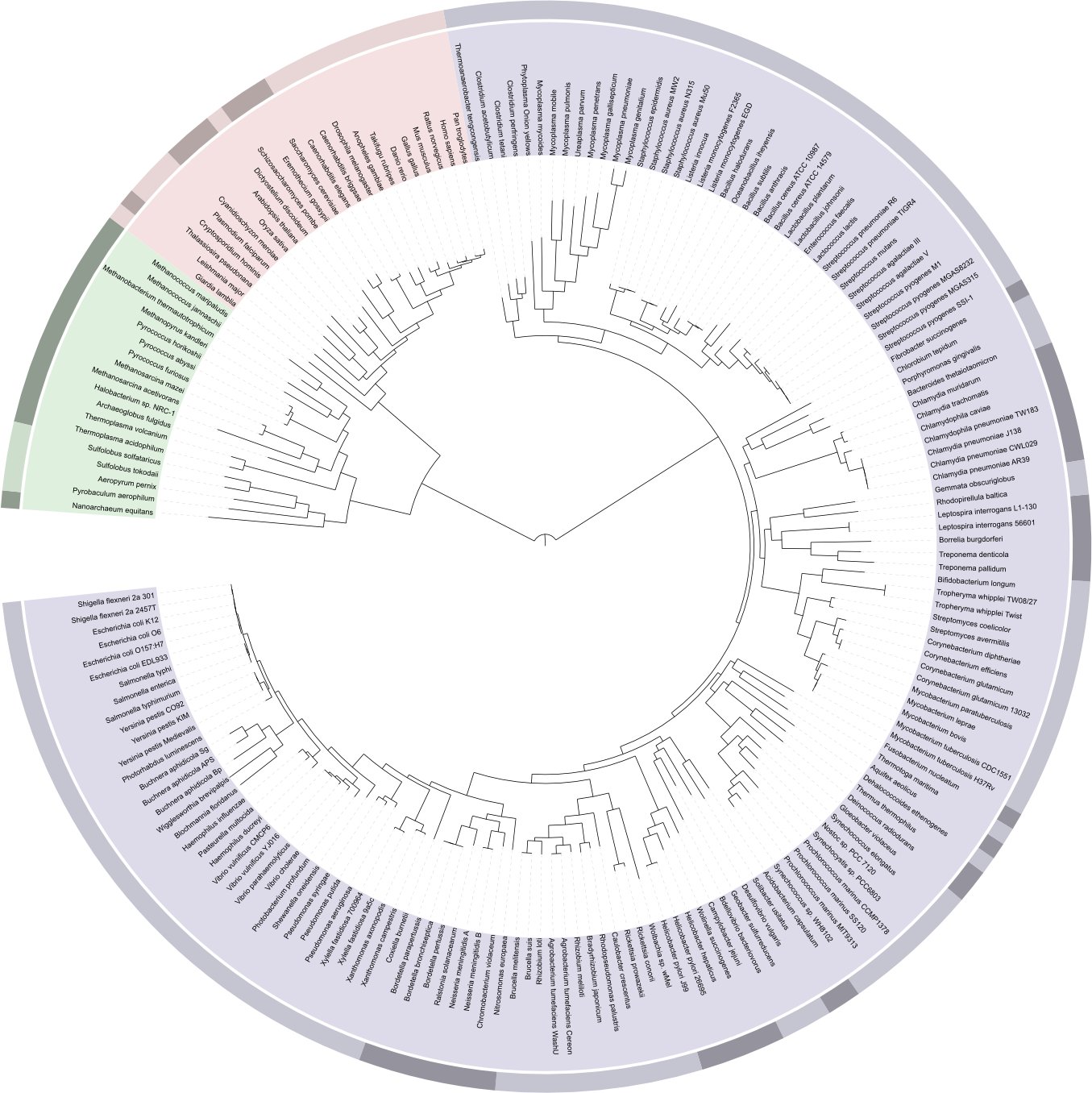
“Tree” of life, showing relationships among species for which we have complete genome data. Center of circle is the common ancestor. Kinship is shown by branching order as you move out from the center. Image from Wikimedia Commons.

Swimming into Deep Time

This week, the Biodiversity class took a break from random numbers tables and rarefaction curves, and visited the Tennessee Aquarium in Chattanooga. Our goal: to study representatives of the most ancient lineages of vertebrate animals. The rivers of the south-eastern U.S. are home to several such venerable creatures and the aquarium has examples of these local species as well as species from more far flung places.

The ancient pedigree of gar is revealed by their skin. They have diamond-shaped ganoid scales, a character they share with extinct relatives and with paddlefish (who have a few such scales around their tail). The scales interlock all over the body, making armor-plating. The scales are very tough and Native Americans used them as arrow heads. Early European settlers covered plough blades with gar skin, literally tearing up the earth with the hides of these fish.

Spotted gar, Lepisosteus oculatus. Note the long mouth: gar grab prey by side-swiping these jaws

Paddlefish were also well represented in the aquarium’s tanks. Like gar, paddlefish date back to the late Cretaceous, so they swam around the ankles of river-stomping dinosaurs. Their long “nose,” the rostrum, is used both as a sense organ and as a stabilizing device. Paddlefish feed by cruising with their large mouths wide open, creating backwards drag that is counteracted by the rostrum.

Paddlefish, Polyodon spathula

The paddlefish is native to the mid-western and south-eastern U.S., although its range is now much smaller than it used to be, partly due to overfishing and partly due to habitat degradation. Some states now have restocking programs for the species. The only other living paddlefish species is found in the Yangtze River in China. It may well be extinct now: no living specimens have been found since 2003.

Paddlefish are not the only ancient lineage to suffer from the ill effects of modernity. Sturgeon rival sharks as the oldest group of fish still alive, with relatives dating back in the fossil record to the Devonian, 400 million years ago. The IUCN now classifies sturgeon as the most endangered group of animals on the planet. Unfortunately for sturgeon, a hyper-abundant species of Old World ape regards sturgeon eggs as a delicacy and a status symbol. Our taste for caviar is hard for the slow-reproducing, long-lived sturgeon to sustain; their populations cannot persist in the face of our nets.

Beluga or European Sturgeon, Huso huso. The four barbs on the lower surface of the snout are used to find food in muddy river bottoms. This individual is about six feet long.

This Stellate Sturgeon shows the heteroceral tail that characterizes many of these old lineages. The vertebral column and associated muscles extend into the top lobe of the tail. This design provides a lot of power, but because the tail is asymmetrical, it twists the fish as it swims and this twisting force has to be counteracted by the pectoral fins.

The Tennessee Aquarium, along with TWRA and other partners, have been reintroducing thousands of Lake Sturgeon in east Tennessee. Hopefully, some of these animals will survive long enough to help buoy the population. This species is listed as endangered by the State of Tennessee, although compared to most other sturgeon species worldwide it is faring rather well, with small but seemingly secure populations.

All these species carry Deep Time in their blood. They are the incarnation of our family tree, ancestors swimming alongside us.

I’ll close with a quote from E. O. Wilson, who became a biologist along the banks of Alabama’s streams: